
Compare current and proposed steam-pipe insulation to estimate project heat loss, condensate reduction, annual fuel savings, and simple payback.
Advanced options
Calculation details by pipe segment
| Segment | Steam | Current loss | Proposed loss | Heat saved |
|---|
Table of contents
How to use our Steam Pipe Heat Loss and Insulation Payback Calculator
- In Pipe segments, check the example row or add one row for every pipe section with a different pressure, NPS, length, ambient temperature, insulation condition, or installed cost.
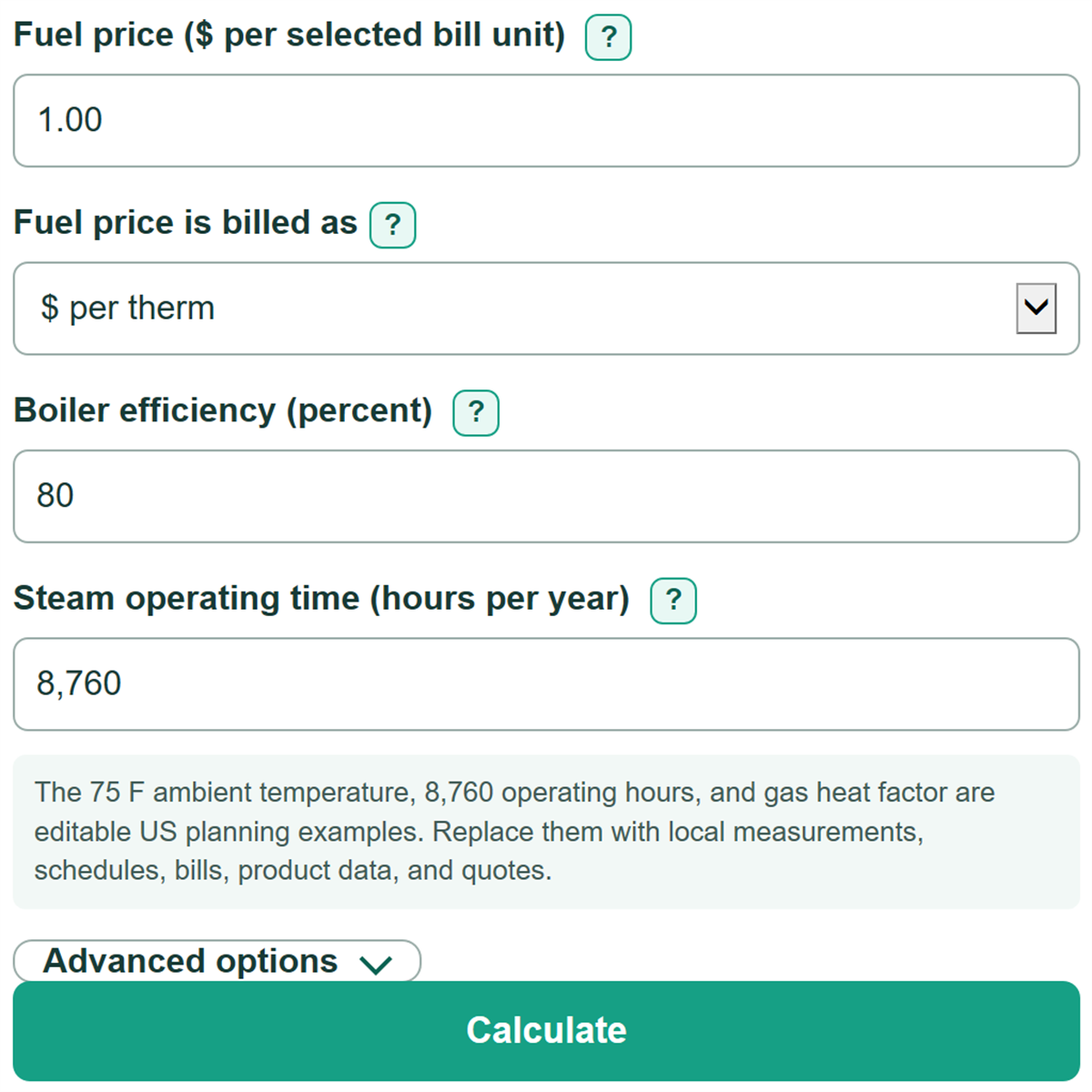
- Enter the bill rate in Fuel price, then choose the exact bill unit in Fuel price is billed as.
- Enter Boiler efficiency (percent) and Steam operating time (hours per year) using plant records or a documented estimate.
- Open Advanced options only if you need to change the shared insulation or outside heat-transfer assumptions, then select Calculate.
- Check that Fuel price used for the calculation looks reasonable for the selected bill unit and that Pipe segments included matches your survey before using the savings or payback estimate.
Definitions
psig: Gauge pressure in pounds per square inch. It is pressure measured above the surrounding air pressure.
Saturated steam: Steam at the boiling temperature that matches its pressure. The calculator uses saturated-steam temperature and latent heat for each pipe row.
NPS: Nominal Pipe Size, the standard pipe-size name used on many US drawings. It is not the same as the pipe's measured outside diameter.
Heat loss: Heat leaving the hot pipe or insulation surface to the surrounding air, shown in BTU/hr.
Continuous condensate: Water formed because operating steam gives up latent heat through the pipe wall. It does not include startup condensate.
Boiler efficiency: The percent of fuel energy that becomes useful steam-system heat.
MMBtu: One million BTU. The calculator converts the entered fuel rate to $/MMBtu so bill units can be compared consistently.
Simple payback: Total entered installed cost divided by estimated annual fuel-cost savings, shown in months.
Common mistakes and quick fixes
Mistake: Entering psi absolute instead of gauge pressure in Pipe segments.
Fix: Enter the gauge reading in psig. The calculator adds atmospheric pressure before finding saturated-steam properties.
Mistake: Treating NPS in Pipe segments as a measured outside diameter.
Fix: Choose the nominal pipe size shown on drawings or pipe markings. NPS is a size name, and its outside diameter is different.
Mistake: Combining unlike pipe runs into one Pipe segments row.
Fix: Add a separate row when pressure, NPS, length, ambient temperature, insulation thickness, or installed cost changes.
Mistake: Copying a $ per therm rate while Fuel price is billed as is set to $ per Ccf or $ per Mcf.
Fix: Match Fuel price is billed as to the unit printed beside the usage charge on the bill.
Mistake: Reading Estimated continuous condensate reduction as startup condensate or a trap-sizing load.
Fix: Use Estimated continuous condensate reduction only for steady operating heat loss while the pipe is hot.
Mistake: Leaving out access, fittings, valves, removal, or labor from the installed cost in Pipe segments.
Fix: Include all costs that belong in the insulation project before relying on Estimated simple payback.
Limitations & Key Assumptions / Boundary Conditions
- The model is for saturated steam at 0 to 300 psig. Do not use it for superheated steam without separate engineering analysis.
- It estimates steady operating heat loss from straight pipe using a shared dry-insulation conductivity and outside heat-transfer setting. Wet, damaged, compressed, missing, or unusually surfaced insulation can give different results.
- The calculation does not model startup loads, fittings, valves, supports, buried pipe, wind effects, changing steam pressure, or changing ambient temperature.
- Continuous condensate reduction is an operating heat-loss estimate. It is not a condensate-trap sizing result or a total startup condensate estimate.
- Annual savings depend on entered operating hours, fuel price, gas energy content when Ccf or Mcf is selected, and boiler efficiency. Fixed utility charges are excluded.
- Simple payback includes only installed costs entered in Pipe segments. Financing, maintenance, downtime, taxes, incentives, and costs omitted from the quote are excluded.
Methodology
Steam properties and pipe heat loss
For each Pipe segments row, gauge pressure is converted to absolute pressure, then the IAPWS-IF97 saturated-steam relations provide saturation temperature and latent heat.
Pabsolute = (Pgage + 14.6959) x 0.006894757293168
The pipe model treats heat flow as radial flow through insulation plus heat transfer from the outside surface to room air.
q per ft = (Tsteam - Tambient) / (ln(router / rpipe) / (2 x pi x k) + 1 / (h x 2 x pi x router))
For bare pipe, the insulation resistance is zero. Each row heat loss equals heat loss per foot times that row's length. The calculator adds current and proposed row results separately.
Heat-loss reduction = current project heat loss - proposed project heat loss
Energy, fuel, and condensate
The calculator multiplies hourly heat-loss reduction by Steam operating time (hours per year), then converts BTU to MMBtu. Fuel savings account for the boiler energy needed to replace delivered steam heat.
Annual delivered heat saved = heat-loss reduction x operating hours / 1,000,000
Annual fuel-cost savings = annual delivered heat saved x fuel price per MMBtu / (boiler efficiency / 100)
Fuel price is converted to $/MMBtu from the selected therm, Ccf, Mcf, or MMBtu bill unit. A therm is treated as 100,000 BTU. For Ccf and Mcf, the entered Gas energy content (MMBtu per Ccf) supplies the volume-to-energy conversion.
Continuous condensate reduction = add(row heat-loss reduction / row latent heat)
Payback example
If one row reduces heat loss by 25,545 BTU/hr for 6,000 hours per year, delivered heat saved is about 153.27 MMBtu/yr. With a $10/MMBtu fuel price and 80% boiler efficiency, estimated annual fuel-cost savings are about $1,915.90. A $5,000 installed cost gives about 31.32 months of simple payback.
Simple payback months = 12 x total installed cost / annual fuel-cost savings
A positive reduction means the proposed condition loses less heat. If savings are zero or negative while installed cost is positive, payback is shown as not reached rather than dividing by zero.