
Calculate the DSP delay needed to align two speaker arrivals using a known path difference or two measured paths.
Advanced options
Air and device settings
Known route delays
Table of contents
How to use our Speaker Delay Alignment and DSP Time Calculator
- Choose Setup type and Measurement method. Use Guided when you can measure each speaker to one shared alignment point.
- Set Distance unit to match your tape measure or laser, then enter the active distance field or fields.
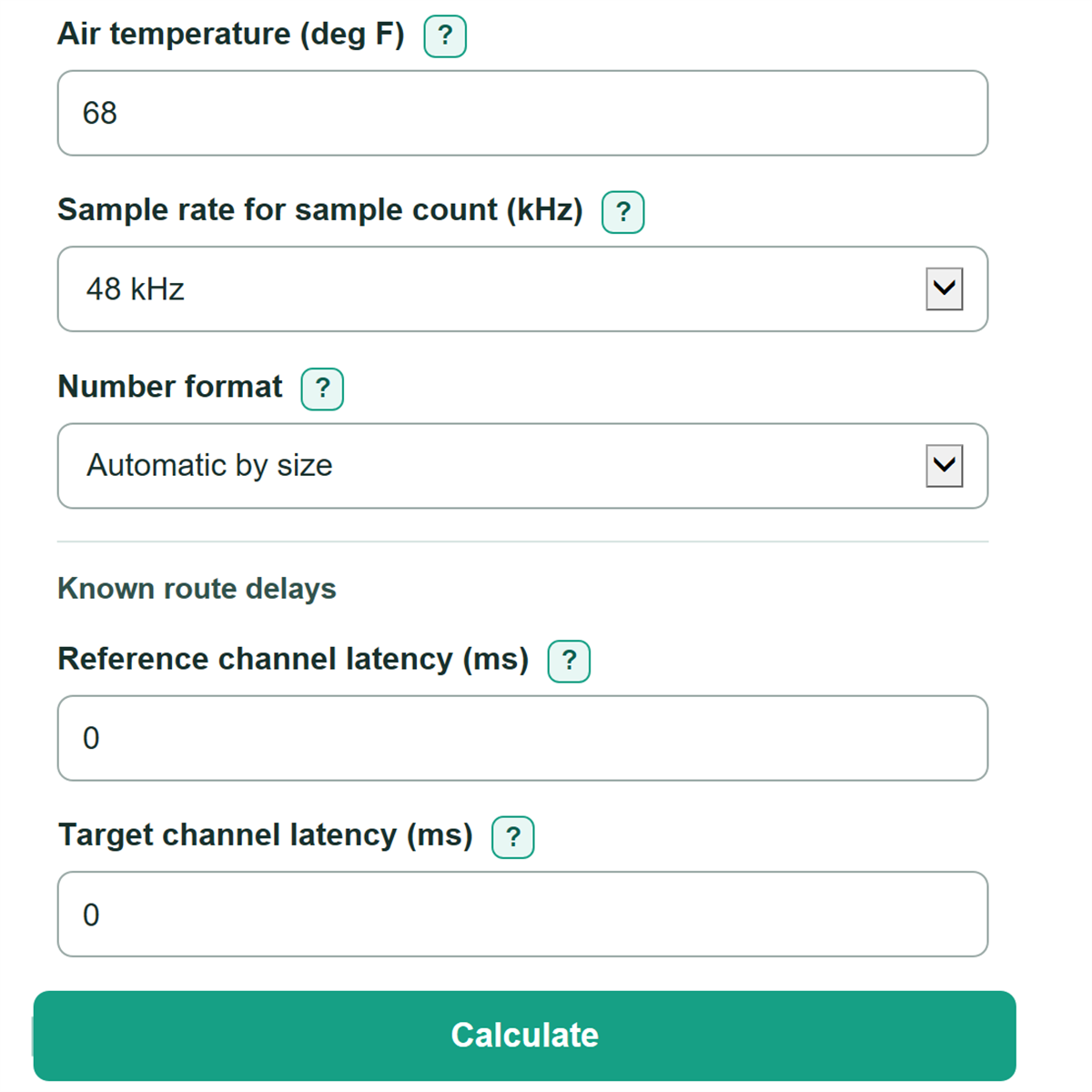
- Open Advanced options only if needed to replace the 68 deg F indoor example, add known channel latency, or choose a sample rate.
- Click Calculate and enter Delay to add on the channel named under Channel to delay.
- Sanity-check that the earlier-arriving channel is the one receiving delay. If the result is 0 ms, the modeled arrivals already match.
Definitions
Alignment point: The one listening or coverage location where both speaker arrivals should match.
Acoustic center: A practical point near the part of a speaker that produces the sound. Use a consistent point for both measurements.
Reference channel: The channel used as the comparison path. In Quick mode, its acoustic path is the longer one.
Target channel: The other channel being compared with the reference channel.
Channel latency: A fixed electronic delay from routing, wireless audio, a DSP, converter, or active speaker, measured in milliseconds.
Sample rate: The number of digital samples processed each second. At 48 kHz, one millisecond equals 48 samples.
Equivalent delay distance: The distance sound travels during the calculated delay. Use it only when a processor accepts a distance setting.
Common mistakes and quick fixes
Mistake: Entering cabinet-to-cabinet spacing as Reference path is longer by.
Fix: Measure the extra acoustic path to the same alignment point, such as the listener or coverage point.
Mistake: Measuring Reference speaker distance and Target speaker distance to different places.
Fix: Measure both from each speaker's acoustic center to one exact alignment point.
Mistake: Delaying the farther speaker after reading Channel to delay.
Fix: Add Delay to add only to the named earlier-arriving channel.
Mistake: Typing an inches measurement while Distance unit is set to Feet (ft).
Fix: Change Distance unit first, or convert the measurement before entering it.
Mistake: Ignoring a wireless, active-speaker, or network route delay.
Fix: Enter documented fixed offsets in Reference channel latency (ms) and Target channel latency (ms).
Mistake: Treating Delay at selected sample rate as a required DSP setting.
Fix: Use samples only when the processor accepts samples; otherwise copy Delay to add in milliseconds.
Limitations & Key Assumptions / Boundary Conditions
- The result is a time-of-flight estimate for uniform dry air. It uses the entered air temperature and does not model humidity, wind, or temperature layers along a long path.
- Both Guided distances must run from each speaker's acoustic center to the same alignment point. Different endpoints make the path difference unreliable.
- Electronic latency is included only when you enter it. Unknown DSP, wireless, network-audio, converter, amplifier, or active-speaker delays can change which channel should be delayed.
- Reflections, room acoustics, crossover filters, driver placement, polarity, and phase response are not modeled.
- This calculation does not replace transfer-function measurement or phase-based subwoofer alignment. Use measurement tools and listening checks for critical systems.
- A sample count can be fractional. Your hardware may round it or use fractional-delay processing differently.
Methodology
Calculation method
The calculator converts the entered temperature to degrees C, estimates sound speed, then compares each channel's acoustic travel time plus any entered fixed electronic latency.
T_C = (T_F - 32) * 5 / 9
c = 331.3 + 0.606 * T_C
In these formulas, T_C is air temperature in degrees C, T_F is air temperature in degrees F, and c is estimated sound speed in meters per second.
For Quick mode, the entered reference extra path is used. For Guided mode, the target path is subtracted from the reference path after both are converted to meters. A positive difference means the reference acoustic path is longer.
acoustic_gap_m = reference_distance_m - target_distance_m
target_delay_ms = 1000 * acoustic_gap_m / c + reference_latency_ms - target_latency_ms
A positive target_delay_ms means delay the target channel. A negative value means delay the reference channel by its absolute value. The displayed Delay to add is always nonnegative.
delay_ms = abs(target_delay_ms)
delay_distance = (delay_ms / 1000) * c
delay_samples = delay_ms * sample_rate_khz
Worked example
With a 10 ft longer reference path, 68 deg F air, and no electronic latency, the estimated delay is about 8.875 ms. The target channel arrives earlier, so add about 8.875 ms to the target. At 48 kHz, that is about 426.02 samples.
Conversions and calculation choices
Distance is converted to meters before time is calculated. One foot is exactly 0.3048 m and one inch is exactly 0.0254 m. [1] The equivalent delay distance is then converted back to the selected distance unit. Blank optional channel-latency fields count as 0 ms. If sample output is disabled, the sample card is omitted.