
Calculate available pump suction head in feet and check it against the pump curve requirement plus your chosen project margin.
Pump check
Advanced options
Pressure and liquid assumptions
Calculation details
Table of contents
How to use our Pump NPSH Available and Cavitation Margin Calculator
- Choose Suction setup: use Flooded suction when the operating liquid level is above the pump centerline, or Suction lift when it is below it.
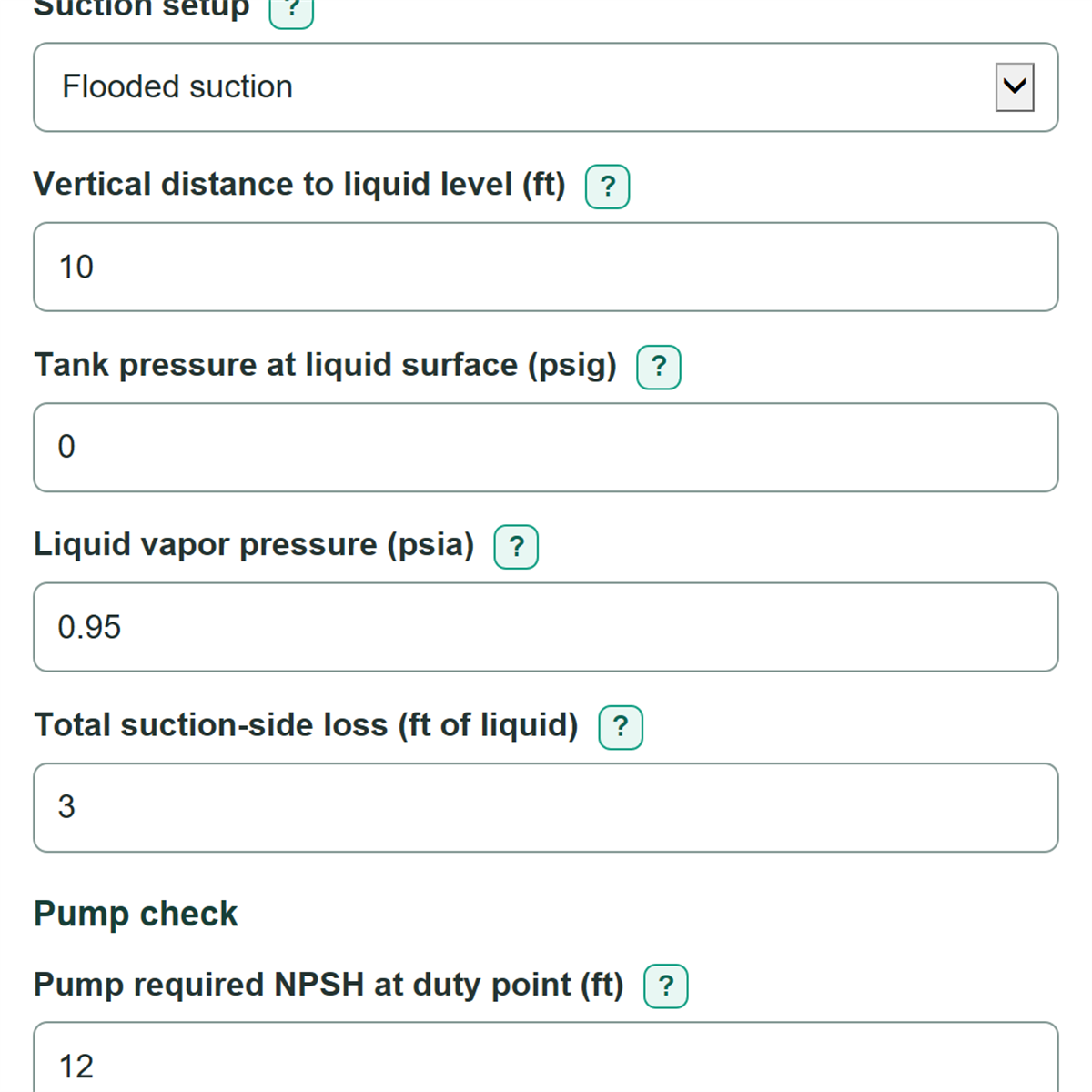
- Enter the positive Vertical distance to liquid level, then enter tank gauge pressure, liquid vapor pressure, and total suction-side loss for the actual operating condition.
- Copy Pump required NPSH at duty point from the manufacturer curve at the actual flow, speed, and impeller condition. Enter the separate Required extra NPSH margin from your project requirement.
- Open Advanced options if needed to replace sea-level Absolute atmospheric pressure (psia) or the water-reference Liquid specific gravity example.
- Click Calculate. Check that Head above required margin is positive, then review the pressure, liquid-level, loss, and vapor-pressure terms to make sure they match the operating case.
Definitions
NPSHa: Net positive suction head available. This is suction head supplied by the system at the pump inlet after vapor pressure and suction-side losses are considered.
NPSHr: Net positive suction head required. This is the pump's required value from its manufacturer curve at a particular duty point.
Duty point: The operating flow and pump condition, including speed and impeller condition, used to select NPSHr from the pump curve.
Flooded suction: The operating liquid surface is above the pump centerline, so vertical distance adds suction head.
Suction lift: The operating liquid surface is below the pump centerline, so vertical distance subtracts suction head.
Specific gravity: Liquid density divided by reference water density. It changes how a pressure in psi converts to feet of that liquid.
Vapor pressure: The absolute pressure where a liquid can begin to vaporize at its current temperature. Its head is removed from NPSHa.
Head above required margin: NPSHa minus pump NPSHr minus the entered extra project margin. A negative value is the head shortfall.
Common mistakes and quick fixes
Mistake: Entering psia in Tank pressure at liquid surface.
Fix: Enter gauge pressure in psig only. Enter 0 for an open vented tank; the calculator adds Absolute atmospheric pressure (psia) separately.
Mistake: Typing a negative number for Vertical distance to liquid level.
Fix: Enter a positive distance. Use Suction setup to show whether the liquid level is flooded suction or suction lift.
Mistake: Using discharge piping loss as Total suction-side loss.
Fix: Include only the suction path at the operating flow, including pipe, fittings, valves, entrance loss, and any strainer condition used for the check.
Mistake: Copying Pump required NPSH at duty point from the wrong point on the pump curve.
Fix: Use NPSHr for the actual flow, speed, and impeller condition, not a catalog minimum or another duty point.
Mistake: Using water data for Liquid vapor pressure or leaving Liquid specific gravity at 1.0 for a different liquid.
Fix: Use property data for the actual liquid and operating temperature.
Mistake: Treating a positive NPSHa to NPSHr ratio as the project pass rule.
Fix: Use Head above required margin and Cavitation margin check ; they apply the separate margin you entered.
Limitations & Key Assumptions / Boundary Conditions
- This is a preliminary steady-condition calculation. It does not model pressure pulsation, transient flow, air entrainment, vortexing, flashing, or pump internal hydraulic behavior.
- NPSHr must come from the pump manufacturer curve at the actual flow, speed, and impeller condition. A value from another point can make the comparison misleading.
- Liquid level, tank pressure, temperature, vapor pressure, suction loss, and strainer condition can change during operation. Recalculate for the lowest expected margin case.
- The default atmospheric pressure is a standard sea-level value. Replace it for site altitude, local barometric conditions, or a project design basis.
- The calculator uses the entered specific gravity and vapor pressure as fixed properties. Mixtures, dissolved gases, changing composition, and temperature gradients may need a separate engineering review.
- Meeting the entered extra margin is not a guarantee that cavitation, noise, vibration, damage, or pump performance problems cannot occur. The selected margin is a project requirement, not a universal rule.
Methodology
Calculation method
The calculation converts absolute pressure at the liquid surface and liquid vapor pressure into feet of the entered liquid. It then adds flooded static head or subtracts suction lift, and subtracts suction-side loss.
surface absolute pressure (psia) = atmospheric pressure (psia) + tank gauge pressure (psig)
pressure-to-head factor (ft per psi) = 2.3066587 / specific gravity
surface pressure head (ft) = surface absolute pressure x pressure-to-head factor
static head effect (ft) = vertical distance for flooded suction, or -vertical distance for suction lift
vapor-pressure head (ft) = liquid vapor pressure x pressure-to-head factor
NPSHa (ft) = surface pressure head + static head effect - suction-side loss - vapor-pressure head
The factor 2.3066587 converts psi to feet of reference water. The same factor is used for both pressure terms, then adjusted by specific gravity. [1]
Margin check
NPSHa above pump NPSHr (ft) = NPSHa - pump NPSHr
head above required margin (ft) = NPSHa - pump NPSHr - required extra NPSH margin
NPSHa to NPSHr ratio = NPSHa / pump NPSHr
A zero or positive head above required margin meets the extra margin entered for this check. A negative value remains negative and states the additional NPSHa needed.
Worked example
For an open, flooded water tank: atmospheric pressure is 14.6959 psia, gauge pressure is 0 psig, vertical distance is 10 ft, vapor pressure is 0.95 psia, suction loss is 3 ft, and specific gravity is 1.0. Surface pressure head is 33.8984 ft and vapor-pressure head is 2.1913 ft, so NPSHa is 38.7071 ft. With pump NPSHr of 12 ft and an extra margin of 3 ft, the head above required margin is 23.7071 ft.