
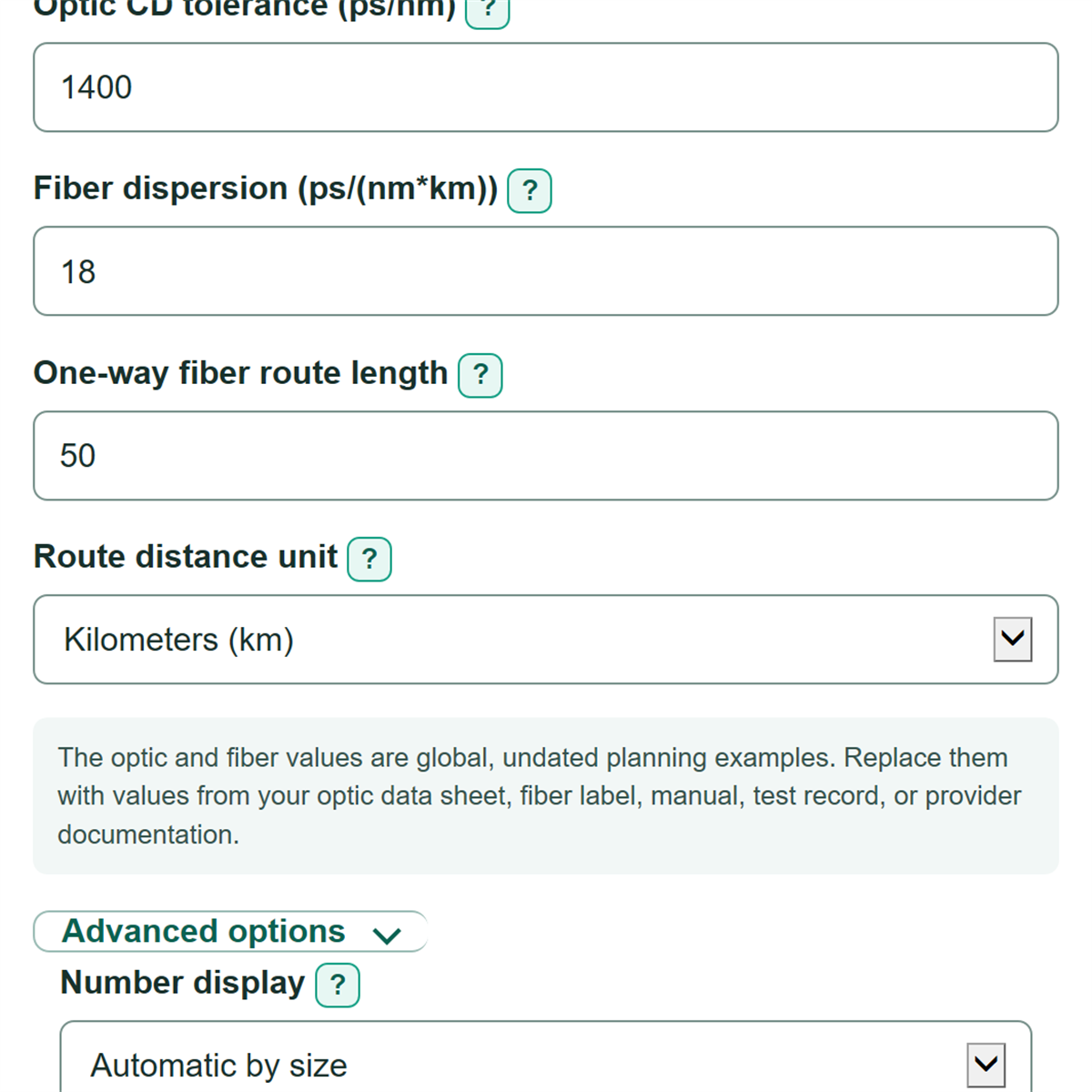
Enter an optic's CD tolerance, fiber dispersion, and one-way route length to check the route and calculate its chromatic-dispersion-only reach.
Advanced options
Table of contents
How to use our Fiber Chromatic Dispersion and Maximum Reach Calculator
- Copy the allowed accumulated value from the optic data sheet into Optic CD tolerance (ps/nm). Use the value for the same modulation, FEC, wavelength, and test condition.
- Enter the wavelength-matched fiber value from the cable data sheet or test record in Fiber dispersion (ps/(nm*km)).
- Enter the installed path in One-way fiber route length, then choose the matching Route distance unit. Do not use straight-line map distance.
- Click Calculate. Read Maximum reach from the optic CD limit first, then check Entered route CD check and CD headroom after the entered route.
- Sanity-check that Accumulated CD on the entered route is no greater than the entered tolerance for a pass. Confirm that One-way route length used in the formula matches your intended distance after conversion.
Definitions
Chromatic dispersion (CD): Wavelength-dependent travel time in fiber that can spread an optical signal.
Fiber dispersion: The CD added per kilometer and per nanometer of wavelength width, entered in ps/(nm*km). [1]
Optic CD tolerance: The largest accumulated CD magnitude, in ps/nm, allowed by the selected optic under its stated data-sheet conditions.
Accumulated CD: The total route CD in ps/nm after fiber dispersion is multiplied by route length in km.
CD headroom: Optic CD tolerance minus accumulated CD magnitude. A negative value means the route is over the entered limit.
Signed accumulated CD: Accumulated CD that keeps the plus or minus sign of the entered fiber dispersion for engineering diagnosis.
Common mistakes and quick fixes
Mistake: Entering an optic marketing reach, such as 10 km, into Optic CD tolerance (ps/nm).
Fix: Enter the allowed accumulated CD value in ps/nm from the data sheet, not a distance rating.
Mistake: Using a generic value in Fiber dispersion (ps/(nm*km)) without checking the fiber design or operating wavelength.
Fix: Use the coefficient for the installed fiber and actual wavelength from its data sheet or test record.
Mistake: Typing miles or feet into One-way fiber route length while Route distance unit is set to kilometers.
Fix: Choose the unit printed on the route record before calculating.
Mistake: Treating a negative CD headroom after the entered route as zero.
Fix: Keep the negative value. Its size shows how many ps/nm the entered route is over the optic CD limit.
Mistake: Treating a pass in Entered route CD check as proof that the optical link will work.
Fix: Also qualify loss, power budget, OSNR, PMD, nonlinear effects, receiver limits, and the applicable FEC conditions.
Limitations & Key Assumptions / Boundary Conditions
- This is a uniform-fiber, one-way route calculation. It does not add separate CD values for mixed fiber segments, splice sections, or compensation modules.
- The entered fiber dispersion must already match the installed fiber design and operating wavelength. The calculator does not derive dispersion from wavelength.
- The optic CD tolerance is valid only under the modulation, FEC, wavelength, penalty, and other conditions stated in the relevant data sheet.
- A CD pass is not a complete link qualification. Loss, power budget, OSNR, PMD, nonlinear effects, receiver overload, and system settings can still limit reach.
- Maximum reach uses the absolute size of fiber dispersion. The signed result is retained for diagnosis only.
Methodology
Calculation method
The calculator converts the entered one-way route length to kilometers because Fiber dispersion (ps/(nm*km)) is a per-kilometer value. It then compares accumulated CD magnitude with Optic CD tolerance (ps/nm).
route length in km = entered route length * selected unit conversion factor
maximum reach in km = optic CD tolerance / absolute fiber dispersion
signed accumulated CD = fiber dispersion * route length in km
accumulated CD magnitude = absolute signed accumulated CD
CD headroom = optic CD tolerance - accumulated CD magnitude
The route passes the displayed CD check when accumulated CD magnitude is less than or equal to optic CD tolerance. Maximum reach is then converted back into the selected Route distance unit. A negative fiber-dispersion entry remains negative in Signed accumulated CD on the entered route, while its absolute value is used for reach and the route check.
Worked example
With a 1,400 ps/nm optic tolerance and fiber dispersion of 18 ps/(nm*km), maximum reach is 1,400 / 18 = 77.778 km. For a 50 km route, accumulated CD magnitude is 18 * 50 = 900 ps/nm, so headroom is 1,400 - 900 = 500 ps/nm and the route is within the entered limit.
Calculation scope
This is a chromatic-dispersion-only planning check. It assumes one uniform dispersion coefficient across the route and does not calculate attenuation, optical power, OSNR, PMD, nonlinear effects, or FEC margin. Results can differ from an installed system when the data-sheet conditions or actual fiber properties differ from the entered values.