
Compare cash purchase, financing, and Lighting as a Service costs for one LED project using your energy use and quoted terms.
The 13.41 cents/kWh default is a 2025 US commercial planning estimate. Replace it with the variable rate from your utility bill.
Comparison period
Cash purchase
Financing
Lighting service agreement
Advanced options
Energy adjustment
Extra finance terms
Extra service terms
Purchase price plus proposed electricity and owned-system maintenance over the comparison period.
Includes the complete quoted payment schedule, separate finance costs, electricity, and owned maintenance.
Positive means the proposed lighting uses less variable-cost electricity. Fixed and demand charges are excluded.
Calculation details
A negative value means the proposed system uses more energy.
Table of contents
How to use our Lighting as a Service vs Buy or Finance TCO Calculator
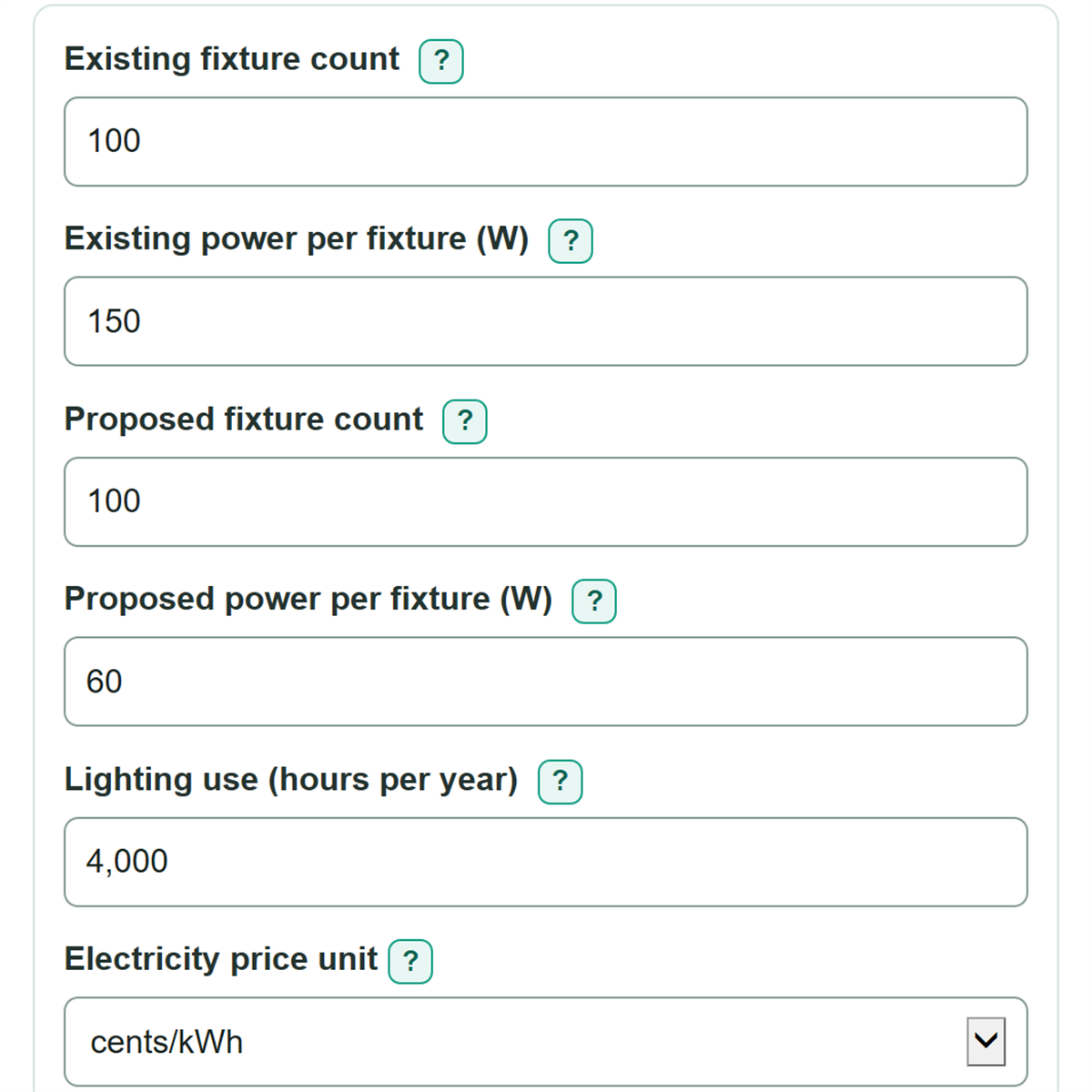
- Enter the existing and proposed fixture counts, power per fixture, and Lighting use (hours per year) from an audit, schedule, or proposal.
- Choose the Electricity price unit shown on your bill, then enter only the variable electricity price.
- Set the Comparison period (years), then copy the cash, finance, and lighting service quote amounts and terms.
- Choose What happens when the service term ends? exactly as stated in the service agreement, then use Advanced options for separately listed fees, buyouts, controls, or fee increases.
- Click Calculate and check that the winning path, upfront cash, and annual lighting energy saved match the scope and ownership terms in each quote.
Definitions
Lighting as a Service: An agreement with a recurring lighting service fee rather than an immediate equipment purchase. The customer may or may not own the system at the end.
Cumulative cash outflow: The total modeled cash paid over the Comparison period (years). This calculator uses nominal dollars, meaning it does not reduce future payments to today's value.
Variable electricity price: The part of an electricity bill that changes with kWh used, shown as cents/kWh or $/kWh. Fixed customer charges are not included.
kWh: Kilowatt-hour, a unit of electrical energy. One thousand watts used for one hour equals one kWh.
Controls energy cut: An extra percentage reduction in proposed lighting energy from documented controls, applied after fixture wattage is calculated.
Balloon payment: A one-time payment due at the end of a finance term, separate from the regular monthly payment.
Buyout: A separate payment required to take ownership when a lighting service term ends.
Common mistakes and quick fixes
Mistake: Entering a total bill amount in Variable electricity price (cents/kWh by default).
Fix: Enter only the variable per-kWh rate, not fixed monthly customer charges.
Mistake: Leaving Electricity price unit on cents/kWh while entering a dollar rate such as 0.1341.
Fix: Choose $/kWh first, or enter 13.41 while cents/kWh is selected.
Mistake: Using lamp watts instead of the full Existing power per fixture (W) or Proposed power per fixture (W).
Fix: Copy full fixture input power from the nameplate, audit, cut sheet, or proposal.
Mistake: Setting Comparison period (years) shorter than Finance term (months).
Fix: Increase the comparison period so it includes every scheduled finance payment.
Mistake: Adding a lender fee that is already included in Finance payment ($ per month).
Fix: Use Finance fee paid upfront ($) only for a separately paid fee listed by the lender.
Mistake: Choosing ownership transfer when What happens when the service term ends? does not promise it.
Fix: Copy the contract wording and include End-of-term ownership payment ($) only when a transfer requires a separate buyout.
Limitations & Key Assumptions / Boundary Conditions
- The comparison uses nominal cash outflow. It does not calculate present value, taxes, depreciation, incentives not already included in the cash price, or the cost of capital.
- Electricity cost uses one entered variable price for every year. It excludes fixed customer charges, demand charges, time-of-use pricing, and future utility-rate changes.
- Lighting energy is based on fixture count, input watts, annual operating hours, and any documented controls reduction. Actual use can differ because of schedules, dimming, occupancy, outages, or installed equipment differences.
- Owned-system maintenance is treated as the same annual amount throughout the comparison. Maintenance is treated as included during the lighting service term and is added afterward only if ownership transfers.
- A no-ownership service agreement cannot be compared beyond its stated term because renewal, removal, or replacement costs are unknown.
- The finance path uses the entered down payment, monthly payment, term, separate fee, and balloon payment. It does not derive payments from an APR or check lender contract details.
Methodology
Energy and cost method
The calculator first converts each lighting system into annual electricity use. It applies the same proposed energy use and electricity price to all three acquisition paths. The default electricity price is a 2025 US commercial planning estimate; replace it with the variable rate from your own bill. [1]
existing annual kWh = existing fixture count * existing watts per fixture * lighting use hours / 1000
proposed annual kWh = proposed fixture count * proposed watts per fixture * lighting use hours / 1000 * (1 - controls energy cut / 100)
annual lighting energy saved = existing annual kWh - proposed annual kWh
annual energy-cost savings = annual lighting energy saved * electricity price in $/kWh
Cash-path totals
Cash purchase includes the entered cash purchase price, proposed electricity cost, and owned-system maintenance. Financed purchase includes the down payment, separately paid finance fee, all scheduled monthly payments, balloon payment, proposed electricity cost, and owned-system maintenance. Lighting service includes the upfront service fee, monthly service payments with any yearly increase, proposed electricity cost, any applicable end buyout, and owned-system maintenance only after ownership transfers.
cash path = cash price + owned maintenance * years + proposed electricity cost
finance path = down payment + finance fee + monthly payment * finance months + balloon payment + owned maintenance * years + proposed electricity cost
lighting service path = upfront fee + service payments + applicable buyout + post-transfer maintenance + proposed electricity cost
Worked example
For 100 existing 150 W fixtures used 4,000 hours per year, annual use is 60,000 kWh. For 100 proposed 60 W fixtures, annual use is 24,000 kWh. The difference is 36,000 kWh per year. At 13.41 cents/kWh, that is $4,827.60 in annual variable energy-cost savings.
Calculation choices
The comparison period must include the complete finance term. If the customer does not own the lighting system after the service term, the comparison cannot continue past that term. A negative annual lighting energy saved value is retained because it means the proposed system uses more energy than the existing system.