
Compare yearly spot replacement costs with a planned group relamping schedule using your fixture count, lamp life, labor, and service charges.
Price and labor
Advanced options
Visit and event charges
The estimate assumes one lamp per spot visit unless you change this value.
Added maintenance work
Number appearance
Expected yearly cost for replacing lamps as they fail.
The planned event and interim work spread across the group cycle.
Estimated cash needed for the planned event, before interim failures.
Calculation details
A planning interval, not an exact failure date.
Table of contents
How to use our Commercial Relamping Cost Calculator
- Enter Number of fixtures and Lamps per fixture from your lighting inventory so the calculator can count all replaceable lamps.
- Enter Operating time in hours per year and Rated lamp life in hours from the building schedule and lamp specification.
- Enter the lamp price, separate spot and group labor prices, then choose when to Replace all lamps at as a percent of rated life.
- Open Advanced options if you need to include service-call charges, cleaning, disposal, or Expected spot replacements between group events.
- Check Lamps included before using the cost comparison, then read the signed annual savings: a positive value means group relamping costs less under your entries.
Definitions
Spot replacement: Replacing lamps individually as they fail.
Group relamping: Replacing all lamps in a planned area at the same scheduled point in their rated life, rather than waiting for each lamp to fail. [1]
Rated lamp life: The manufacturer-stated operating life in hours used for planning. It is not a guarantee that every lamp will last exactly that long.
Operating time: The total hours the lights operate in one year.
Annualized cost: A cost converted to a per-year amount so a large group event can be compared fairly with yearly spot work.
Fixed service charge: A charge that applies per visit or per group event, such as mobilization, a contractor minimum, or lift delivery.
Interim spot replacements: Expected reactive lamp replacements between planned group events.
Common mistakes and quick fixes
Mistake: Entering total lamps in Number of fixtures and also entering more than one Lamps per fixture.
Fix: Enter the physical fixture count in Number of fixtures. Enter the number of replaceable lamps in each fixture separately.
Mistake: Entering a lamp life in years in Rated lamp life.
Fix: Enter Rated lamp life in hours from the lamp carton, cut sheet, or luminaire manual.
Mistake: Entering an hourly wage in Spot replacement labor or Group replacement labor.
Fix: Enter the all-in cost per lamp for each type of work, using work orders or a contractor quote.
Mistake: Treating Replace all lamps at as the expected percent of lamps that will fail.
Fix: Enter the planned point in lamp life, such as 70 for 70 percent of rated life.
Mistake: Leaving Average lamps changed per spot visit at 1 when a maintenance visit usually replaces several failed lamps.
Fix: Use your work-order history to estimate the average lamps handled per reactive visit, especially when Fixed spot service charge ($ per visit) is used.
Mistake: Reading a negative Estimated annual savings with group relamping as a calculator error.
Fix: A negative value means the entered group plan costs more per year than spot replacement. Review labor, fixed charges, and the planned replacement point.
Limitations & Key Assumptions / Boundary Conditions
- Results are budget estimates based on rated life and average operating hours. Actual failures can cluster earlier or later than the average.
- The calculation assumes the same scheduled fixture-cleaning budget is included in both strategies, so cleaning does not create a cost advantage by itself.
- A zero value for Expected spot replacements between group events means no interim failures are budgeted. Replace it with failure-log or work-order data when available.
- Fixed spot service charges use Average lamps changed per spot visit. A different batching pattern changes reactive visit costs.
- Energy use, demand charges, ballast or driver failures, emergency repairs, taxes, annual maintenance contracts, and downtime costs are outside this maintenance-only comparison.
- If Operating time is zero, annual costs and annual savings are zero and the planned interval in years and months is not defined.
Methodology
How the comparison is calculated
The calculator first finds the number of replaceable lamps from the fixture inventory. It estimates spot replacements as a long-run average using annual operating time and rated lamp life.
Total lamps = Number of fixtures x Lamps per fixture
Expected spot replacements each year = Total lamps x Operating time / Rated lamp life
The planned group interval is the selected percentage of rated life. The interval is shown in years and months only when operating time is greater than zero.
Group interval in hours = Rated lamp life x Replace all lamps at / 100
Group interval in years = Group interval in hours / Operating time
Group interval in months = Group interval in years x 12
Spot cost includes expected lamp replacements, spot labor, disposal, fixed spot visits, and annualized fixture cleaning. Group cost includes one full planned event plus any entered interim spot replacements, then divides that cycle cost by the unrounded group interval. Annual savings stays signed: positive means group relamping costs less.
Estimated annual savings with group relamping = Estimated annual spot-replacement cost - Estimated annual group-relamping cost
Worked example
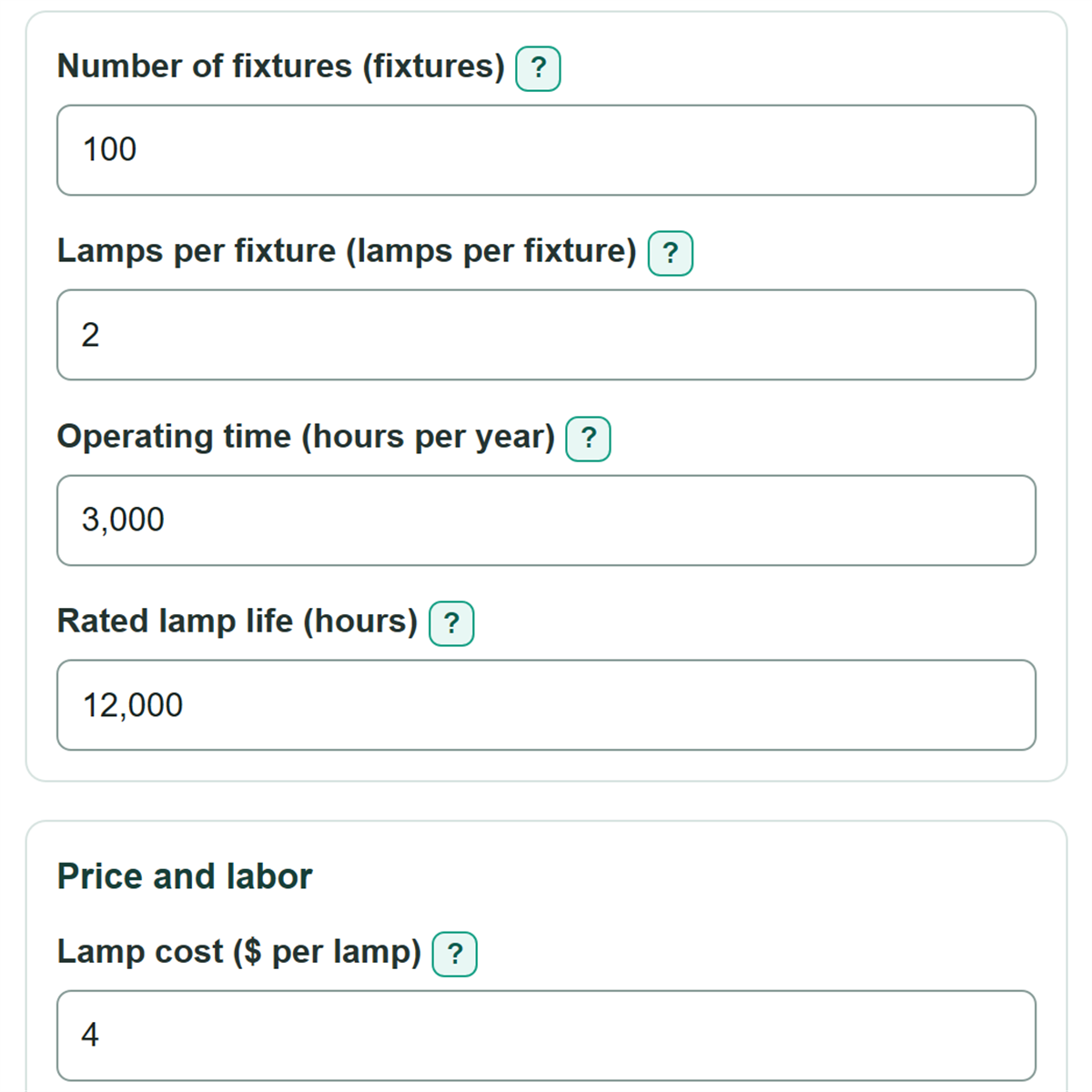
For 100 fixtures with 2 lamps each, there are 200 lamps. At 3,000 operating hours per year and 12,000 hours of rated life, expected spot replacements are 50 lamps per year. Replacing at 70 percent of rated life gives a 2.8-year group interval. With $4 lamps, $8 spot labor per lamp, $3 group labor per lamp, and no added charges, spot work is $600 per year and group relamping is $500 per year, for estimated annual savings of $100.
Calculation assumptions
The model treats rated life as an average planning input and keeps spot labor separate from group labor. Optional fixed charges are applied by visit or event, not per lamp. Cleaning is annualized over the same group cycle for both strategies. Group relamping is a planned maintenance approach used to reduce repeated reactive work, but the best replacement point depends on the site, lamp type, access needs, and maintenance policy. [1]