
Estimate annual electricity savings, power reduction, and simple payback from your existing sign load, LED proposal, operating time, and bill rate.
Calculation details
Table of contents
How to use our Commercial Sign LED Retrofit Savings Calculator
- Enter the total Existing sign input power for the whole sign, then choose W or kW exactly as shown on a label, record, or measurement.
- Enter the total Proposed LED system input power from the LED quote or specification, including the system power supplies.
- Enter Sign operating time in hours per year and the usage-based Electricity energy rate from your bill. Choose cents per kWh or $ per kWh to match the bill.
- Open Advanced options only if you have a project quote, confirmed incentive, or maintenance estimates. Leave unknown optional money fields blank.
- Check that the existing and LED annual electricity use match the direction you expect. If the LED power is lower, Estimated annual electricity saved and Connected power reduction should normally be positive.
Definitions
W (watt): A unit of electric power, or how fast equipment uses electricity.
kW (kilowatt): Equal to 1,000 W. The calculator converts W or kW to the same power basis.
kWh (kilowatt-hour): A unit of electricity use. One kW running for one hour uses one kWh.
Electricity energy rate: The part of an electric bill charged per kWh that changes with electricity use.
Connected power reduction: The percent difference between existing sign input power and proposed LED system input power.
Net upfront retrofit cost: Installed retrofit cost minus a confirmed rebate or incentive.
Simple payback: The number of years for annual savings to equal the entered net upfront cost, without financing or future price changes.
Common mistakes and quick fixes
Mistake: Entering volts, amps, or VA as Existing sign input power.
Fix: Use a documented total input watt value or a measured real power value. Volts, amps, and VA alone are not watts.
Mistake: Entering one tube, module, transformer, or ballast rating as Proposed LED system input power.
Fix: Enter the total for all LED modules and power supplies included in the sign project.
Mistake: Choosing W when the label for Existing power unit says kW.
Fix: Select the unit printed beside the number. For example, 1 kW and 1,000 W describe the same power.
Mistake: Including fixed customer or meter charges in Electricity energy rate.
Fix: Use only per-kWh charges that change when electricity use changes. Do not add fixed monthly charges.
Mistake: Treating Simple payback using electricity savings only as a full project profit forecast.
Fix: Use it as net upfront cost divided by annual energy savings; it does not include financing, taxes, demand charges, or future rate changes.
Limitations & Key Assumptions / Boundary Conditions
- Use total real input power for the full sign system. A label that shows only volts, amps, or VA does not establish watts without more information or a measurement.
- The electricity estimate uses only charges that change with kWh. Fixed customer, account, meter, minimum, and demand charges are excluded.
- Annual results depend directly on the entered Sign operating time. Timer changes, photocells, outages, and seasonal schedules can make actual hours different.
- Maintenance savings are included only when you enter Existing sign maintenance and Expected LED maintenance. Blank maintenance fields count as $0 per year.
- Simple payback is a basic recovery estimate. It excludes loan interest, taxes, permit changes, future electricity-rate changes, equipment failures, and resale value.
- A proposed LED system with higher input power is allowed and produces negative savings. In that case, a positive-cost project has no available payback from those savings.
Methodology
Calculation method
The calculator converts both sign power entries to kW and converts the entered electricity rate to $ per kWh. It then compares yearly electricity use and usage-based electricity cost before and after the retrofit.
existing_power_kw = existing_power / 1000 when Existing power unit is W
led_power_kw = led_power / 1000 when LED power unit is W
annual_kwh = power_kw * Sign operating time
annual_energy_cost = annual_kwh * electricity_rate_dollars
Estimated annual electricity saved = existing_annual_kwh - led_annual_kwh
Estimated annual electricity-cost savings = existing_annual_energy_cost - led_annual_energy_cost
Connected power reduction = ((existing_power_kw - led_power_kw) / existing_power_kw) * 100
If maintenance values are entered, the calculator adds existing annual maintenance minus expected LED annual maintenance to electricity-cost savings. If Installed retrofit cost is entered, net upfront cost equals installed cost minus the confirmed rebate or incentive. Each simple payback equals net upfront cost divided by the matching positive annual savings; it is 0 years when the net upfront cost is zero or negative.
Worked example
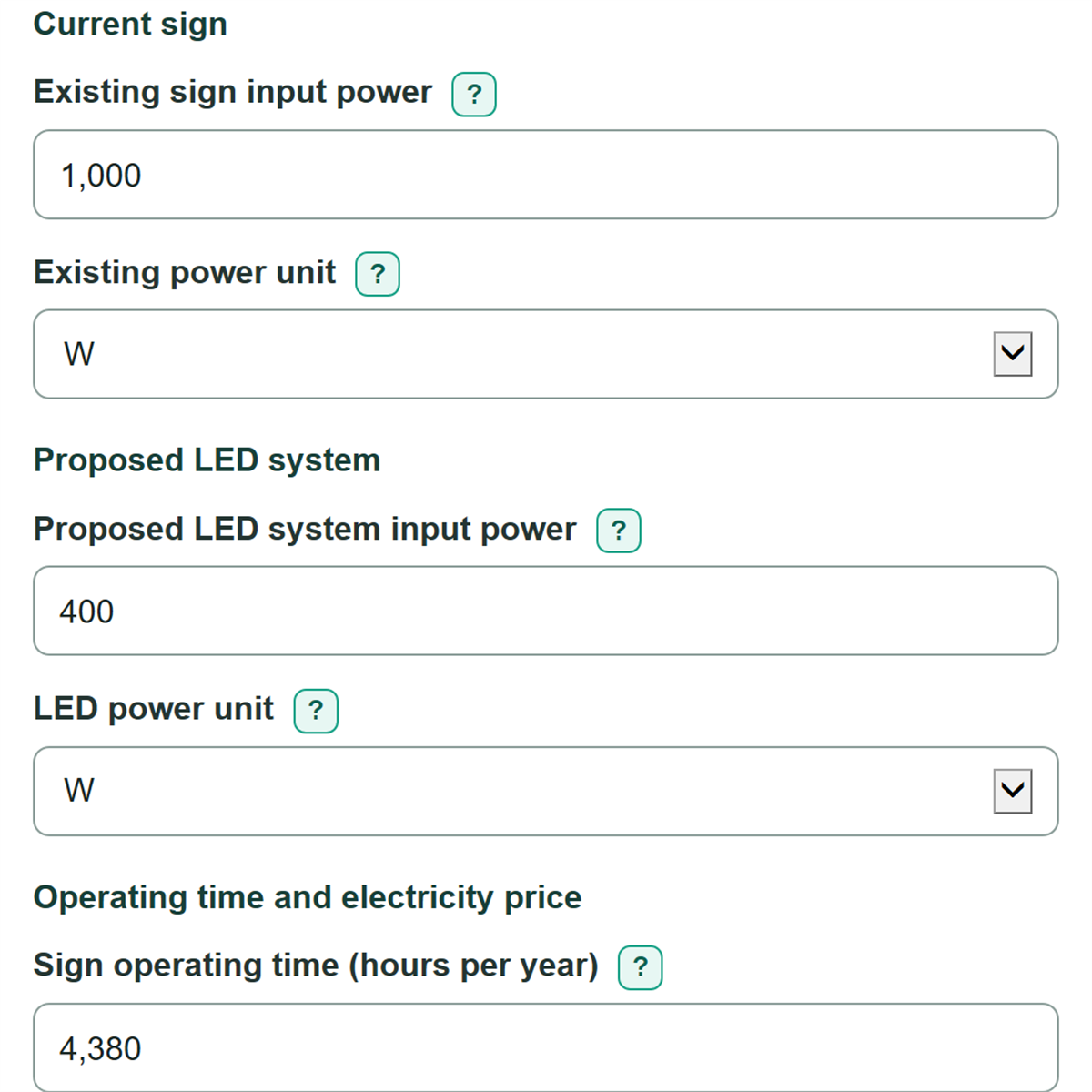
For a 1,000 W existing sign, a 400 W LED system, 4,380 hours per year, and an electricity rate of $0.1379 per kWh, the existing sign uses 4,380 kWh per year and the LED system uses 1,752 kWh per year. The difference is 2,628 kWh per year, or about $362.40 per year in electricity-cost savings.
Assumptions and limits
The default electricity rate is a 2026 US commercial planning estimate from the U.S. Energy Information Administration and should be replaced with the usage-based rate from your own bill. [1] Fixed charges and demand-charge savings are not calculated because they depend on the utility tariff and when the sign contributes to billed peak demand.