
Estimate direct LED lighting savings and extra refrigeration electricity savings for a cooler or freezer using fixture, schedule, and utility-bill inputs.
Advanced options
Calculation details
Table of contents
How to use our Cold Storage LED Savings Calculator
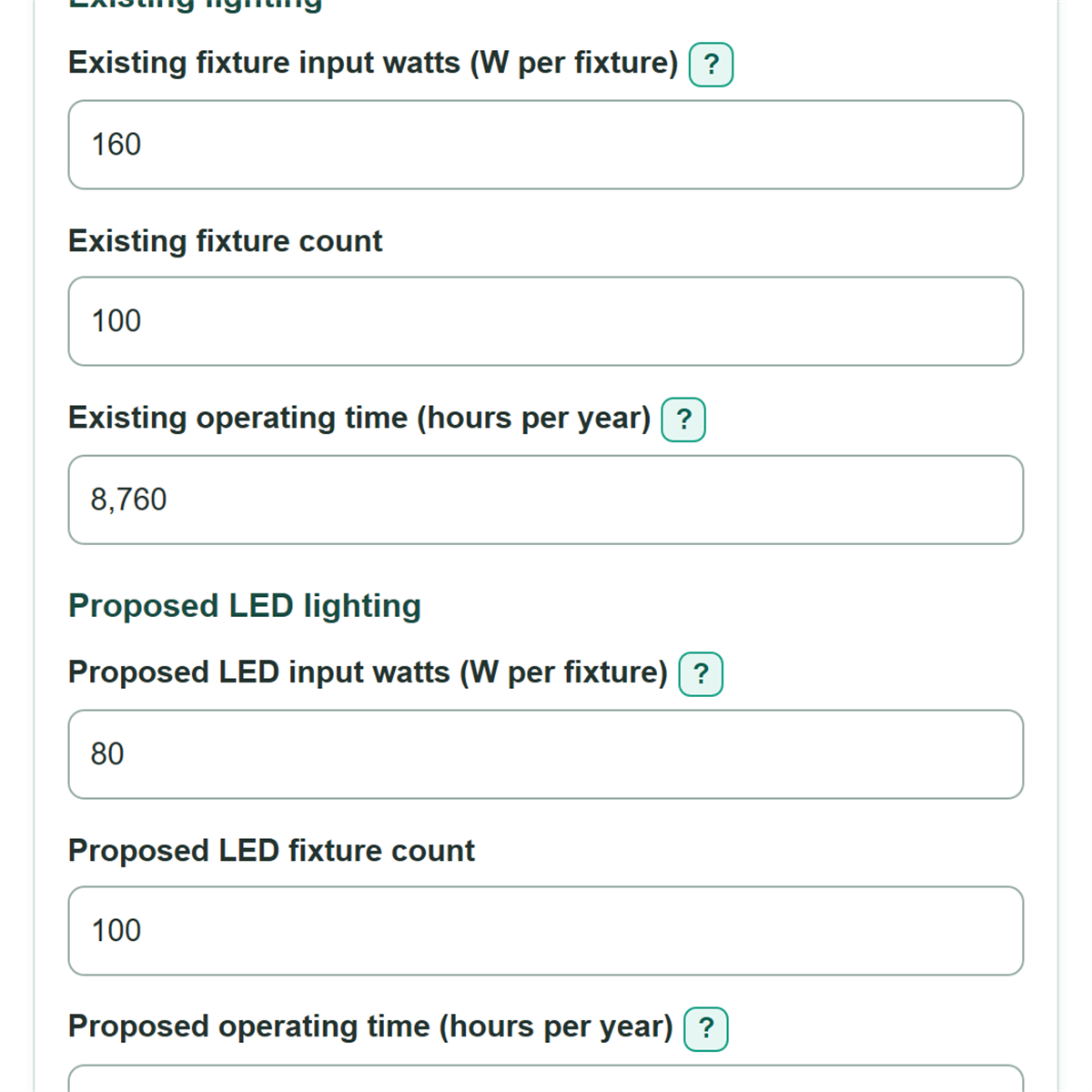
- Enter complete input watts, fixture counts, and annual operating time for the existing lighting. Include ballast or driver power in the fixture watts.
- Enter the proposed LED input watts, proposed LED fixture count, and proposed operating time. Use different hours if controls will change the schedule.
- Enter the bill's variable electricity rate and choose the matching Electricity rate unit. Leave out fixed monthly charges.
- Choose Refrigerated space type, then use Advanced options to replace Average refrigeration COP or Lighting heat entering the refrigerated space (percent) if site information is available.
- Check that Direct lighting electricity savings and Estimated refrigeration electricity savings are shown separately, then use Total annual electricity savings and Estimated annual energy-cost savings for screening.
Definitions
Fixture input watts: Electrical power used by one complete fixture, including its lamps and ballast or LED driver.
Operating time: The total hours per year that a fixture group is on. Existing and proposed schedules can differ.
Variable electricity rate: The part of a utility charge that changes with each kWh used. Fixed monthly charges are not included.
COP: Coefficient of performance. It is cooling delivered divided by electricity used by the refrigeration system. A higher COP produces a smaller refrigeration-electricity estimate for the same avoided heat.
Lighting heat entering the refrigerated space: The share of fixture power that becomes heat inside the cooler or freezer boundary.
Connected refrigeration heat-load reduction: The change in lighting heat at one moment, shown in W and BTU/hr. It is not annual energy savings.
Common mistakes and quick fixes
Mistake: Entering lamp-only watts in Existing fixture input watts (W per fixture).
Fix: Use complete fixture input watts, including ballast or driver power.
Mistake: Using the proposed control schedule for Existing operating time (hours per year).
Fix: Enter current annual hours there and put the expected post-retrofit schedule in Proposed operating time (hours per year).
Mistake: Typing 8.62 while Electricity rate unit is set to $ per kWh.
Fix: Choose Cents per kWh for 8.62, or enter 0.0862 with $ per kWh selected.
Mistake: Treating Connected refrigeration heat-load reduction as annual electricity savings.
Fix: Read it as a connected load change in W; use Estimated refrigeration electricity savings for annual kWh.
Mistake: Filling only one or two Second group fields.
Fix: Check Existing fixture input watts (W per fixture) and then recalculate. Complete all six second-group fields or clear every one so the group is not included.
Mistake: Leaving Average refrigeration COP at a planning value when site trend data are available.
Fix: Replace it with a site-specific average COP from a contractor, submittal, or controls data.
Limitations & Key Assumptions / Boundary Conditions
- The refrigeration result is a simplified annual estimate based on direct lighting kWh savings, the entered heat fraction, and one average refrigeration COP.
- Actual refrigeration savings can differ with room temperature, compressor staging, defrost, part-load operation, condenser conditions, and controls.
- The calculation assumes the entered lighting heat fraction applies to both existing and proposed fixtures. Enter less than 100 percent when some fixture heat is outside the refrigerated boundary.
- Annual energy-cost savings use only the entered variable per-kWh rate. Fixed customer charges, demand charges, rebates, project cost, and maintenance are excluded.
- Connected heat-load reduction is a screening value, not a complete refrigeration sizing calculation. It does not include envelope, infiltration, product, people, or equipment loads.
- A second fixture group is included only when all six second-group fields are completed.
Methodology
Energy calculation
For each active fixture group, the calculator finds annual lighting use from fixture input watts, fixture count, and annual operating time. It adds both groups when the optional second group is complete.
lighting_kwh = watts_per_fixture * fixture_count * hours_per_year / 1000
Direct lighting electricity savings are existing annual lighting use minus proposed annual lighting use. Signed results are kept: a negative value means the proposal uses more electricity.
direct_lighting_kwh_savings = existing_lighting_kwh - proposed_lighting_kwh
Refrigeration interaction
Lighting inside a refrigerated space becomes heat that the refrigeration system must remove. The calculator estimates the electricity avoided by reducing that heat with the entered heat fraction and average refrigeration COP.
refrigeration_kwh_savings = direct_lighting_kwh_savings * (heat_fraction_percent / 100) / refrigeration_cop
Total annual electricity savings combine the direct fixture savings and estimated refrigeration savings, so both lines stay visible instead of being hidden in one number.
total_annual_kwh_savings = direct_lighting_kwh_savings + refrigeration_kwh_savings
Annual energy-cost savings multiply total annual kWh savings by the entered variable rate. If cents per kWh is selected, the entered rate is divided by 100 first. The prefilled electricity rate is a 2025 US industrial planning estimate; replace it with the variable supply and delivery charges on the local bill. [1]
annual_energy_cost_savings = total_annual_kwh_savings * variable_rate_per_kwh
Connected load check
The connected heat-load result compares fixture watts without using operating hours, then applies the heat fraction. BTU/hr is calculated using 1 W = 3.412141633 BTU/hr.
connected_heat_load_reduction_w = (existing_connected_w - proposed_connected_w) * (heat_fraction_percent / 100)
Worked example
With 100 existing 160 W fixtures and 100 proposed 80 W fixtures, both running 8,760 hours per year, existing lighting use is 140,160 kWh/year and proposed use is 70,080 kWh/year. Direct savings are 70,080 kWh/year. With 100 percent heat entering the space and COP 1.88, estimated refrigeration savings are about 37,277 kWh/year, making total savings about 107,357 kWh/year.
Calculation choices
The model requires a COP greater than zero and a heat fraction from 0 to 100 percent. It ignores the second fixture group when all six fields are blank, but stops with an error when the group is only partly completed. The result estimates annual energy only; it does not calculate demand charges or equipment capacity.