
Estimate how many identical LED fixtures can start together on one breaker using documented inrush and normal input-current data.
Breaker data
Startup plan
Advanced options
The input values are editable examples, not equipment ratings. Replace them with voltage-matched fixture and breaker documentation.
Calculation details
Table of contents
How to use our LED Inrush Current and Fixtures per Breaker Calculator
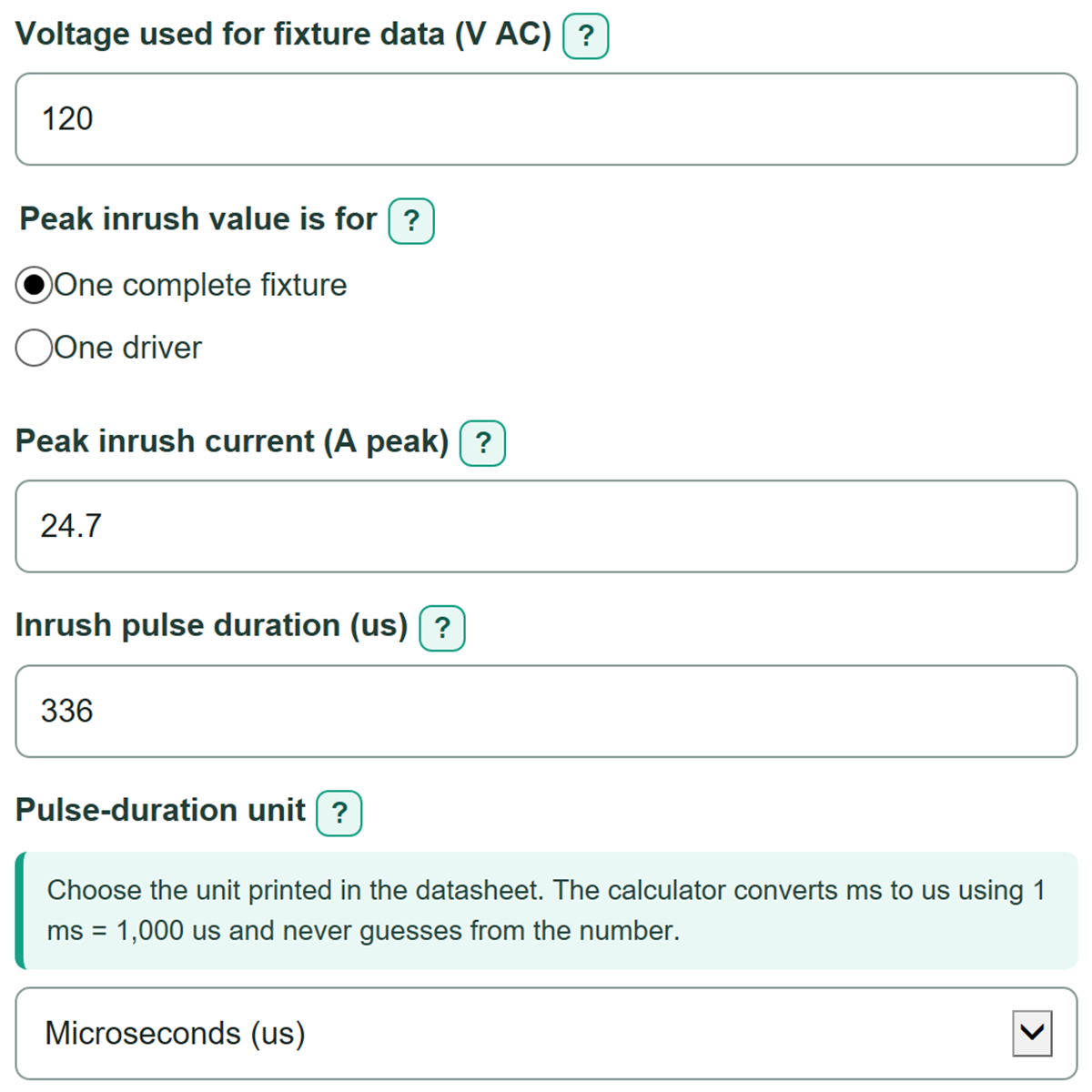
- Copy the voltage, peak inrush, and pulse duration from the same fixture or driver data row into Voltage used for fixture data, Peak inrush current, and Inrush pulse duration.
- Choose whether Peak inrush value is for one complete fixture or one driver. If it is for one driver, enter Drivers in each fixture.
- Enter Normal input current per fixture, Breaker handle rating, and the Published breaker inrush limit at this pulse duration from documentation for the exact breaker.
- Enter Fixtures switched on at once, then select Calculate.
- Check that the planned group is at or below Maximum identical fixtures per breaker and that the displayed controlling limit matches the equipment data you expect.
Definitions
Peak inrush current: The brief highest AC input current when a fixture or driver is energized, measured in A peak.
Inrush pulse duration: How long the startup-current pulse lasts. Datasheets may call it pulse width, T50, or half-value time.
Per-fixture inrush: The peak current for one complete fixture. For per-driver data, it is peak current multiplied by drivers in each fixture.
Published breaker inrush limit: The documented peak current the exact breaker can allow at a stated pulse duration. It is different from the number printed on the breaker handle.
Continuous-load planning limit: The percentage of breaker handle rating used to calculate planned available normal current. The calculator starts at 80 percent and lets you change it.
Common mistakes and quick fixes
Mistake: Entering LED output current in milliamps for Normal input current per fixture.
Fix: Enter the AC input current in amps from the fixture nameplate or cut sheet.
Mistake: Copying Peak inrush current from a different voltage row than Voltage used for fixture data.
Fix: Use voltage, peak current, and pulse duration from the same documented test condition.
Mistake: Treating Breaker handle rating as the Published breaker inrush limit at this pulse duration.
Fix: Use a published peak-current capability for the exact breaker and matching pulse duration.
Mistake: Selecting one driver under Peak inrush value is for but leaving Drivers in each fixture at zero or using the fixture count.
Fix: Enter the actual number of drivers inside one fixture, at least 1.
Mistake: Entering all installed fixtures instead of Fixtures switched on at once.
Fix: Count only fixtures energized in the same startup event unless a documented control sequence starts separate groups.
Limitations & Key Assumptions / Boundary Conditions
- This is a preliminary count for identical fixtures on one branch breaker. It uses only the entered equipment data and rounds down to whole fixtures.
- The published breaker inrush limit must apply to the exact breaker and the entered pulse duration. A handle rating alone does not establish startup capability.
- Voltage, peak inrush, and pulse duration must come from the same fixture or driver test condition.
- For per-driver data, the calculation assumes all drivers in each fixture start together.
- The 80 percent continuous-load planning setting is editable. Applicable design rules, listing instructions, and local requirements can use a different condition.
- The result does not evaluate conductor ampacity, ambient temperature, control-device ratings, breaker tolerance, pulse shape, fault current, voltage drop, or local approval.
Methodology
Calculation method
The calculator keeps startup current and normal operating current separate. It converts pulse duration to microseconds, converts per-driver data to a per-fixture peak when needed, then calculates two whole-fixture limits.
pulse_duration_us = pulse_duration for us; pulse_duration_us = pulse_duration * 1000 for ms
per_fixture_inrush_a = peak_inrush_a for one fixture; otherwise peak_inrush_a * drivers_per_fixture
inrush_limited_fixtures = floor(breaker_allowable_inrush_a / per_fixture_inrush_a)
continuous_current_limit_a = breaker_rating_a * continuous_load_percent / 100
continuous_limited_fixtures = floor(continuous_current_limit_a / fixture_input_current_a)
max_fixtures_per_breaker = min(inrush_limited_fixtures, continuous_limited_fixtures)
planned_group_inrush_a = per_fixture_inrush_a * simultaneous_fixtures
Worked example
With 24.7 A peak inrush per fixture, a documented 247 A peak breaker limit, a 20 A breaker, a planning limit of 80 percent, and 0.63 A normal current per fixture, startup allows floor(247 / 24.7) = 10 fixtures. Normal load allows floor(16 / 0.63) = 25 fixtures. The final count is 10 because startup inrush controls. If 8 fixtures start together, their calculated startup current is 197.6 A peak.