
Compare Type A, Type B, and Type C LED tube retrofit costs using your fixture count, power use, operating time, and project quotes.
- Upfront project cost
- Annual electricity cost
- Annual electricity savings
- Simple payback time
- Upfront project cost
- Annual electricity cost
- Annual electricity savings
- Simple payback time
- Upfront project cost
- Annual electricity cost
- Annual electricity savings
- Simple payback time
Calculation details
Table of contents
How to use our LED Tube Type A vs Type B vs Type C Lifetime Cost Calculator
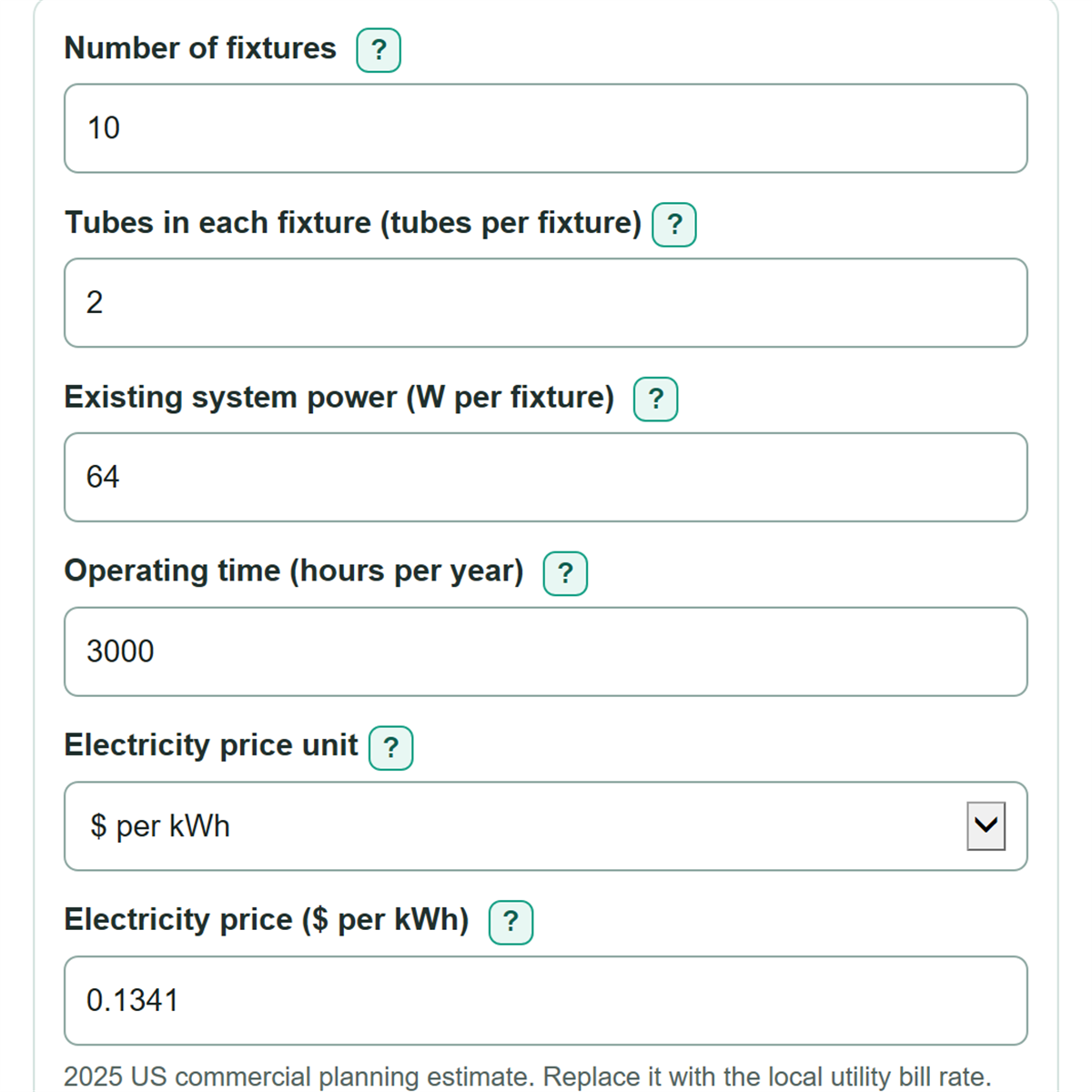
- Enter the Number of fixtures and Tubes in each fixture; tube prices use the total tube count, while rewiring, drivers, and labor use the fixture count.
- Enter Existing system power, Operating time, and the electricity price from your utility bill. Choose the matching Electricity price unit before entering the rate.
- Fill in the system power and quoted costs for Type A, Type B, and Type C. Use full fixture power, not tube watts alone.
- Set Time to compare, then add confirmed rebates or other project charges in Advanced options if they apply.
- Check the lowest-cost path against the three lifetime cost cards and confirm that the power, labor, driver, ballast, and rewiring inputs match the actual product and installation scope.
Definitions
Type A: An LED tube retrofit path that keeps a compatible fluorescent ballast in the fixture.
Type B: An LED tube retrofit path that bypasses or removes the fluorescent ballast and uses wiring specified for that tube.
Type C: An LED tube retrofit path that uses compatible tubes with an external LED driver.
System power: Total input power for one completed fixture in watts (W), including a retained ballast or external driver when present.
Upfront project cost: Tube, ballast, driver, rewiring, labor, and other entered project charges minus the entered rebate.
Annual electricity savings: Existing annual electricity cost minus a retrofit path's annual electricity cost. A negative number means that path costs more to run each year.
Simple payback time: Upfront project cost divided by annual electricity savings when both are positive. It does not include financing, inflation, or future replacements.
Electricity price: The usage-based cost per kilowatt-hour (kWh). The default is a 2025 US commercial planning estimate and should be replaced with the local bill rate. [1]
Common mistakes and quick fixes
Mistake: Entering total tubes in Number of fixtures .
Fix: Count complete fixtures in Number of fixtures and enter lamps per fixture in Tubes in each fixture .
Mistake: Using only the tube's printed watts for Type A system power .
Fix: Enter full fixture input power, including the retained ballast, or use a fixture-level measurement.
Mistake: Entering 13.41 while Electricity price unit is set to $ per kWh.
Fix: Choose cents per kWh for 13.41, or enter 0.1341 when the unit is $ per kWh.
Mistake: Putting Type B bypass work into Type B tube price .
Fix: Put the tube quote in Type B tube price and fixture-level wiring work in Type B rewiring labor .
Mistake: Treating Lowest-cost retrofit path as proof that a tube will work in the fixture.
Fix: Verify the selected tube, ballast, driver, wiring method, controls, and installation instructions separately before buying or installing.
Limitations & Key Assumptions / Boundary Conditions
- The comparison uses entered purchase, labor, power, operating-time, rebate, and other project-cost values. It does not estimate missing quotes.
- Lifetime cost covers the selected Time to compare only. It does not automatically include tube, ballast, driver, or control failures and replacements.
- Electricity costs use a constant rate and annual operating time. Actual bills can change with tariffs, demand charges, seasonal pricing, controls, and future rate changes.
- Fixed utility account charges are excluded because a lighting retrofit normally does not remove the electric account.
- A cost result does not confirm Type A ballast compatibility, Type B wiring suitability, Type C driver compatibility, dimming behavior, light output, code compliance, or installation safety.
- Type B rewiring and Type C driver work must follow the exact product instructions and applicable electrical requirements.
Methodology
Cost calculation
The calculator keeps tube-based and fixture-based costs separate. It first finds how many tubes are needed, then calculates each retrofit path's upfront cost, yearly electricity cost, annual savings, lifetime cost, and simple payback.
Total tubes = Number of fixtures * Tubes in each fixture
Electricity price in $ per kWh = entered price, or entered cents per kWh / 100
Annual electricity cost = fixtures * system power in W per fixture * operating hours per year * electricity price / 1000
Lifetime cost = upfront project cost + annual electricity cost * Time to compare
For Type A, upfront cost includes tubes, any entered ballast cost, installation labor, other project charges, and the Type A rebate. Type B uses tubes and rewiring labor. Type C uses tubes, driver cost, and installation labor. Rebates are subtracted, so an entered rebate larger than charges can create a negative upfront cost.
Annual electricity savings = existing annual electricity cost - retrofit annual electricity cost
Simple payback time = upfront project cost / annual electricity savings
Simple payback is shown as 0 years when upfront cost is zero or negative. When upfront cost is positive and annual savings are zero or negative, payback is not reached. The lowest-cost path is the path with the smallest lifetime cost; equal values are reported as a tie.
Worked example
With 10 fixtures, 2 tubes per fixture, Type A tube price of $8, no Type A ballast cost, and $5 Type A installation labor per fixture, the Type A upfront cost is $210. At 36 W per fixture, 3,000 hours per year, and $0.1341 per kWh, Type A annual electricity cost is $144.83. Over 8 years, its modeled lifetime cost is $1,368.62.
Planning inputs
The default electricity price of $0.1341 per kWh is a 2025 US commercial planning estimate from the U.S. Energy Information Administration. Replace it with the usage-based rate from the local utility bill. [1] Life-cycle cost comparisons can differ from a simple purchase-price comparison because operating costs occur over time. [2]