
Estimate sports lighting installation, energy, annual operating cost, and LED retrofit payback using your project budget, schedule, system load, and utility price.
Lighting power
Facility schedule
Electricity price
Advanced options
Annual demand charges
Annual maintenance
Calculation details
Table of contents
How to use our Sports Lighting Installation and Operating Cost Calculator
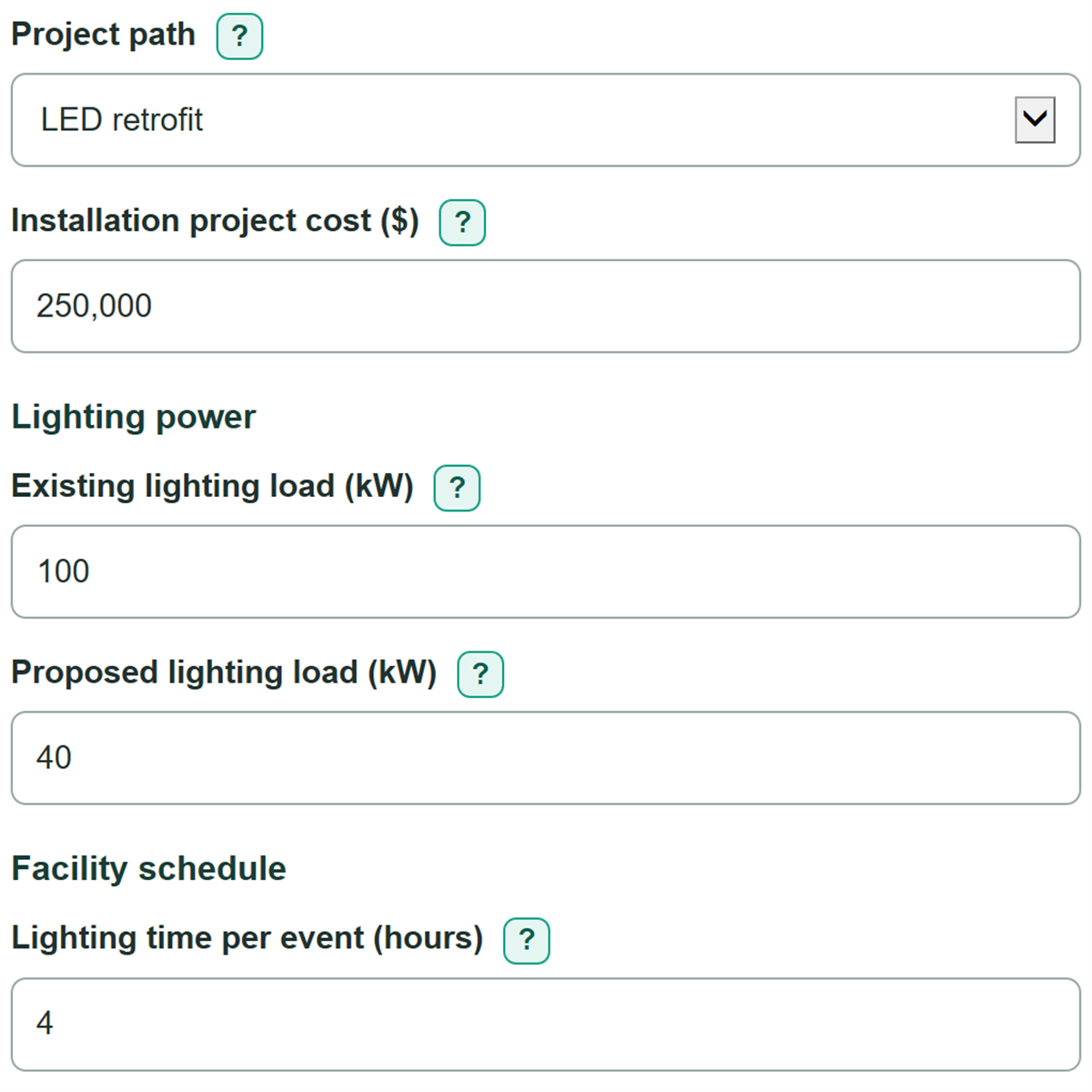
- Choose Project path. Select LED retrofit if you can enter both the old and proposed lighting loads.
- Enter Installation project cost ($) from a quote or planning budget, then copy total input power into the lighting load fields.
- Enter Lighting time per event (hours), Lit events per year, and the electricity price exactly as shown on the utility bill. Choose the matching Electricity price unit.
- Open Advanced options only if you know lighting-specific demand charges or maintenance costs; leave those fields blank if they are unknown.
- Check that Annual lighting time matches the facility calendar and that the proposed energy cost per event looks reasonable before using the annual cost or payback result.
Definitions
kW: Kilowatts, a measure of electric power. This is the total input load while the lights are on.
kWh: Kilowatt-hours, a measure of energy. Utilities commonly bill electricity use in kWh.
Annual lighting time: Lighting time per event multiplied by lit events per year.
Demand charges: Utility charges tied to measured or billed peak power demand, separate from per-kWh energy charges.
Simple payback time: Installation project cost divided by positive annual operating savings. It estimates how many years of savings equal the entered installation cost.
Annual operating savings: Existing annual lighting operating cost minus proposed annual lighting operating cost. A positive amount means the proposed system costs less to operate.
Common mistakes and quick fixes
Mistake: Entering a metal-halide lamp rating instead of total input power in Existing lighting load (kW) .
Fix: Use the electrical schedule, meter study, or fixture input power that includes ballast power.
Mistake: Typing 13.41 while Electricity price unit is set to $ per kWh.
Fix: Choose Cents per kWh for 13.41, or enter 0.1341 when using $ per kWh.
Mistake: Counting only game time in Lighting time per event (hours) .
Fix: Include warm-up, the event, cleanup, and other time when lights normally operate.
Mistake: Treating a monthly customer charge as Proposed lighting demand charges ($ per year) .
Fix: Enter only demand cost attributable to lighting; fixed customer and meter charges are excluded.
Mistake: Reading Simple payback time as a guaranteed recovery date.
Fix: Use it as a simple planning comparison because it excludes financing, inflation, and future rate changes.
Limitations & Key Assumptions / Boundary Conditions
- The installation budget is an amount you enter, not an independent contractor quote or final construction price.
- The calculation uses total lighting input load and scheduled run time. It does not model dimming, controls, outages, seasonal schedules, or partial-field operation.
- Energy cost is based on the entered electricity price and kWh. Fixed customer and meter charges are excluded because they usually do not change with lighting use.
- Demand charges and maintenance affect operating cost only when their optional annual fields are filled in. Blank optional fields count as $0.
- Simple payback excludes financing, taxes, incentives, inflation, electricity-price changes, equipment life, and the time value of money.
- A photometric study and project-specific quote are still needed to size fixtures, confirm light levels, check glare, and price poles, wiring, permits, and construction work.
Methodology
Calculation method
The calculator first finds annual lighting time from the event schedule. It converts cents to dollars only when Cents per kWh is selected. The 13.41 cents per kWh starting value is a 2025 US commercial planning estimate; replace it with a local bill value when available. [1]
annual lighting time = lighting time per event x lit events per year
proposed energy per event = proposed lighting load (kW) x lighting time per event
proposed annual lighting energy = proposed lighting load (kW) x annual lighting time
proposed annual operating cost = proposed annual kWh x electricity price per kWh + proposed demand charges + proposed maintenance
first-year project and operating cost = installation project cost + proposed annual operating cost
For an LED retrofit, the same annual schedule and electricity price are applied to the existing load. Annual operating savings keep their sign, so a negative amount means the proposed system costs more to operate.
annual operating savings = existing annual operating cost - proposed annual operating cost
simple payback time = installation project cost / annual operating savings
Simple payback is shown only when annual operating savings are positive. If installation cost is $0 and savings are positive, payback is 0 years.
Worked example
A proposed 40 kW system used 4 hours per event for 100 events has 400 annual lighting hours and uses 16,000 kWh per year.
40 kW x 4 hours x 100 events = 16,000 kWh per year
At 13.41 cents per kWh, proposed annual energy cost is $2,145.60 before optional demand and maintenance costs. If an existing 100 kW system uses the same schedule, its energy cost is $5,364.00, so energy-only annual savings are $3,218.40. With a $250,000 installation cost, simple payback is about 77.68 years.
Calculation scope
Annual demand and maintenance entries are added as separate annual amounts because they are not proportional to kWh. Fixed utility charges are not multiplied by lighting hours. Final project decisions need a photometric design, actual tariff review, and a project-specific construction quote.