
Compare your employer mileage reimbursement with your estimated vehicle cost for the same business-driving period.
Table of contents
How to use our Mileage Reimbursement vs Actual Vehicle Cost Calculator
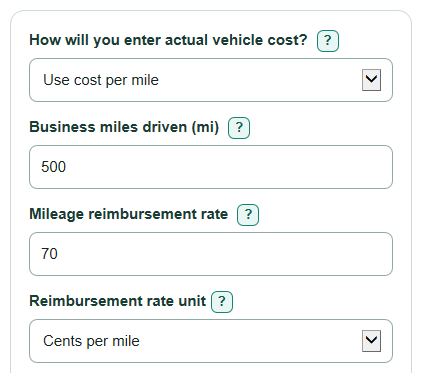
- Choose Use cost per mile if you already have a personal estimate, or choose Add expenses to build the estimate from vehicle bills.
- Enter Business miles driven (mi) and your Mileage reimbursement rate, then choose the matching Reimbursement rate unit.
- For the expense method, enter Total miles driven in the same period (mi) and each cost from that same period. Choose the correct Vehicle cost type.
- Click Calculate. A positive Reimbursement surplus or shortfall means reimbursement is above estimated cost; a negative amount means estimated cost is higher.
- Sanity-check that business miles do not exceed total miles and that every entered bill covers the same period without being counted twice.
Definitions
Business miles: Miles driven for work during the selected period.
Reimbursement rate: The amount an employer pays per business mile, entered in cents or dollars per mile.
Actual vehicle cost per mile: Your estimated vehicle cost divided by miles driven. It is not automatically the IRS standard mileage rate.
Business share of vehicle miles: Business miles divided by all miles driven by the same vehicle in the same period.
Depreciation: Estimated loss in value of an owned vehicle during the period.
Reimbursement surplus or shortfall: Reimbursement received minus estimated vehicle cost assigned to business miles. A negative value is an estimated uncovered cost.
Common mistakes and quick fixes
Mistake: Entering 0.70 while Reimbursement rate unit is set to Cents per mile.
Fix: Enter 70 for 70 cents per mile, or select Dollars per mile before entering 0.70.
Mistake: Using costs from a year but entering one month of Business miles driven (mi) .
Fix: Make the miles and every cost cover the same period.
Mistake: Entering only business miles in Total miles driven in the same period (mi) .
Fix: Include all driving for that vehicle in the period, including personal and commuting miles.
Mistake: Entering a full loan payment as Vehicle loan interest for the period ($) .
Fix: Enter only the interest shown by the lender; do not include loan principal.
Mistake: Entering both lease payments and depreciation in the expense method.
Fix: Set Vehicle cost type to Owned vehicle for Vehicle depreciation for the period ($) , or Leased vehicle for Vehicle lease cost for the period ($) .
Limitations & Key Assumptions / Boundary Conditions
- This compares an employer payment with your estimated vehicle cost; it does not determine a tax deduction, taxable reimbursement, or tax owed.
- Itemized costs must cover the same period as both mileage inputs. A yearly insurance bill or registration fee needs a matching-period portion.
- The itemized method assigns all included period costs by the business share of total vehicle miles. Actual costs may not rise evenly with each mile.
- For owned vehicles, the calculation includes depreciation and optional loan interest, not loan principal. For leased vehicles, it uses lease cost and excludes depreciation and loan interest.
- Results depend on complete records and a reasonable depreciation estimate. Parking, tolls, employer allowances, and costs not included in the listed inputs are outside this calculation.
Methodology
Calculation method
The calculator first converts the entered employer rate to dollars per mile. A cents entry is divided by 100; a dollars entry is used as entered.
reimbursement received = business miles driven * reimbursement rate per mile
With Use cost per mile, the entered Actual vehicle cost ($ per mi) is used directly.
actual vehicle cost assigned to business miles = business miles driven * actual vehicle cost per mile
With Add expenses, the calculator adds fuel or charging, maintenance, repairs, tires, insurance, registration-related costs, and one ownership cost. Owned vehicles use depreciation and loan interest; leased vehicles use lease cost instead.
itemized vehicle cost for the period = fuel or charging + maintenance, repairs, and tires + insurance + registration fees + selected ownership cost + eligible loan interest
business share of vehicle miles = business miles driven / total miles driven in the same period
actual vehicle cost used per mile = itemized vehicle cost for the period / total miles driven in the same period
reimbursement surplus or shortfall = mileage reimbursement received - actual vehicle cost assigned to business miles
Worked example
For 500 business miles, a 70 cents per mile reimbursement rate, and an actual cost of $0.60 per mile, reimbursement is $350 and estimated cost is $300. The reimbursement surplus is $50, or 10 cents per mile.
Calculation boundaries
In itemized mode, total miles must be greater than zero and at least as large as business miles. A negative surplus or per-mile coverage amount is kept because it shows an estimated shortfall rather than an input error.