
Enter miles driven and gallons used to find your actual gas mileage in MPG, or plan a trip's fuel use and gasoline cost.
Table of contents
How to use our Gas Mileage Calculator
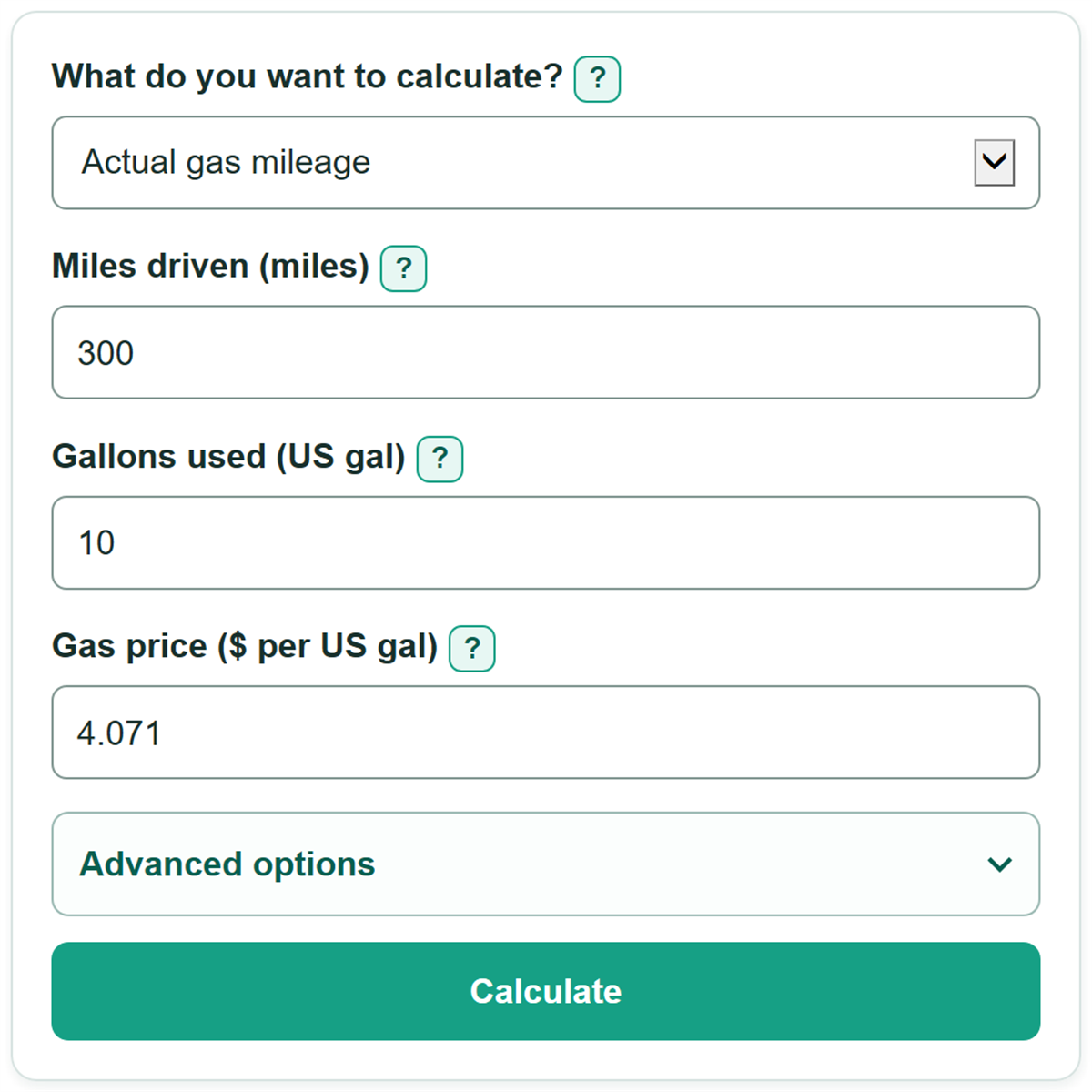
- Choose "Actual gas mileage" for driving you have already completed, or choose "Trip fuel plan" for a future route.
- For actual mileage, enter miles from a trip odometer and gallons from the next refill receipt. Measure from one complete fill to the next for the best comparison.
- For a trip, enter the full driving distance, expected MPG, and gas price. Include return travel only when it is part of the distance you entered.
- Click Calculate. In Trip fuel plan, open Advanced options and enter both low and high MPG values if you want a planning range for gallons and fuel cost.
- Check the direction of the result: for the same trip, higher MPG should need fewer gallons, and a higher gas price should increase fuel cost.
Definitions
MPG: Miles per US gallon. Higher MPG means the vehicle travels farther on each gallon.
Fuel economy: How far a vehicle travels for a given amount of fuel. EPA gasoline labels list city, highway, and combined MPG values. [1]
Complete fill: Filling the tank to the same full level at the start and end of a measured driving interval.
Expected fuel economy: The MPG you expect for a planned trip. It can come from a label value, dashboard history, or your measured average.
km/L: Kilometers per liter. Like MPG, a higher value means better fuel economy.
L/100 km: Liters needed to travel 100 kilometers. A lower value means less fuel is used for the same distance.
Gasoline cost per mile: Gasoline spending divided by miles driven. It does not include other vehicle costs.
Common mistakes and quick fixes
Mistake: Entering the ending odometer reading as miles driven.
Fix: Check What do you want to calculate? and then recalculate. Subtract the starting odometer reading from the ending reading, or use the trip odometer distance.
Mistake: Using gallons from a partial refill.
Fix: Check What do you want to calculate? and then recalculate. Record miles and gallons from one complete fill to the next complete fill so the fuel amount matches the driving interval.
Mistake: Entering one-way map miles for a trip that includes a return drive.
Fix: Check What do you want to calculate? and then recalculate. Enter the full planned driving distance, including the return route and any expected local driving.
Mistake: Using city, highway, combined, and personal measured MPG as if they are interchangeable.
Fix: Check What do you want to calculate? and then recalculate. Use the MPG that best fits the planned route, or use your own refill-based average. EPA labels show separate city, highway, and combined values. [1]
Mistake: Filling in only low MPG or high MPG for the planning range.
Fix: Check What do you want to calculate? and then recalculate. Enter both values, with low MPG no higher than expected MPG and high MPG no lower than expected MPG.
Mistake: Treating gasoline cost per mile as the full cost of driving.
Fix: Check What do you want to calculate? and then recalculate. This number covers gasoline only. Add tolls, parking, insurance, maintenance, and depreciation separately if they matter for your decision.
Limitations & Key Assumptions / Boundary Conditions
- Actual MPG is only as accurate as the miles and gallons entered. A partial refill can make the gallons fail to match the driving interval.
- A single tank may differ from a longer average because of traffic, speed, weather, terrain, cargo, towing, tire condition, and idling.
- Trip results assume that the entered MPG and gas price apply for the entire distance. Actual MPG and pump prices can change during a trip.
- The optional low-to-high range uses only the MPG values you enter. It is a planning estimate, not a guaranteed fuel-use or spending range.
- All input gallons are US gallons. Do not enter Imperial gallons or liters without converting them first.
- Fuel-cost results include gasoline only. They exclude tolls, parking, maintenance, depreciation, insurance, lodging, food, and other trip expenses.
Methodology
Actual gas mileage
The calculator divides miles driven during a measured refill interval by US gallons used.
MPG = miles driven / gallons used
For example, 300 miles divided by 10 US gallons is 30 MPG. If gas costs $4.071 per US gallon, the 10 gallons cost $40.71. Dividing $40.71 by 300 miles gives $0.1357 per mile before display rounding.
Measured-interval gasoline cost = gallons used * gas price
Gasoline cost per mile = measured-interval gasoline cost / miles driven
Trip fuel plan
For a planned drive, the calculator divides the full trip distance by expected MPG to estimate gallons needed. It then multiplies the estimated gallons by the gas price.
Expected fuel needed = trip distance / expected fuel economy
Expected trip fuel cost = expected fuel needed * gas price
For example, a 500-mile trip at 25 MPG needs 20 US gallons. At $4.071 per US gallon, estimated gasoline cost is $81.42. If you enter both low and high MPG values, high MPG creates the lower gallons and cost endpoint, while low MPG creates the higher endpoint.
Low-end trip gallons = trip distance / high fuel economy
High-end trip gallons = trip distance / low fuel economy
Metric equivalents
The actual MPG result is converted using 1 mile = 1.609344 kilometers and 1 US gallon = 3.785411784 liters.
km/L = MPG * 1.609344 / 3.785411784
L/100 km = 100 / km/L