
Compare the estimated cost of filing an own-car damage claim with paying the repair bill yourself.
Advanced options
Table of contents
How to use our File a Car Insurance Claim vs Pay Out of Pocket Calculator
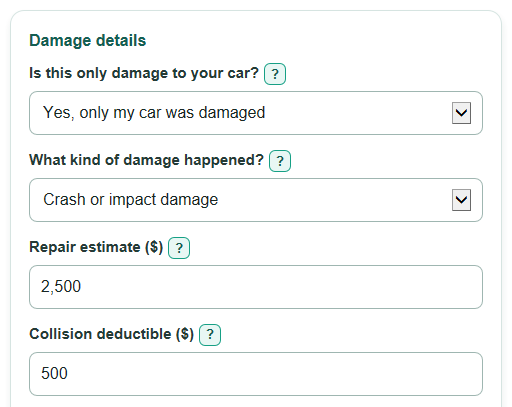
- Choose whether this is only damage to your car, then choose crash damage or non-crash damage so the matching deductible appears.
- Enter the written Repair estimate and the deductible from your policy declarations page or insurer app.
- Choose how you will enter the expected premium increase. Use added dollars if you have a dollar estimate, or use a percent with your current premium and its exact billing period.
- Set How many years could the increase last?, then add optional repair damage or claim-only costs if you have a reasonable dollar estimate.
- Check the signed claim savings result: a positive amount means filing is estimated to cost less; a negative amount means paying cash is estimated to cost less. Confirm that the premium period matches your bill before using the comparison.
Definitions
Deductible: The part of a covered repair that you pay before the insurer pays its share.
Collision deductible: The deductible for crash or impact damage, if your policy has collision coverage.
Comprehensive deductible: The deductible for covered non-crash events, such as theft, weather, glass damage, fire, or an animal strike.
Future added premium: The estimated extra premium paid over the selected number of years after a claim.
Claim savings compared with paying cash: The cash-repair cost minus the estimated claim cost. A positive amount favors filing in this estimate; a negative amount favors paying cash.
Common mistakes and quick fixes
Mistake: Entering the amount due each month but choosing a 6-month or 12-month Current premium period.
Fix: Choose the exact period printed with the Current premium amount.
Mistake: Using the Collision deductible for theft, glass, weather, or animal damage.
Fix: Choose the right answer for What kind of damage happened? and enter the matching deductible.
Mistake: Entering the full premium in Expected added premium.
Fix: Enter only the estimated increase, then select its period in Added premium period.
Mistake: Treating the Estimated insurer payment before premium effects as your total benefit from filing.
Fix: Compare Estimated cost of filing the claim with Estimated cost of paying for repairs yourself, since the claim cost includes the deductible and future added premium.
Mistake: Leaving out likely supplemental damage from an early shop quote.
Fix: Add a cautious amount in Possible additional repair damage only if the shop expects damage may be found after disassembly.
Mistake: Using this cost comparison as a reason not to act after an injury, property damage, unclear fault, or an unsafe car.
Fix: Choose "No, or I am not sure" for Is this only damage to your car? and follow the Claim and safety scope note.
Limitations & Key Assumptions / Boundary Conditions
- This compares only estimated costs for damage to your own car. It does not decide reporting duties, liability, legal issues, or claim handling when another person, vehicle, or property may be involved.
- The insurer payment estimate assumes the damage is covered and payable, with no policy limit, exclusion, valuation dispute, fraud review, or total-loss calculation changing the settlement.
- Future premium impact is a planning estimate. Actual renewal pricing can depend on the insurer, state, claim facts, fault, driving history, coverage, discounts, and accident forgiveness.
- The default 3-year duration is a New York planning example, not a rule for every driver. Replace it with information from your insurer, agent, or renewal documents.
- A repair estimate can change after disassembly. The optional additional-damage amount affects both paths, while Other claim-only costs affects only the filing path.
- A deductible at or above the adjusted repair cost can produce a $0 insurer payment. Filing may still have non-financial reasons, but this calculator does not evaluate them.
Methodology
How the comparison is calculated
The calculator first chooses the deductible that matches the selected damage type. It adds any optional additional repair damage to the repair estimate. That adjusted repair cost is the estimated cash-payment path.
adjusted repair cost = repair estimate + possible additional repair damage
For an added-dollar premium estimate, the calculator converts the selected period to yearly occurrences: 12 for monthly, 2 for every 6 months, and 1 for every 12 months.
future added premium = added premium x periods per year x impact years
For a percent estimate, it first converts the current premium to a yearly amount.
future added premium = current premium x periods per year x premium increase percent / 100 x impact years
The claim path includes the smaller of the adjusted repair cost or the applicable deductible, plus future added premium and any other claim-only costs. The insurer payment cannot go below $0.
estimated claim cost = min(adjusted repair cost, deductible) + future added premium + other claim-only costs
estimated insurer payment = max(0, adjusted repair cost - deductible)
claim savings = estimated cash repair cost - estimated claim cost
Worked example
With a $2,500 repair estimate, a $500 deductible, and an added premium of $300 every 6 months for 3 years, future added premium is $1,800. Estimated claim cost is $2,300, while paying cash is $2,500. Estimated claim savings is $200, so filing has the lower estimated cost in this example.
What this estimate assumes
Unchanged base premiums are excluded because they are paid either way. The 3-year default is a New York 2026 planning estimate; premium changes after an accident can vary by insurer and circumstances. [1] The result is a financial comparison only and does not replace prompt reporting, safety action, or claim guidance for injuries, third-party damage, unclear fault, an unsafe vehicle, or a possible total loss.