
Estimate monthly, 6-month, and yearly car insurance costs using state averages plus driver, vehicle, mileage, and deductible choices.
Table of contents
How to use our Car Insurance Estimate Calculator
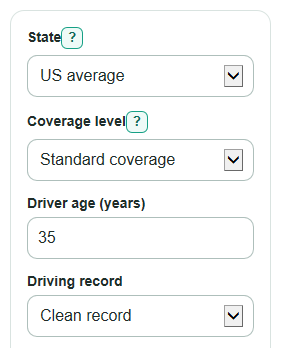
- Choose the State where the car is mainly kept, or leave it on US average if you only need a quick budget number.
- Pick the Coverage level, then enter Driver age, Driving record, and Car value using the car's current market value.
- Open Advanced options if you want the estimate to reflect Deductible, Miles driven per year, Recent insurance history, or Monthly take-home pay.
- Select Calculate and compare Estimated monthly cost, Likely yearly range, Estimated 6-month policy cost, and Estimated yearly cost.
- Sanity-check the result by comparing it with at least two real quotes; a quote far outside the Likely yearly range usually means a detail such as ZIP code, discounts, vehicle trim, or coverage limits is changing the price.
Definitions
State: The state where the car is mainly kept and insured; state averages are used as the starting point.
Coverage level: The broad policy type used in the estimate: low-limit liability, standard average spending, or full coverage with physical-damage coverage included.
Deductible: The amount you pay before collision or comprehensive coverage pays for damage to your own car.
Driving record: A simple risk group based on whether the driver has a clean record, a ticket, an at-fault crash, or a serious violation.
Recent insurance history: Whether the driver has kept continuous auto insurance or has had a recent gap.
Likely yearly range: A low-to-high yearly estimate around the middle result because real quotes can vary by insurer and exact address.
Older-car coverage check: A comparison of the estimated extra yearly cost of full coverage against the car's current value.
Common mistakes and quick fixes
Mistake: Using the new-car sticker price for Car value.
Fix: Enter the car's current market value, since the older-car coverage check depends on today's value.
Mistake: Choosing Full coverage under Coverage level when you only want a low-limit liability budget.
Fix: Choose Minimum or low limits for a liability-style estimate, or Standard coverage for a broad average spending estimate.
Mistake: Entering a learner age, a child age, or an age over 85 in Driver age.
Fix: Enter a Driver age from 16 to 85.
Mistake: Leaving Miles driven per year as 12,000 when the car is barely driven or used for a long commute.
Fix: Update Miles driven per year so the mileage factor matches your use.
Mistake: Entering gross salary in Monthly take-home pay.
Fix: Use after-tax monthly pay, or leave Monthly take-home pay blank if you do not want the budget share result.
Mistake: Treating Estimated monthly cost as a final insurer price.
Fix: Use Estimated monthly cost as a budget target, then compare quotes from insurers using the same coverage limits and Deductible.
Limitations & Key Assumptions / Boundary Conditions
- This is a budget estimate, not a quote from an insurance company.
- The model starts from state average premium data, so exact ZIP code, garaging address, local claim trends, and insurer pricing can move a real quote up or down.
- The calculator does not ask for VIN, vehicle trim, credit-based insurance score where allowed, discounts, coverage limits, lienholder rules, or household driver details.
- Minimum or low limits uses a 0.65 model factor because the state average table is not a minimum-liability quote table.
- Driver age, driving record, car value, deductible, mileage, and recent insurance history use broad factors, not insurer-filed rating rules.
- The older-car check is only a comparison aid. If the car is financed or leased, the lender may require comprehensive and collision coverage.
- Monthly take-home pay only affects Share of monthly take-home pay. It does not change the insurance cost estimate.
Methodology
Starting point
The calculator starts with 2023 NAIC state average auto insurance amounts, using average expenditure for Standard coverage and combined average premium for Full coverage [1]. US average is used when State is set to US average.
coverage_base_annual = state_avg_exp * 0.65 for Minimum or low limits
coverage_base_annual = state_avg_exp for Standard coverage
coverage_base_annual = state_combined_avg for Full coverage
Adjustment factors
The starting amount is multiplied by broad factors for Driver age, Driving record, Car value, Deductible, Miles driven per year, and Recent insurance history. Driver age factors are 2.25 for ages 16 to 19, 1.55 for ages 20 to 24, 1.00 for ages 25 to 64, and 1.10 for ages 65 to 85. Driving record factors are 1.00 for Clean record, 1.15 for One ticket, 1.35 for One at-fault crash, and 2.00 for Serious violation.
Car value factors are 0.85 below $8,000, 0.95 from $8,000 to $14,999.99, 1.00 from $15,000 to $29,999.99, 1.10 from $30,000 to $49,999.99, and 1.25 at $50,000 or more. For Minimum or low limits, the car value factor is treated as 1.00 because that policy is modeled as liability-focused.
Deductible factors are 1.08 for $250, 1.00 for $500, 0.92 for $1,000, and 0.85 for $2,000. The deductible factor is 1.00 for Minimum or low limits, and the standard coverage effect is halfway between 1.00 and the full deductible factor. Mileage factors are 0.92 up to 7,500 miles, 1.00 over 7,500 through 12,000 miles, 1.08 over 12,000 through 18,000 miles, and 1.15 above 18,000 miles. Recent insurance history factors are 1.00 for Continuous coverage, 1.10 for Short gap, and 1.25 for No recent policy.
Main calculation
annual_estimate = coverage_base_annual * age_factor * record_factor * value_factor * deductible_factor * miles_factor * prior_factor
monthly_estimate = annual_estimate / 12
six_month_estimate = annual_estimate / 2
annual_low = annual_estimate * 0.85
annual_high = annual_estimate * 1.25
If Monthly take-home pay is entered, the budget share is calculated from the monthly estimate.
income_share_percent = monthly_estimate / monthly_take_home_pay * 100
Older-car check
The older-car check reruns the estimate once as Full coverage and once as Minimum or low limits using the same driver, record, mileage, insurance history, deductible, state, and car value choices. It then compares the extra estimated yearly cost with Car value.
physical_damage_extra_estimate = max(0, full_coverage_estimate_same_inputs - minimum_coverage_estimate_same_inputs)
physical_damage_share_of_car_value = physical_damage_extra_estimate / vehicle_value * 100
Mini-example
For the default case, State is US average, Coverage level is Standard coverage, Driver age is 35, Driving record is Clean record, Car value is $22,000, Deductible is $500, Miles driven per year is 12,000, Recent insurance history is Continuous coverage, and Monthly take-home pay is left blank. The starting annual amount is $1,281.60 and all adjustment factors are 1.00, so Estimated yearly cost is $1,281.60, Estimated monthly cost is $106.80, Estimated 6-month policy cost is $640.80, and Likely yearly range is $1,089.36 to $1,602.00. Entering $4,000 take-home pay would additionally show a 2.67% budget share.