
Compare the cash outlay of keeping or replacing one fleet vehicle and find its estimated break-even month and mileage.
Replacement quote
Planning period
Advanced options
Add costs that differ between the vehicles. Blank fields count as $0.
Cost assumptions
Calculation details
Table of contents
How to use our Fleet Vehicle Replacement Timing Calculator
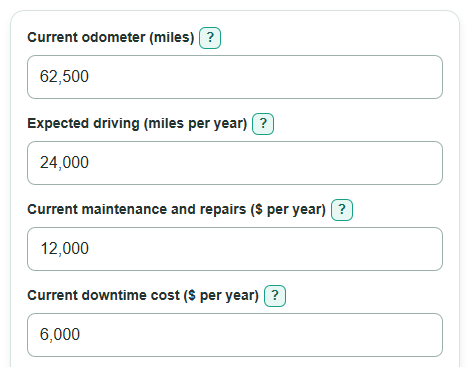
- Enter the Current odometer and Expected driving from the dashboard, telematics, or a recent mileage report.
- Enter annual current and replacement repair and downtime costs. Use yearly totals, not monthly amounts.
- Copy the full quote into Replacement vehicle price and Replacement taxes and fees, then enter Trade-in or resale proceeds as a positive amount.
- Choose the Planning period that matches your budget or replacement plan. Add fixed charges, fuel or electricity cost, and repair growth in Advanced options if they matter to this vehicle.
- Click Calculate. Check that the result uses realistic annual miles and that a positive Keep minus replace cash outlay matches your expectation that replacement saves cash over the period.
Definitions
Break-even month: The first whole month when projected keep cash outlay is at least as high as projected replacement cash outlay.
Net upfront replacement cash: Replacement vehicle price plus Replacement taxes and fees, minus positive Trade-in or resale proceeds.
Downtime cost: The estimated yearly cost when a vehicle is unavailable, such as rental, towing, lost productive work, or labor disruption.
Fixed charges: Time-based yearly costs such as insurance, registration, licensing, telematics, or subscriptions that can continue even when miles are low.
Cash outlay per mile: Projected cash paid during the Planning period divided by expected miles driven in that period.
Common mistakes and quick fixes
Mistake: Entering a monthly loan payment in Replacement vehicle price.
Fix: Enter the full quoted cash price in Replacement vehicle price; this model does not include financing interest.
Mistake: Entering Trade-in or resale proceeds as a negative number.
Fix: Enter Trade-in or resale proceeds as a positive dollar amount. The calculator subtracts it from the replacement cash needed.
Mistake: Combining repair invoices with Current downtime cost.
Fix: Put service and repair spending in Current maintenance and repairs, and put rental, towing, lost work, and disruption costs in Current downtime cost.
Mistake: Using last month's miles for Expected driving.
Fix: Enter a yearly mileage estimate based on the last 12 months or the next year's route plan.
Mistake: Treating a negative Keep minus replace cash outlay as an error.
Fix: A negative Keep minus replace cash outlay means keeping has lower projected cash outlay during the Planning period.
Mistake: Leaving out insurance or fuel when those costs differ between vehicles.
Fix: Add Current fixed charges, Replacement fixed charges, Current fuel or electricity cost, and Replacement fuel or electricity cost in Advanced options.
Limitations & Key Assumptions / Boundary Conditions
- The comparison is a cash-outlay estimate for one vehicle. It does not include financing interest, loan payments, lease terms, income taxes, depreciation, or the replacement vehicle's resale value at the end of the Planning period.
- Annual costs are spread evenly by month. Actual repairs and downtime can arrive in irregular, large events.
- Yearly repair cost growth applies only to Current maintenance and repairs. It does not increase downtime, fixed charges, fuel, or replacement costs.
- Expected driving is assumed to occur evenly through the year, so the Estimated odometer at break-even is a planning trigger rather than a precise future reading.
- A break-even result does not measure safety, service reliability, emissions, capacity, warranty coverage, or customer-impact risk. Consider those factors separately before purchasing.
- Blank Advanced options count as $0 or 0 percent. Add them when they materially differ between the current and replacement vehicles.
Methodology
Cash comparison
The calculator compares future cash paid to keep the current vehicle with cash paid to acquire and operate a replacement. The replacement purchase is treated as an upfront cash flow, while annual operating costs are spread across 12 months.
net upfront replacement cash = replacement vehicle price + replacement taxes and fees - trade-in or resale proceeds
Trade-in or resale proceeds are entered as a positive number. A negative net upfront amount is allowed if proceeds exceed the price and fees.
monthly repair growth = (1 + yearly repair cost growth / 100)^(1 / 12) - 1
keep cash outlay at month m = current repairs / 12 * repair growth factor + m * (current downtime + current fixed charges + current fuel or electricity cost) / 12
replacement cash outlay at month m = net upfront replacement cash + m * (replacement maintenance + replacement downtime + replacement fixed charges + replacement fuel or electricity cost) / 12
Timing and mileage
The calculator checks month 0 first. When trade-in or resale proceeds cover at least the replacement price and fees, it shows Immediate (month 0) at the current odometer. Otherwise it tests each whole month from 1 through the Planning period and shows the first month where keep cash outlay is greater than or equal to replacement cash outlay. If that does not happen, it shows Beyond planning period.
estimated odometer at break-even = current odometer + expected driving * break-even month / 12
keep minus replace cash outlay = projected keep cash outlay - projected replacement cash outlay
A positive Keep minus replace cash outlay means replacement has lower projected cash outlay at the end of the period. A negative amount means keeping has lower projected cash outlay.
Worked example
With a $30,000 replacement vehicle price, $1,000 in fees, and $15,000 in trade-in proceeds, net upfront replacement cash is $16,000. If current annual repairs plus downtime are $18,000 and replacement annual maintenance plus downtime are $2,400, the monthly savings are $1,300. The crossover occurs in month 13. At 24,000 expected miles per year and a 62,500-mile starting odometer, the estimated break-even odometer is 88,500 miles.
Model scope
Annual miles must be greater than zero because the calculator uses them for cash outlay per mile and break-even mileage. The Planning period must be at least one whole month. The model blocks negative costs and negative repair growth, while blank optional Advanced values are treated as zero.