
Compare vented and conditioned attic quotes using your energy-cost estimate, incentives, and planned years in the home.
Table of contents
How to use our Vented vs Conditioned Attic Lifetime Energy Cost Calculator
- Enter Current heating and cooling cost using the usage-based part of your yearly bills or an energy audit estimate; do not include fixed monthly customer charges.
- Choose Years to compare based on how long you expect to own the home or want to evaluate the project.
- Enter each option's estimated energy reduction and full installed project cost from an audit, contractor model, or written quote.
- Open Advanced options to add Vented option incentives, Conditioned option incentives, energy-price growth, or a discount rate if those assumptions fit your plan.
- Check the sign of Conditioned minus vented lifetime cost: a negative amount means the conditioned option costs less under your entries; then confirm the payback status before using the comparison to choose a quote.
Definitions
Vented attic: An attic that is outside the home's conditioned space, usually with insulation and an air boundary at the attic floor. Ventilation is part of this assembly. [1]
Conditioned attic: An unvented attic where the air and insulation boundary is at the roof deck, bringing the attic inside the conditioned enclosure. [2]
Energy cost reduction: The estimated percent change in yearly heating and cooling cost after a project. A negative percentage means the estimate predicts a cost increase.
Net project cost: Installed project cost minus entered incentives. It can be negative if entered incentives are greater than the project cost.
Discount rate: A yearly rate used to express future energy costs in today's dollars.
Lifetime cost: Net project cost paid now plus the calculated energy costs over the selected years. When a discount rate is used, future energy costs are discounted.
Common mistakes and quick fixes
Mistake: Entering the whole electric or gas bill as Current heating and cooling cost.
Fix: Use only the estimated usage-based heating and cooling portion, excluding fixed monthly customer charges.
Mistake: Treating Vented option energy cost reduction and Conditioned option energy cost reduction as guesses with no connection to the quoted scope.
Fix: Use the energy estimate from an audit or contractor model for each specific project, including duct effects when ducts are in the attic.
Mistake: Entering a rebate for both Vented option incentives and Conditioned option incentives.
Fix: Put each rebate or tax credit only with the project that qualifies for it.
Mistake: Reading a positive Conditioned minus vented lifetime cost as savings.
Fix: A positive amount means the conditioned option costs more; a negative amount means it costs less.
Mistake: Assuming a lower Conditioned attic yearly energy cost proves the project pays back.
Fix: Check Conditioned option pays back within selected years because its higher project cost may not be recovered during Years to compare.
Mistake: Using 1,01 or another malformed comma pattern in Vented attic project cost.
Fix: Use normal thousands commas such as 1,000, or use a decimal point for cents.
Limitations & Key Assumptions / Boundary Conditions
- This is a financial scenario comparison, not a whole-house building-energy simulation or a ventilation-sizing tool.
- Energy reductions are entered estimates. Results can differ because of climate, house shape, air leakage, insulation details, HVAC efficiency, thermostat settings, duct location, and workmanship.
- Use a conditioned-attic estimate only for the actual proposed unvented roof-deck assembly. Supplying air to a vented attic does not make it a conditioned attic.
- Only usage-based heating and cooling costs belong in Current heating and cooling cost. Fixed utility charges usually do not change after attic work.
- Project costs include only what you enter. Financing charges, maintenance, roof work, permit costs, insurance effects, and future replacements are excluded unless already included in the quotes.
- Incentives are treated as one-time offsets paid now. Confirm eligibility, filing rules, and timing before counting a rebate or tax credit.
- Yearly energy-price increase and Discount rate are planning assumptions, not predictions. Results can change substantially when either assumption changes.
Methodology
Calculation method
The calculator starts with the entered yearly heating and cooling cost and applies a separate energy-cost reduction to each attic option. Project cost and incentives stay separate from yearly energy costs.
Vented yearly energy cost = Current heating and cooling cost x (1 - Vented option energy cost reduction / 100)
Conditioned yearly energy cost = Current heating and cooling cost x (1 - Conditioned option energy cost reduction / 100)
Vented net project cost = Vented attic project cost - Vented option incentives
Conditioned net project cost = Conditioned attic project cost - Conditioned option incentives
For each future year, the energy cost grows by the entered Yearly energy-price increase and is discounted by the entered Discount rate. Energy costs are treated as occurring at the end of each year.
Present-value ratio = (1 + energy-price increase / 100) / (1 + discount rate / 100)
Lifetime energy factor = [1 / (1 + discount rate / 100)] x [1 - (present-value ratio ^ years)] / [1 - present-value ratio]
When the present-value ratio equals 1, the calculator uses the first-year present-value factor multiplied by Years to compare. This avoids dividing by zero.
Vented attic lifetime cost = Vented net project cost + Vented yearly energy cost x lifetime energy factor
Conditioned attic lifetime cost = Conditioned net project cost + Conditioned yearly energy cost x lifetime energy factor
Conditioned minus vented lifetime cost = Conditioned attic lifetime cost - Vented attic lifetime cost
Worked example
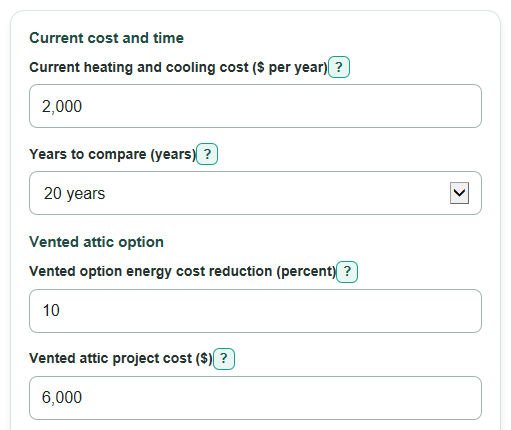
With a current cost of $2,000 per year, 20 years, a 10% vented reduction, and a 25% conditioned reduction, the yearly energy costs are $1,800 and $1,500. If energy-price increase and Discount rate are both 0%, the 20-year energy totals are $36,000 and $30,000. With net project costs of $5,000 for vented and $13,000 for conditioned, lifetime costs are $41,000 and $43,000. The gap is $2,000, so the conditioned option does not pay back within 20 years in this example.
Assumptions and limits
Equal energy-price growth and the same discount rate are applied to both options. The comparison does not estimate energy reductions, verify incentive eligibility, or add costs that were not entered. A negative lifetime-cost gap means the conditioned option is lower cost; a positive gap means the vented option is lower cost.