
Compare your two window quotes to estimate the extra triple-pane price, yearly heating savings, and simple payback.
Table of contents
How to use our Double-Pane vs Triple-Pane Window Payback Calculator
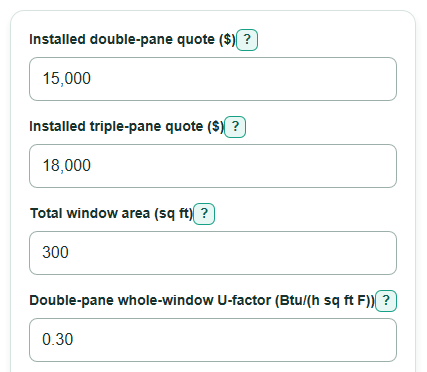
- Enter the full project totals from each quote in Installed double-pane quote and Installed triple-pane quote. Use quotes with the same window count, labor, permits, trim, disposal, and tax scope.
- Enter Total window area from the contractor's window schedule or add the area of every window in the project.
- Copy the whole-window ratings for each exact product into Double-pane whole-window U-factor and Triple-pane whole-window U-factor, then enter a local yearly Heating degree days for one year value.
- Enter Delivered heating cost using your usage-based energy rate and heating equipment performance. Leave out fixed utility account charges.
- Calculate and check that Estimated yearly heating savings is positive and that Triple-pane price difference matches the gap between your quotes. A negative savings value means the entered triple-pane U-factor is worse for heating.
Definitions
Whole-window U-factor: A measure of how quickly heat passes through the complete window, including glass and frame. It is measured in Btu/(h sq ft F); a lower value means less heat flow. [2]
Heating degree days: A yearly measure of how much outdoor temperatures create a need for heating. The calculator uses F-days per year.
Delivered heating cost: The cost of one million Btu of useful heat inside the home after heating-equipment performance is considered. It should use variable energy charges, not fixed account fees.
Triple-pane price difference: Installed triple-pane quote minus Installed double-pane quote. A negative amount means triple-pane costs less in the entered quotes.
Simple payback: The extra upfront price divided by estimated yearly heating savings. It does not include financing, future energy-price changes, or other window benefits.
Common mistakes and quick fixes
Mistake: Using only the window unit price in Installed double-pane quote or Installed triple-pane quote.
Fix: Enter each full installed project total, including applicable labor, permits, trim, disposal, and taxes.
Mistake: Using a center-of-glass rating for Double-pane whole-window U-factor or Triple-pane whole-window U-factor.
Fix: Use the whole-window U-factor from the NFRC label, product sheet, or quote for the exact package.
Mistake: Treating Heating degree days for one year as the number of days the heating system runs.
Fix: Enter the annual F-days value from a local climate reference, using the temperature base reported by that source.
Mistake: Including a fixed monthly customer charge in Delivered heating cost.
Fix: Use only charges that change when energy use changes, converted to $ per million Btu of useful heat.
Mistake: Reading a negative Triple-pane price difference as an error.
Fix: It means the triple-pane quote is lower. If Estimated yearly heating savings is positive too, Estimated triple-pane payback is immediate.
Limitations & Key Assumptions / Boundary Conditions
- This is a heating-only seasonal estimate. It excludes cooling energy, solar heat gain, shading, orientation, and window solar heat gain coefficient.
- The model estimates heat flow through the entered window area. It does not model air leakage, installation gaps, thermal bridging, window coverings, or occupant thermostat choices.
- Results depend on using whole-window U-factors for the exact quoted products. Pane count alone does not determine U-factor.
- Delivered heating cost must match the home's fuel and heating equipment. The $53.08 default is a US electric-resistance planning estimate, not a local utility quote.
- Simple payback is unavailable when Estimated yearly heating savings is zero or negative. A financial decision can still include comfort, condensation, noise, durability, and home-value considerations that this calculation does not price.
Methodology
Calculation
The calculator first keeps the quote difference signed, so a lower triple-pane quote remains a negative price difference.
price difference = installed triple-pane quote - installed double-pane quote
It estimates the annual reduction in heating energy from the difference between the two whole-window U-factors. The factor 24 converts heating degree days to degree-hours.
heat reduction in Btu/year = 24 * window area * (double-pane U-factor - triple-pane U-factor) * heating degree days
heat reduction in million Btu/year = heat reduction in Btu/year / 1000000
Yearly heating savings multiply the unrounded energy reduction by Delivered heating cost.
yearly heating savings = heat reduction in million Btu/year * delivered heating cost
simple payback in years = price difference / yearly heating savings
The payback formula is used only when yearly heating savings and the price difference are both positive. If savings are positive and triple-pane costs the same or less, payback is shown as 0 years. If savings are zero or negative, no heating-only payback is shown.
Worked example
With 300 sq ft of windows, U-factors of 0.30 and 0.20, and 5,000 heating degree days, the estimated heat reduction is 3.6 million Btu per year. At $53.08 per million Btu, yearly heating savings are $191.09. A $3,000 triple-pane price difference gives a simple payback of about 15.70 years.
The default Delivered heating cost of $53.08 per million Btu is a planning estimate for electric-resistance heat. It uses 18.11 cents per kWh and 293.07107 kWh per million Btu; replace it with a value based on your utility rate and heating system. [1]