
Estimate boiler replacement payback, yearly fuel savings, and 15-year net savings using your fuel cost, efficiencies, price, and rebate.
Table of contents
How to use our Boiler Replacement Savings Calculator
- Enter your Current yearly boiler fuel cost, using only the heating part of the bill if you can separate it.
- Enter Current boiler efficiency and New boiler efficiency as percent values from a label, service report, quote, or product sheet.
- Enter the full Installed replacement cost, then enter any known Rebate or tax credit you expect to use.
- Click Calculate and read Payback time after rebates first, then compare it with Estimated 15-year net savings after rebates.
- Sanity-check the output: if Estimated yearly fuel cost with new boiler is higher than your current fuel cost, recheck the efficiency entries.
Definitions
Current yearly boiler fuel cost: The amount you spend each year on fuel used by the boiler for heat.
Boiler efficiency: The percent of fuel energy that becomes usable heat. AFUE is a common yearly efficiency rating for home heating equipment.
Installed replacement cost: The total price to replace the boiler, including the equipment and required installation work.
Rebate or tax credit: Money you expect to get back or subtract from taxes for the boiler project. The calculator uses only the amount you enter.
Payback time after rebates: The number of years it takes estimated yearly fuel savings to recover the net upfront cost after the entered incentive.
Estimated 15-year net savings after rebates: Fifteen years of estimated fuel savings minus the net upfront cost after the entered incentive.
Common mistakes and quick fixes
Mistake: Entering the full household utility bill in Current yearly boiler fuel cost when the boiler is only part of that bill.
Fix: Use the heating portion if you can, or use your best yearly boiler-only estimate.
Mistake: Typing 0, a negative number, or more than 100 in Current boiler efficiency or New boiler efficiency .
Fix: Enter a percent from more than 0 through 100, such as 70 or 95.
Mistake: Leaving labor, permits, venting, or disposal out of Installed replacement cost .
Fix: Use the total installed quote, not just the boiler equipment price.
Mistake: Entering a possible incentive in Rebate or tax credit before you know you can use it.
Fix: Enter only the amount you reasonably expect to receive, or enter 0.
Mistake: Reading Payback time after rebates as a promise about the exact month you will break even.
Fix: Treat it as a simple estimate based on fuel savings only, then compare bids and local fuel prices.
Limitations & Key Assumptions / Boundary Conditions
- The calculation assumes the home needs the same amount of useful heat before and after replacement.
- Fuel prices are held constant. Rising or falling gas, oil, or propane prices can change the savings.
- The 15-year view is a fixed comparison period, not a promise that a boiler will last exactly 15 years.
- Maintenance, repair changes, financing costs, comfort changes, and resale value are not included.
- Efficiency values are treated as percent ratings. Real fuel use can differ because of sizing, controls, venting, weather, and installation quality.
- The Rebate or tax credit field does not check eligibility. Confirm program rules, tax limits, and timing before relying on an incentive amount.
Methodology
Calculation steps
The calculator first estimates the new yearly fuel cost by keeping the same useful heat demand and changing only boiler efficiency.
estimated_new_annual_fuel_cost = current_annual_fuel_cost * (old_efficiency_percent / new_efficiency_percent)
It then subtracts the estimated new fuel cost from the current fuel cost.
annual_fuel_savings = current_annual_fuel_cost - estimated_new_annual_fuel_cost
The net upfront cost uses the installed price minus the rebate or tax credit amount entered by the user. The IRS has separate rules for energy efficient home improvement credits, so this calculator does not decide eligibility or amounts [1].
net_upfront_cost_after_incentives = installed_cost - incentive_amount
Simple payback divides net upfront cost by yearly fuel savings. This is a common screening method for energy upgrades because it shows how long savings take to recover cost [2].
if annual_fuel_savings > 0 and net_upfront_cost_after_incentives > 0, simple_payback_after_incentives = net_upfront_cost_after_incentives / annual_fuel_savings
if annual_fuel_savings > 0 and net_upfront_cost_after_incentives <= 0, simple_payback_after_incentives = 0
if annual_fuel_savings <= 0, simple_payback_after_incentives is not available
The 15-year net savings number uses a fixed 15-year comparison period.
net_savings_15_years_after_incentives = (annual_fuel_savings * 15) - net_upfront_cost_after_incentives
Mini-example
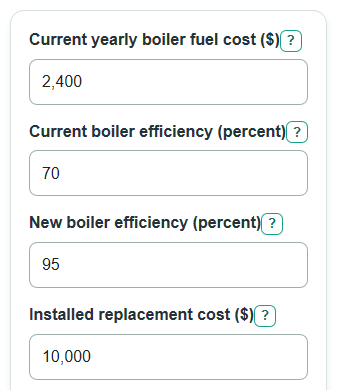
If the current yearly boiler fuel cost is $2,400, current efficiency is 70%, new efficiency is 95%, installed cost is $10,000, and the rebate or tax credit is $2,000, the estimated new yearly fuel cost is $2,400 * (70 / 95), or about $1,768.
The estimated yearly fuel savings is about $632. Net upfront cost after rebates is $8,000. Payback time after rebates is $8,000 / $632, or about 12.7 years. Estimated 15-year net savings after rebates is about $1,474.