
Estimate how long your battery can run a furnace blower, including inverter losses, usable battery share, and blower cycling.
Table of contents
How to use our Furnace Blower Battery Backup Runtime Calculator
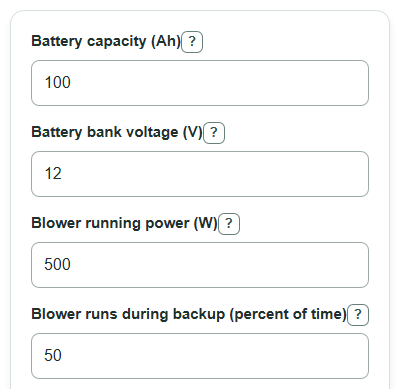
- Enter Battery capacity and Battery bank voltage from the battery bank label or setup, not from one battery if several are wired together.
- Enter Blower running power using measured running watts when possible; do not enter the short startup surge power.
- Set Blower runs during backup to the percent of time the blower is actually on, such as 50 for half the time or 100 for nonstop fan use.
- Open Advanced options if you want to change Inverter efficiency, Usable battery share, or Control board and small loads.
- After you calculate, compare Backup time with blower cycling with Backup time if blower ran nonstop; a huge gap usually means the run percent is the number to double-check first.
Definitions
Battery capacity: The battery bank size in amp-hours (Ah). Amp-hours describe how much electric charge the battery can store at the battery bank voltage.
Battery bank voltage: The voltage of the whole battery setup feeding the inverter, such as 12 V, 24 V, or 48 V.
Blower running power: The watts used while the blower is already running. This is different from the short startup surge.
Blower runs during backup: The percent of backup time when the blower is on. A 50 percent setting means the blower is on half the time.
Inverter efficiency: The percent of battery energy that becomes usable AC power after inverter losses.
Usable battery share: The percent of the battery capacity you plan to use before stopping, leaving a reserve or following battery limits.
Control board and small loads: Always-on watts from the furnace control board, thermostat power, or other small loads on the same backup.
Average power while cycling: The steady average load used for the cycling estimate: control board watts plus the blower's running watts multiplied by its on-time percent.
Common mistakes and quick fixes
Mistake: Entering startup surge in Blower running power.
Fix: Use running watts for Blower running power, and treat surge as a separate inverter and battery limit check.
Mistake: Using one battery's voltage for Battery bank voltage when the bank is wired for a higher voltage.
Fix: Enter the full Battery bank voltage for the battery bank that feeds the inverter.
Mistake: Setting Blower runs during backup to 100 when the blower cycles on and off.
Fix: Estimate the on-time percent for Blower runs during backup, then use Backup time if blower ran nonstop as the conservative comparison.
Mistake: Leaving Control board and small loads at 0 when the same backup also powers the furnace board, thermostat, or a small transformer load.
Fix: Add those always-on watts to Control board and small loads so Average power while cycling is not too low.
Mistake: Entering 100 for Usable battery share just because Battery capacity is printed on the label.
Fix: Use the Usable battery share you are willing and allowed to use, based on your battery type, battery settings, and reserve plan.
Mistake: Reading Extra time compared with nonstop blower as guaranteed extra heat time.
Fix: Treat Extra time compared with nonstop blower as a cycling math comparison, not a promise that the furnace will always cycle the same way.
Limitations & Key Assumptions / Boundary Conditions
- The estimate is runtime math only. It does not prove the inverter, battery management system, wiring, or battery can handle motor startup surge.
- Battery capacity can be lower in cold rooms, with older batteries, at high discharge rates, or when manufacturer limits reduce usable energy.
- Blower Runs During Backup is an estimate. Furnace cycle length changes with outdoor temperature, thermostat settings, duct restrictions, and fan settings.
- Blower running power should be measured or taken from reliable equipment data. Nameplate values can differ from real running watts.
- Inverter efficiency is treated as one fixed percent, but real efficiency can change with load size and inverter model.
- Control board and small loads are treated as constant watts during the whole backup period.
- The formulas use DC battery energy converted to estimated AC energy. They do not model charging, generator support, solar input, or voltage cutoff behavior over time.
Methodology
Energy and load math
The calculator starts with battery energy, then adjusts it for Usable battery share and Inverter efficiency. It then divides that usable energy by the average furnace load.
battery_wh = battery_capacity_ah * battery_voltage_v
usable_battery_energy_wh = battery_wh * (usable_battery_percent / 100) * (inverter_efficiency_percent / 100)
average_load_w = control_board_w + blower_running_w * (blower_run_percent / 100)
runtime_with_cycling_hours = usable_battery_energy_wh / average_load_w
runtime_if_blower_nonstop_hours = usable_battery_energy_wh / (control_board_w + blower_running_w)
extra_runtime_from_cycling_hours = runtime_with_cycling_hours - runtime_if_blower_nonstop_hours
Mini example
For Battery capacity of 100 Ah, Battery bank voltage of 12 V, Blower running power of 500 W, Blower runs during backup of 50 percent, Inverter efficiency of 90 percent, Usable battery share of 80 percent, and Control board and small loads of 0 W, battery energy is 1,200 Wh and Usable battery energy after settings is 864 Wh.
Average power while cycling is 250 W. Backup time with blower cycling is 864 / 250 = 3.456 hours, or about 3.46 hours. Backup time if blower ran nonstop is 864 / 500 = 1.728 hours, so Extra time compared with nonstop blower is 1.728 hours.
Validation choices
Battery capacity, Battery bank voltage, Blower running power, Inverter efficiency, and Usable battery share must be greater than 0. Percent settings cannot be below 0 or above 100. Control board and small loads can be 0, but not negative. If Average power while cycling would be 0, the calculator stops instead of dividing by zero.