
Compare Roth, Traditional, and mixed 401(k) contributions by after-tax retirement wealth using your tax rates and time horizon.
Advanced options
Table of contents
How to use our Roth vs Traditional 401(k) Calculator
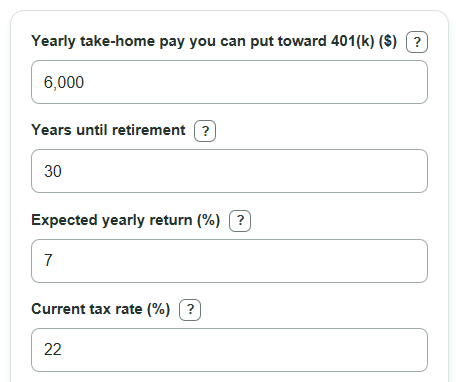
- Enter the Yearly take-home pay you can put toward 401(k), which means the yearly amount you can spare from your paycheck after taxes.
- Enter Years until retirement, Expected yearly return, Current tax rate, and Retirement tax rate. Tax rate means the percent of the next dollar that goes to tax.
- Open Advanced options if you want to change Roth share for mixed plan or add a Yearly employer match.
- Select Calculate and read Highest after-tax retirement wealth first, then compare Mixed plan after-tax retirement wealth with All Roth after-tax retirement wealth and All Traditional after-tax retirement wealth.
- Sanity-check the output: if Break-even retirement tax rate is close to your Retirement tax rate, small changes in tax assumptions can change which choice looks best.
Definitions
Roth 401(k): Employee contributions are made after tax in this calculator, so the employee Roth balance is treated as tax-free at retirement.
Traditional 401(k): Employee contributions are made before tax in this calculator, so the balance is taxed when withdrawn in retirement.
Take-home pay cost: The amount of current paycheck money you give up. This calculator keeps that cost the same when comparing Roth and Traditional.
Current tax rate: The percent of your next taxable dollar that would go to tax today. This is often called a marginal tax rate.
Retirement tax rate: The estimated percent paid in tax on Traditional 401(k) withdrawals in retirement.
Roth share for mixed plan: The percent of the mixed plan's take-home budget that goes to Roth. The rest goes to Traditional.
Break-even retirement tax rate: The retirement tax rate where all Roth and all Traditional produce the same after-tax retirement wealth under this same-cost method.
Common mistakes and quick fixes
Mistake: Using a gross salary number for Yearly take-home pay you can put toward 401(k).
Fix: Enter the yearly after-tax amount you can actually give up from your paycheck.
Mistake: Treating Current tax rate as your average tax rate for the whole year.
Fix: Use the tax rate on your next dollar of income, because that is the rate used to size the Traditional contribution.
Mistake: Entering 100 for Current tax rate or Retirement tax rate.
Fix: Enter a rate from 0 to less than 100, such as 22 or 24.
Mistake: Using a short-term market guess for Expected yearly return.
Fix: Use a long-run average estimate for the whole Years until retirement period, and test a lower return if the result looks too high.
Mistake: Forgetting that Yearly employer match is treated as pre-tax money in the calculator.
Fix: Enter only the match dollars you expect each year, and remember that the match is taxed at the Retirement tax rate in all scenarios.
Mistake: Reading Mixed plan gap from the best choice as an error when it is negative.
Fix: A negative value is allowed. It shows how far the mixed plan is below the best scenario.
Limitations & Key Assumptions / Boundary Conditions
- The calculator uses one Current tax rate and one Retirement tax rate. Real tax returns can have brackets, deductions, credits, state taxes, and local taxes.
- It assumes yearly contributions are made at the end of each year and grow at the same Expected yearly return every year.
- It does not enforce 401(k) contribution limits, catch-up rules, income limits, plan rules, vesting schedules, fees, loans, penalties, or required minimum distribution rules.
- Employer match is treated as pre-tax money taxed at the Retirement tax rate, even when employee contributions go to Roth.
- Inflation is not separated from investment return. If you use a return after inflation, read the dollar results as inflation-adjusted dollars.
- The output is a planning comparison, not tax advice. A real Roth or Traditional choice can also depend on cash flow, future law changes, and account withdrawal order.
Methodology
Same paycheck cost method
The calculator compares choices using the same yearly take-home pay cost. A Roth employee contribution uses the entered Yearly take-home pay you can put toward 401(k). A Traditional employee contribution is larger because the current tax break lets the same paycheck cost buy more pre-tax contribution.
Growth formula
Percent inputs are first divided by 100 to make decimal rates.
annual_return_rate = expected_annual_return_percent / 100
current_tax_rate = current_tax_rate_percent / 100
retirement_tax_rate = retirement_tax_rate_percent / 100
Yearly contributions are treated as an ordinary annuity, meaning one contribution at the end of each year.
fv_factor = years if annual_return_rate = 0
fv_factor = ((1 + annual_return_rate) ^ years - 1) / annual_return_rate if annual_return_rate is not 0
Scenario formulas
All Roth uses after-tax employee contributions, plus any employer match after retirement tax.
all_roth_after_tax_wealth = annual_take_home_budget * fv_factor + annual_employer_match * fv_factor * (1 - retirement_tax_rate)
All Traditional increases the employee contribution so the paycheck cost matches the Roth case, then taxes the retirement withdrawal.
traditional_employee_contribution = annual_take_home_budget / (1 - current_tax_rate)
all_traditional_after_tax_wealth = (traditional_employee_contribution + annual_employer_match) * fv_factor * (1 - retirement_tax_rate)
The mixed plan sends the chosen Roth share to Roth and the rest to Traditional, still using the same take-home pay cost.
roth_share = roth_share_percent / 100
mixed_traditional_contribution = annual_take_home_budget * (1 - roth_share) / (1 - current_tax_rate)
mixed_plan_after_tax_wealth = annual_take_home_budget * roth_share * fv_factor + (mixed_traditional_contribution + annual_employer_match) * fv_factor * (1 - retirement_tax_rate)
Comparison outputs
The highest after-tax retirement wealth is the largest value among the all Roth, all Traditional, and mixed plan results. The mixed plan gap is not clamped to zero, so a negative value shows how much the mixed plan trails the best scenario.
mixed_plan_gap_from_best = mixed_plan_after_tax_wealth - max(all_roth_after_tax_wealth, all_traditional_after_tax_wealth, mixed_plan_after_tax_wealth)
after_tax_advantage_of_best_over_second = largest_scenario_value - second_largest_scenario_value
Under this same-cost method, all Roth and all Traditional break even when the retirement tax rate equals the current tax rate.
break_even_retirement_tax_rate = current_tax_rate_percent
The first-year tax cut from the mixed plan comes only from the Traditional part.
first_year_mixed_tax_cut = mixed_traditional_contribution * current_tax_rate
Mini-example
Suppose Yearly take-home pay you can put toward 401(k) is $6,000, Years until retirement is 30, Expected yearly return is 7%, Current tax rate is 22%, Retirement tax rate is 12%, Roth share for mixed plan is 50%, and Yearly employer match is $0. The future value factor is about 94.4608. All Roth after-tax retirement wealth is $566,764.72. All Traditional after-tax retirement wealth is $639,426.86. Mixed plan after-tax retirement wealth is $603,095.79, so the mixed plan gap from the best choice is -$36,331.07.
Assumptions used
The method uses constant annual returns, constant tax rates, end-of-year contributions, and a simple pre-tax treatment for employer match. It does not model annual IRS limits, salary changes, fees, penalties, state taxes, or changing tax law.