
Compare two business line of credit offers to estimate interest, origination fees, monthly payments, and which offer costs less.
Offer A
Offer B
Offer A payment details
Offer B payment details
Table of contents
How to use our Business Line of Credit Calculator
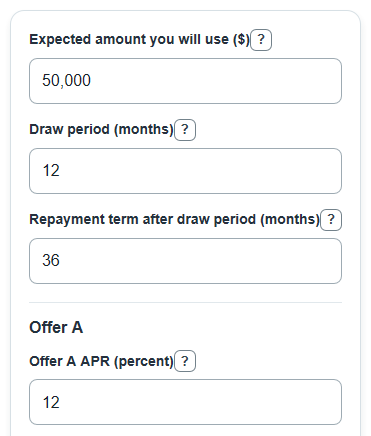
- Enter the Expected amount you will use, which is the amount you expect to borrow, not the full credit limit unless you plan to use it all.
- Enter the Draw period and Repayment term after draw period in months so both offers use the same borrowing timeline.
- Enter Offer A APR, Offer A origination fee, Offer B APR, and Offer B origination fee as percentages.
- Select Calculate, then read Offer B cost compared with Offer A first. A negative number means Offer B costs less, and a positive number means Offer B costs more.
- Sanity-check the output by comparing the Lower estimated cost offer with Offer A interest and fees and Offer B interest and fees. A lower APR can still lose if the fee is high.
Definitions
Business line of credit: A borrowing account that lets a business use money up to a limit, repay it, and often borrow again, subject to the lender's rules [2].
APR: Annual percentage rate. It is the yearly rate used here to estimate monthly interest [1].
Draw period: The months when this estimate assumes you have the borrowed amount outstanding and pay interest only.
Repayment term after draw period: The months used to pay the borrowed balance back with fixed monthly payments.
Origination fee: A fee charged to set up the credit. This calculator applies the fee percent to Expected amount you will use.
Interest-only payment: A payment that covers interest for the month but does not reduce the borrowed balance.
Offer B cost compared with Offer A: Offer B interest and fees minus Offer A interest and fees. Negative means Offer B is cheaper; positive means Offer B is more expensive.
Common mistakes and quick fixes
Mistake: Entering the full credit limit in Expected amount you will use when you only plan to draw part of the line.
Fix: Use the amount you expect to borrow, because the interest and fees are based on Expected amount you will use.
Mistake: Typing years into Draw period or Repayment term after draw period.
Fix: Convert years to months before calculating, such as 3 years = 36 months for Repayment term after draw period.
Mistake: Putting a monthly rate into Offer A APR or Offer B APR.
Fix: Enter the yearly APR percent shown in the offer, not the monthly rate.
Mistake: Leaving Offer A origination fee or Offer B origination fee blank because the fee is 0 percent.
Fix: Enter 0 for the origination fee percent if that offer has no origination fee.
Mistake: Treating Offer B cost compared with Offer A as total dollars repaid.
Fix: Read it as the difference in interest and fees only; use Offer A total paid including principal and Offer B total paid including principal for principal-included totals.
Limitations & Key Assumptions / Boundary Conditions
- This is a cost estimate, not a credit approval estimate, loan offer, tax advice, or legal advice.
- The model assumes one starting borrowed amount, a constant balance during the draw period, interest-only draw payments, and fixed repayment payments after the draw period.
- It does not model multiple draws, extra principal payments, missed payments, compounding fee rules, annual fees, maintenance fees, late fees, prepayment fees, or variable-rate changes.
- APR is split into 12 equal monthly periods. A lender may calculate interest daily or use a different billing method.
- Origination fee is applied to Expected amount you will use, not to the full approved credit limit.
- Offer A and Offer B are compared over the same amount, draw period, and repayment term. If the real offers have different draw rules or required payments, the comparison can change.
Methodology
How the estimate is calculated
For each offer, the calculator turns APR into a monthly rate, estimates interest-only payments during the draw period, then estimates a fixed monthly payment for the repayment term. It then adds total interest and the origination fee. Principal is left out of the main cost comparison because both offers use the same Expected amount you will use.
monthly_rate = apr_percent / 100 / 12
interest_only_payment = amount_drawn * monthly_rate
draw_interest = interest_only_payment * draw_period_months
if monthly_rate = 0, repayment_payment = amount_drawn / repayment_term_months
otherwise repayment_payment = amount_drawn * monthly_rate / (1 - (1 + monthly_rate)^(-repayment_term_months))
repayment_interest = repayment_payment * repayment_term_months - amount_drawn
origination_fee = amount_drawn * origination_fee_percent / 100
total_cost = draw_interest + repayment_interest + origination_fee
cost_difference_b_minus_a = offer_b_total_cost - offer_a_total_cost
Mini example
Suppose the business expects to use $10,000, the draw period is 2 months, and repayment is 1 month. Offer A has a 12% APR and a 1% origination fee. Offer B has a 6% APR and a 2% origination fee. Offer A has a $100 monthly interest-only payment, $200 of draw-period interest, a $10,100 repayment payment, $300 total interest, and a $100 fee, so Offer A interest and fees are $400. Offer B has a $50 monthly interest-only payment, $100 of draw-period interest, a $10,050 repayment payment, $150 total interest, and a $200 fee, so Offer B interest and fees are $350.
cost_difference_b_minus_a = 350 - 400 = -50
The negative $50 means Offer B is estimated to cost $50 less in interest and fees, even though its origination fee is higher.