
Compare estimated maximum Solo 401(k) and SEP IRA contributions using your tax year, business type, age, and income.
Table of contents
How to use our Solo 401(k) vs SEP IRA Calculator
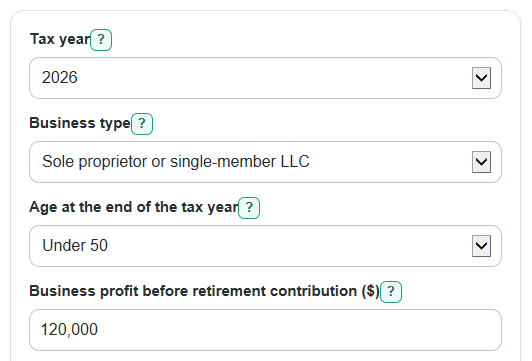
- Choose the Tax year, Business type, and Age at the end of the tax year.
- Enter only the income field that matches your business type: Business profit before retirement contribution ($) for sole proprietor mode, or Owner W-2 wages from this business ($) for corporation mode.
- Open Advanced options if you already made Employee 401(k)-type contributions made at another job ($), or if you need to change Use the age 60 to 63 higher catch-up if allowed.
- Click Calculate, then compare Estimated Solo 401(k) maximum, Estimated SEP IRA maximum, and How much more the Solo 401(k) allows.
- Sanity-check the result: if income is low, the total should not be higher than the income base; if other-job deferrals are high, the Solo 401(k) employee part should shrink or become $0.
Definitions
Solo 401(k): A retirement plan for a business owner with no common-law employees other than a spouse. It can include an employee elective deferral and an employer contribution.
SEP IRA: A retirement plan funded with employer contributions. For this comparison, it has no employee deferral and no catch-up contribution.
Employee elective deferral: The amount you choose to put into a 401(k)-type plan from your own pay or self-employment income. This limit is shared across jobs for the same person.
Employer contribution: The business contribution part. In this calculator, it is based on adjusted earnings for a sole proprietor or owner W-2 wages for a corporation owner.
Catch-up contribution: An extra Solo 401(k) employee amount allowed at age 50 or older when the plan allows it. SEP IRAs do not use catch-up contributions.
Adjusted earnings: For sole proprietor mode, this is business profit minus the estimated deduction for one-half of self-employment tax.
Annual additions limit: The yearly cap on regular defined contribution plan additions before catch-up contributions. The calculator uses the selected tax year's limit.
Compensation cap: The highest amount of compensation the calculator uses for the employer contribution formula in corporation mode.
Common mistakes and quick fixes
Mistake: Entering total sales in Business profit before retirement contribution ($) instead of profit after business expenses.
Fix: Use net business profit before subtracting your own Solo 401(k) or SEP IRA contribution.
Mistake: Using total corporate profit in Owner W-2 wages from this business ($) .
Fix: Enter the owner's W-2 wages paid by the S corporation or C corporation, not the company's profit.
Mistake: Leaving Employee 401(k)-type contributions made at another job ($) at $0 when you already deferred pay into another plan this year.
Fix: Enter your employee elective deferrals from the other job, but do not include employer match.
Mistake: Choosing the wrong Age at the end of the tax year and getting the wrong catch-up amount.
Fix: Use your age on December 31 of the selected tax year.
Mistake: Setting Use the age 60 to 63 higher catch-up if allowed to Yes when your plan does not allow the higher catch-up.
Fix: Choose No unless the plan terms allow that higher age 60 to 63 catch-up.
Mistake: Comparing only Estimated Solo 401(k) maximum and ignoring Solo 401(k) employee part .
Fix: Check the employee part separately if you have another job, because that deferral limit is shared across plans.
Limitations & Key Assumptions / Boundary Conditions
- This is an estimate, not tax advice. Plan documents, payroll setup, deadlines, employee status, and tax filing details can change what you can actually contribute.
- Sole proprietor results use a simplified self-employment tax estimate. It uses the 92.35% factor, Social Security part, and Medicare part, but it excludes Additional Medicare Tax and other Schedule SE details.
- The calculator assumes the business has no eligible employees who would require plan coverage or employer contributions.
- The Solo 401(k) employee deferral limit is reduced by Employee 401(k)-type contributions made at another job ($). Employer match from another job should not be entered there.
- The age 60 to 63 higher catch-up is used only when Use the age 60 to 63 higher catch-up if allowed is set to Yes. Your plan must allow it for the estimate to fit your plan.
- Corporation mode uses Owner W-2 wages from this business ($). It does not test reasonable compensation rules or corporate tax deductions.
- The comparison only estimates maximum contribution room. It does not compare Roth options, loans, paperwork, plan costs, filing requirements, or investment choices.
Methodology
How the comparison is calculated
The calculator first picks the limits for the selected Tax year. It then uses the selected Business type to choose the income base. Sole proprietor mode uses business profit adjusted for estimated self-employment tax. Corporation mode uses owner W-2 wages.
se_tax = min(0.9235 * profit, social_security_wage_base) * 0.124 + (0.9235 * profit) * 0.029
adjusted_earnings = max(0, profit - se_tax / 2)
For a self-employed owner's employer contribution, a stated 25% plan rate becomes a 20% reduced rate because the owner's contribution is calculated from income after the contribution. The calculation is 0.25 divided by 1.25, which equals 0.20.
reduced_rate = 0.25 / (1 + 0.25) = 0.20
SEP IRA estimate
For a sole proprietor, the SEP IRA estimate is 20% of adjusted earnings, limited by the selected year's annual additions limit and available adjusted earnings. For a corporation owner, it is 25% of owner W-2 wages after applying the compensation cap, limited by the annual additions limit and wages.
sole proprietor sep_total = min(adjusted_earnings * 0.20, annual_additions_limit, max(0, adjusted_earnings))
corporation sep_total = min(min(owner_w2_wages, compensation_cap) * 0.25, annual_additions_limit, owner_w2_wages)
Solo 401(k) estimate
The Solo 401(k) estimate adds an employee part and an employer part. The employee part is reduced by Employee 401(k)-type contributions made at another job ($), because employee elective deferrals are limited across plans for the same person [2].
solo_employee_deferral = min(compensation_base, max(0, base_deferral_limit + catchup_limit - other_plan_deferrals))
Regular employee deferrals count against the annual additions limit, but catch-up contributions are handled separately. The calculator tracks the regular employee piece before finding employer contribution room.
solo_regular_employee_deferral = min(solo_employee_deferral, max(0, base_deferral_limit - min(other_plan_deferrals, base_deferral_limit)))
The employer part is then limited by the employer formula amount, remaining annual additions room, and remaining compensation after the employee part. For a sole proprietor, the employer formula amount is 20% of adjusted earnings. For a corporation owner, it is 25% of capped owner W-2 wages.
solo_employer_contribution = min(employer_rate_base, max(0, annual_additions_limit - solo_regular_employee_deferral), max(0, compensation_base - solo_employee_deferral))
solo_total = solo_employee_deferral + solo_employer_contribution
solo_advantage = solo_total - sep_total
Worked mini-example
For 2026, a sole proprietor under age 50 with $120,000 of business profit and $0 of other job deferrals has estimated self-employment tax of $16,955.46, so the estimated half self-employment tax deduction is $8,477.73. Adjusted earnings are $111,522.27. The SEP IRA estimate is 20% of that amount, or $22,304.45. The Solo 401(k) employee part is $24,500, and the employer part is $22,304.45, so the estimated Solo 401(k) maximum is $46,804.45. The Solo 401(k) advantage is $24,500.