
Enter your balance, APR, fixed payment, and first payment date to estimate payoff time, interest cost, and small payment increase savings.
Table of contents
How to use our Credit Card Payoff with Fixed Payment Calculator
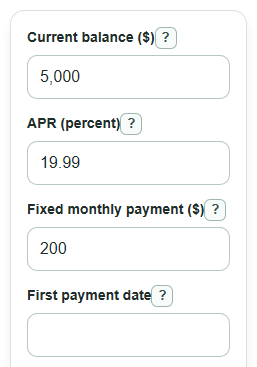
- Enter Current balance ($) as the amount you owe today, not the amount you might owe after future purchases.
- Enter APR (percent) from your card statement and Fixed monthly payment ($) as the same payment you plan to make each month.
- Choose First payment date so the calculator can estimate the payoff month.
- Select Calculate, then read Time to pay off, Total interest paid, Total paid, and If you paid a little more.
- Sanity-check the result by comparing First-month interest with Fixed monthly payment ($); if interest takes most of the payment or Payment check warns you, the balance will shrink slowly or not at all.
Definitions
Current balance ($): The credit card balance you want to pay off before adding any future purchases.
APR (percent): Annual percentage rate, the yearly interest rate shown on a credit card account or statement.
Monthly rate: The APR divided by 12 months, used here to estimate one month of interest.
Fixed monthly payment ($): The same planned payment amount used each month until the final payment, which may be smaller.
First-month interest: The estimated interest added during the first month before your payment is applied.
First-month balance drop: The part of the first payment that lowers the balance after first-month interest is covered.
First payment used by interest: The percent of the first payment that goes to interest instead of lowering the balance.
Payment to finish in 36 months: A fixed-payment benchmark that estimates the monthly payment needed to pay the balance in 36 monthly payments.
Common mistakes and quick fixes
Mistake: Entering Current balance ($) with planned future purchases included.
Fix: Use only the balance you owe now, and recalculate later if new charges are added.
Mistake: Leaving APR (percent) blank or entering a monthly rate instead of the annual rate.
Fix: Enter the yearly APR from your statement, such as 19.99, and use 0 only for a true 0 percent rate.
Mistake: Using Fixed monthly payment ($) for a changing minimum payment.
Fix: Enter the steady amount you plan to pay every month; this calculator does not model a minimum payment that falls as the balance falls.
Mistake: Ignoring Payment check when the payment is too low to reduce the balance.
Fix: Increase Fixed monthly payment ($) until it is higher than First-month interest.
Mistake: Treating Estimated payoff month as an exact card due date.
Fix: Use it as a month-level estimate based on First payment date, then check your card statement for the real due date.
Mistake: Expecting Total paid to equal Fixed monthly payment ($) times Time to pay off.
Fix: Check Final payment; the last payment can be smaller than the regular monthly payment.
Limitations & Key Assumptions / Boundary Conditions
- The interest model uses a simple monthly rate equal to APR divided by 12. Real cards may use daily interest, different billing-cycle lengths, grace-period rules, and issuer rounding.
- The payoff estimate assumes no new purchases, cash advances, balance transfers, annual fees, late fees, or APR changes.
- Fixed monthly payment ($) is treated as the same amount every month until the last payment. The calculator does not model a changing minimum payment.
- Estimated payoff month is based on monthly steps from First payment date. It is not a statement due-date or billing-cycle calculator.
- If the payment does not cover the first month's interest, the calculator does not show a payoff time because the balance would not shrink under this fixed-payment plan.
- The loop has a long-horizon safety cap. Very long payoff plans may be reported as too long to estimate reliably with this simple monthly model.
- Payment to finish in 36 months is a planning benchmark, not a promise that your issuer will accept that amount as a required payment.
Methodology
Monthly interest rate
The calculator converts APR (percent) to a monthly rate by dividing by 100 and then by 12.
monthly_rate = apr_percent / 100 / 12
Payoff loop
Each month, the calculator adds interest to the starting balance, applies the fixed payment, and counts one payment. In the final month, payment_used is limited to the amount due, so the final payment can be smaller than Fixed monthly payment ($).
interest = balance_start * monthly_rate
amount_due = balance_start + interest
payment_used = min(monthly_payment, amount_due)
balance_end = amount_due - payment_used
Total interest paid is the sum of all monthly interest amounts. Total paid is the original balance plus Total interest paid.
total_paid = starting_balance + total_interest
Payment check
If APR is greater than 0 and the fixed payment is less than or equal to the first month's interest, the plan is not feasible because the balance does not go down.
if monthly_rate > 0 and monthly_payment <= starting_balance * monthly_rate, payoff is not feasible
First payment details
First-month interest is the starting balance times the monthly rate. First-month balance drop is the payment minus that interest, unless the card is paid off in the first month.
first_month_interest = starting_balance * monthly_rate
interest_share_first_payment = first_month_interest / monthly_payment * 100
36-month payment benchmark
For a 0 percent APR, the 36-month payment is the balance divided by 36. Otherwise, the calculator uses the standard fixed-payment amortization formula.
if monthly_rate = 0, payment_36_months = balance / 36
if monthly_rate > 0, payment_36_months = balance * monthly_rate / (1 - (1 + monthly_rate)^(-36))
Small payment increase check
The If you paid a little more table reruns the same payoff loop with Fixed monthly payment ($) plus $25 and plus $50. Months saved equals the base payoff months minus the test payoff months. Interest saved equals the base Total interest paid minus the test interest.
months_saved = base_months - test_months
interest_saved = base_interest - test_interest
Mini-example
For Current balance ($) of $1,000, APR (percent) of 12, and Fixed monthly payment ($) of $100, the monthly rate is 1 percent. First-month interest is $10, so the first payment lowers the balance by $90. The payoff takes 11 months, Total interest paid is about $58.98, Total paid is about $1,058.98, and Final payment is about $58.98. Paying $25 more saves about 2 months and $11.37 of interest; paying $50 more saves about 4 months and $18.88 of interest.