
Estimate first-year and ongoing cash back after fees, bonuses, caps, credits, and a simple flat-rate card comparison.
Table of contents
How to use our Cash Back Rewards Calculator
- Enter Monthly spending at the higher rate and Higher cash back rate for the purchases that earn your best rate.
- Enter Monthly spending at the regular rate, Regular cash back rate, and Annual fee for the card.
- Open Advanced options if the higher rate has a Yearly limit for the higher rate, if you expect a First-year bonus, or if you want to compare a Flat-rate card to compare.
- Click Calculate and read First-year cash back after fee first, then use Yearly cash back after fee later for the card's ongoing value.
- Sanity-check the answer by comparing Cash back before fee and bonus with your total yearly spending; a very high First-year cash back rate after fee often means a bonus, credit, cap, or spending amount needs a second look.
Definitions
Cash back: Money returned as a percent of eligible card spending. A 3% cash back rate returns $3 for every $100 of eligible purchases before fees and caps.
Higher cash back rate: The best rate used for the spending bucket named Monthly spending at the higher rate.
Regular cash back rate: The rate used for the rest of your card spending in Monthly spending at the regular rate.
Yearly limit for the higher rate: The yearly spending cap where the best rate stops applying. A value of 0 means no limit.
Rate after the limit: The cash back rate used on higher-rate spending that goes above the yearly limit.
Annual fee: The yearly card cost subtracted from rewards, bonuses, and credits.
Effective first-year rate: First-year cash back after fee divided by total yearly spending, shown as a percent.
Flat-rate card: A comparison card that earns one cash back rate on all spending entered in this calculator.
Common mistakes and quick fixes
Mistake: Entering a decimal like 0.03 in Higher cash back rate.
Fix: Enter the percent number, such as 3 for a 3% rate.
Mistake: Putting all card spending in Monthly spending at the higher rate.
Fix: Put only purchases that earn the best rate there, and put the rest in Monthly spending at the regular rate.
Mistake: Leaving Annual fee out because rewards look larger before fees.
Fix: Enter the yearly fee in Annual fee, or enter 0 if the card has no fee.
Mistake: Ignoring Yearly limit for the higher rate when the card has a bonus-category cap.
Fix: Enter the yearly cap and the Rate after the limit so spending above the cap earns the lower rate.
Mistake: Counting First-year bonus even if you will not meet the offer rules.
Fix: Use First-year bonus only for a bonus you expect to earn, and use Yearly cash back after fee later for ongoing value.
Mistake: Treating Yearly gain vs flat-rate card as a first-year comparison.
Fix: Read it as an ongoing comparison, because it uses later-year rewards and leaves out the one-time First-year bonus.
Limitations & Key Assumptions / Boundary Conditions
- The calculator estimates cash back only from the spending buckets you enter. It does not decide which purchases are eligible under a card's terms.
- Reward caps, bonus rules, redemption minimums, merchant category rules, and program changes can make real rewards different from the estimate.
- First-year cash back after fee includes First-year bonus, but Yearly cash back after fee later and Yearly gain vs flat-rate card do not.
- Yearly credits you will use should include only credits you would use without extra spending. Credits you chase with extra purchases can overstate value.
- The cap applies only to Monthly spending at the higher rate. The calculator does not model several separate category caps.
- Monthly spending needed to cover the fee uses the blended reward rate from your entered spending mix. If your spending mix changes, that break-even number changes too.
- Taxes, interest, late fees, balance transfers, foreign transaction fees, and the cost of carrying debt are not included.
Methodology
How the calculator turns monthly spending into yearly rewards
The calculator first converts the two monthly spending buckets into yearly spending. It keeps the two buckets separate so a higher-rate cap can be applied only to the higher-rate spending.
annual_bonus_spend = monthly_bonus_spend * 12
annual_regular_spend = monthly_regular_spend * 12
total_annual_spend = annual_bonus_spend + annual_regular_spend
Rewards from the higher-rate bucket
If Yearly limit for the higher rate is 0, the full higher-rate bucket earns the Higher cash back rate. If the limit is positive, spending up to the limit earns the higher rate and spending above the limit earns the Rate after the limit.
if bonus_annual_cap > 0: bonus_rewards = min(annual_bonus_spend, bonus_annual_cap) * (bonus_rate_percent / 100) + max(annual_bonus_spend - bonus_annual_cap, 0) * (after_cap_rate_percent / 100)
if bonus_annual_cap = 0: bonus_rewards = annual_bonus_spend * (bonus_rate_percent / 100)
cap_spend_over = max(annual_bonus_spend - bonus_annual_cap, 0) when bonus_annual_cap > 0; otherwise cap_spend_over = 0
Regular rewards and net value
Regular rewards use the regular spending bucket and Regular cash back rate. Gross rewards are purchase rewards before the annual fee, first-year bonus, or yearly credits.
regular_rewards = annual_regular_spend * (regular_rate_percent / 100)
gross_yearly_rewards = bonus_rewards + regular_rewards
net_first_year_rewards = gross_yearly_rewards + first_year_bonus + yearly_credits - annual_fee
net_later_year_rewards = gross_yearly_rewards + yearly_credits - annual_fee
Negative net rewards are kept as negative numbers. A negative value means the Annual fee is larger than the rewards, credits, and any included bonus.
Rates, comparison, and break-even spending
The effective rate uses first-year net rewards divided by total yearly spending. The flat-rate comparison uses later-year value so a one-time bonus does not decide the ongoing comparison.
effective_first_year_rate = (net_first_year_rewards / total_annual_spend) * 100
average_monthly_rewards = gross_yearly_rewards / 12
compare_net = total_annual_spend * (compare_flat_rate_percent / 100) - compare_annual_fee
extra_vs_flat_card = net_later_year_rewards - compare_net
blended_gross_rate = gross_yearly_rewards / total_annual_spend
fee_break_even_monthly_spend = max(0, (annual_fee - yearly_credits) / (12 * blended_gross_rate))
If total yearly spending is 0, the calculator does not divide by spending. If yearly credits are at least as large as the Annual fee, the fee break-even result is $0 per month.
Mini-example
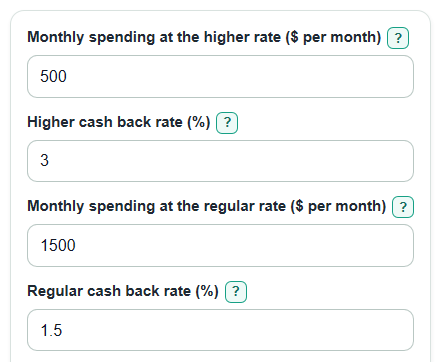
Suppose Monthly spending at the higher rate is $500, Higher cash back rate is 3%, Monthly spending at the regular rate is $1,500, Regular cash back rate is 1.5%, Annual fee is $95, First-year bonus is $200, and there is no cap or yearly credit. Higher-rate yearly spending is $6,000, so higher-rate rewards are $180. Regular yearly spending is $18,000, so regular rewards are $270. Cash back before fee and bonus is $450. First-year cash back after fee is $450 + $200 - $95 = $555. Yearly cash back after fee later is $450 - $95 = $355.