
Estimate your HELOC payment after the draw period and see how extra principal now can change the later monthly payment.
Advanced options
Table of contents
How to use our HELOC Payment Calculator
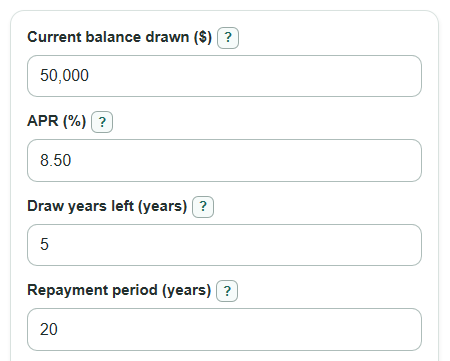
- Enter Current balance drawn ($), which is only the amount you have already borrowed from the HELOC.
- Enter APR (%), Draw years left (years), and Repayment period (years) using the numbers from your statement or loan papers.
- Use Extra principal paid each month during draw ($) if you want to test how paying more now changes Balance when repayment starts and Estimated repayment payment.
- If you want a rough limit check, enter Home value ($), Mortgage balance ($), and Max total home debt allowed (% of home value); otherwise leave those fields blank.
- Check whether Payment change when repayment starts looks affordable, then compare Total estimated interest across different extra-principal amounts.
Definitions
HELOC: A home equity line of credit is a revolving loan backed by your home, so the home is collateral if you do not repay it [1].
Draw period: The time when you can still borrow from the HELOC. Payments during this phase may be interest-only or may include extra principal [1].
Repayment period: The time after the draw period ends, when new borrowing stops and the remaining balance is paid down [1].
APR (%): Annual percentage rate. This calculator converts it to a monthly rate by dividing by 100 and then by 12.
Current balance drawn ($): The part of the HELOC you have already borrowed. It is not the same as the total credit limit.
Extra principal paid each month during draw ($): Money paid above the draw-period interest amount. It reduces the future balance. Applied principal is capped at the balance owed; if less than one draw month remains, the first payment uses that fraction of a month.
Payment change when repayment starts: The later repayment payment minus the first draw-period payment. Positive means a higher later payment; negative means a lower later payment. With no draw period left, this comparison and the first draw-period payment are not applicable. If less than one draw month remains, the partial draw payment is shown but is not compared as a full monthly payment.
Max total home debt allowed (% of home value): A rough combined loan-to-value limit, often shortened to CLTV, used here to compare total home debt with home value.
Common mistakes and quick fixes
Mistake: Entering the full credit line in Current balance drawn ($) even if you have not borrowed all of it.
Fix: Enter only the HELOC balance you already used, not the unused credit limit.
Mistake: Putting a monthly rate in APR (%) instead of the annual percentage rate.
Fix: Use the yearly APR from your HELOC statement, such as 8.50 for 8.50%.
Mistake: Setting Repayment period (years) to 0 while Balance when repayment starts is still above $0.
Fix: Enter the number of years the lender gives you to repay the balance after the draw period.
Mistake: Treating Extra principal paid each month during draw ($) as the whole draw-period payment.
Fix: Enter only the amount paid above the interest part; the calculator adds interest to get First draw-period payment .
Mistake: Entering Home value ($) but leaving Mortgage balance ($) blank, or the other way around.
Fix: Enter both fields for Estimated HELOC limit from home value , or leave both blank for payment-only results.
Mistake: Reading Payment change when repayment starts as always positive.
Fix: A positive number means the later payment is higher; a negative number means the later payment is lower than the first draw-period payment.
Limitations & Key Assumptions / Boundary Conditions
- The calculator assumes the entered APR (%) stays fixed. Many HELOCs have variable rates, so actual payments can change.
- The draw-period estimate assumes no new draws. Borrowing more during the draw period raises the later balance and repayment payment.
- The payment math uses monthly compounding and monthly payments. A lender may use daily interest, different billing dates, minimum-payment rules, or rounding.
- Fees, annual charges, late charges, rate caps, rate floors, escrow items, taxes, insurance, and closing costs are not included.
- The repayment payment is a standard fixed-payment estimate that pays the projected balance to $0 over the entered Repayment period (years). Some HELOCs may have different payoff structures.
- Estimated HELOC limit from home value is only a rough home-equity check. It is not an approval amount and does not include credit score, income, debt-to-income ratio, property type, or lender rules.
- Fractional years are converted to months by multiplying by 12. Very unusual term lengths may not match how your lender rounds its billing schedule.
Methodology
Payment path
The calculator treats the HELOC as two phases. During the remaining draw period, it estimates the first payment as monthly interest on the current drawn balance plus any extra principal you choose to pay. After the draw period, it estimates a level monthly principal-and-interest payment that pays off the projected balance over the repayment period. HELOCs commonly move from a draw period into a repayment period, and payments can rise when principal repayment begins [1][3].
Formulas
monthly_rate = APR (%) / 100 / 12
first_draw_fraction = min(1, draw_years_left * 12)
first_draw_period_payment = current_balance_drawn * monthly_rate * first_draw_fraction + min(current_balance_drawn, extra_principal_paid_each_month_during_draw * first_draw_fraction)
draw_months = draw_years_left * 12
for each draw month: interest = balance * monthly_rate; principal_paid = min(extra_principal_paid_each_month_during_draw, balance); balance = balance - principal_paid
balance_when_repayment_starts = ending draw-period balance
repayment_months = repayment_period_years * 12
if balance_when_repayment_starts = 0, estimated_repayment_payment = 0
if monthly_rate = 0 and balance_when_repayment_starts > 0, estimated_repayment_payment = balance_when_repayment_starts / repayment_months
if monthly_rate > 0, estimated_repayment_payment = balance_when_repayment_starts * monthly_rate / (1 - (1 + monthly_rate)^(-repayment_months))
payment_change_when_repayment_starts = estimated_repayment_payment - first_draw_period_payment (only when a draw period remains)
total_estimated_interest = total_draw_interest + (estimated_repayment_payment * repayment_months - balance_when_repayment_starts)
estimated_HELOC_limit_from_home_value = home_value * max_total_home_debt_allowed_percent / 100 - mortgage_balance
estimated_room_left_after_this_balance = estimated_HELOC_limit_from_home_value - current_balance_drawn
Worked mini-example
For a $50,000 current balance, 8.50% APR, 5 draw years left, 20 repayment years, and $0 extra principal, the monthly rate is 0.085 / 12, or about 0.7083% per month. The first draw-period payment is $50,000 times 0.7083%, or $354.17. Because no extra principal is paid, the balance when repayment starts stays $50,000. Using the standard amortization formula over 240 months gives an estimated repayment payment of $433.91 per month. The payment change is $433.91 minus $354.17, or $79.74 higher per month.
Optional home-value check
If Home value ($) and Mortgage balance ($) are both entered, the calculator estimates a rough HELOC limit by multiplying home value by Max total home debt allowed (% of home value) and subtracting the mortgage balance. It then subtracts Current balance drawn ($) to show the estimated room left after this balance. Negative values are kept because they show that the entered debt is above the rough limit.