
Enter two lender quotes to see whether mortgage points lower your monthly payment enough to recover their cost before you sell or refinance.
Loan terms
Point charge and timing
A positive amount means the with-points quote has the lower monthly principal-and-interest payment.
This excludes remaining-balance differences, investment returns, taxes, insurance, mortgage insurance, and tax effects.
Calculation details
Table of contents
How to use our Mortgage Points Calculator
- Copy the loan amount, loan term, and quoted interest rate from each comparable lender quote or Loan Estimate.
- Enter the dollar point charge tied to the lower rate, then choose whether you will pay it in cash at closing or add it to the loan balance.
- Select "Calculate" to see the payment break-even time, monthly principal-and-interest savings, and each monthly payment.
- If you expect to sell, refinance, or pay off the loan, enter that time to compare it with the break-even time.
- Sanity-check that both quotes use the same loan term and that the with-points rate is lower. If either is untrue, ask the lender for comparable quotes.
Definitions
Discount points: Upfront lender charges connected to a lower mortgage interest rate. They are also called mortgage points. [2]
Note rate: The annual interest rate used to calculate principal-and-interest payments. It differs from APR.
APR: Annual percentage rate. This broader borrowing-cost measure may include certain fees, so it is not the rate used in this calculator's payment formula.
Principal and interest: The part of a monthly mortgage payment that repays the loan balance and interest. Property taxes, insurance, and mortgage insurance are separate costs.
Payment break-even time: The number of months of lower principal-and-interest payments needed to equal the point charge.
Loan Estimate: A standardized lender document that shows loan terms, costs, and estimated cash to close. [1]
Common mistakes and quick fixes
Mistake: Entering the home price instead of the loan amount.
Fix: Use the mortgage principal shown on the lender quote or Loan Estimate.
Mistake: Entering APR instead of the quoted interest rate.
Fix: Enter each loan's annual note rate. APR can include costs beyond the rate used for the monthly payment.
Mistake: Guessing how much a point lowers the rate.
Fix: Enter the lender's actual no-points rate and with-points rate. The rate reduction depends on the quote.
Mistake: Counting financed points as cash due at closing.
Fix: Choose "Added to the loan balance" if the lender finances the charge. This raises the starting balance and changes the with-points payment.
Mistake: Ignoring a likely sale or refinance.
Fix: Enter the expected years before the current loan ends, then compare that time with the payment break-even time.
Limitations & Key Assumptions / Boundary Conditions
- The calculation compares fixed monthly principal-and-interest payments only. It excludes property taxes, homeowners insurance, mortgage insurance, escrow payments, and other closing costs.
- Break-even compares the point charge with monthly payment savings. It does not compare remaining loan balances, investment returns, tax effects, or the time value of money.
- The quotes need the same loan term and otherwise comparable loan terms. A lower rate on a different term is not a like-for-like points comparison.
- A sale, refinance, payoff, missed payment, loan modification, or changed payment plan can alter the actual outcome.
- Financed points are added to the starting balance in this calculation. Confirm the lender's actual treatment and any limit on financing closing costs.
Methodology
Payment calculation
The calculator compares two fixed-rate principal-and-interest payments using the same loan term. It uses the two lender-quoted note rates instead of assuming that a point always produces a certain rate reduction. A fixed monthly mortgage payment is based on the starting balance, monthly interest rate, and number of monthly payments. [3]
n = loan term in years * 12
r = annual note rate / 1200
monthly payment = balance * r / (1 - (1 + r)^(-n))
In these formulas, n is the number of monthly payments and r is the monthly interest rate written as a decimal. If the annual note rate is 0%, the monthly payment is the balance divided by n. For cash-paid points, the with-points balance is the original loan amount. For financed points, the point charge is added once to that balance.
Break-even calculation
monthly savings = no-points payment - with-points payment
break-even months = point charge / monthly savings
A positive monthly savings means the with-points quote has the lower monthly principal-and-interest payment. If that payment is equal to or higher than the no-points payment, there is no payment break-even.
Worked mini-example
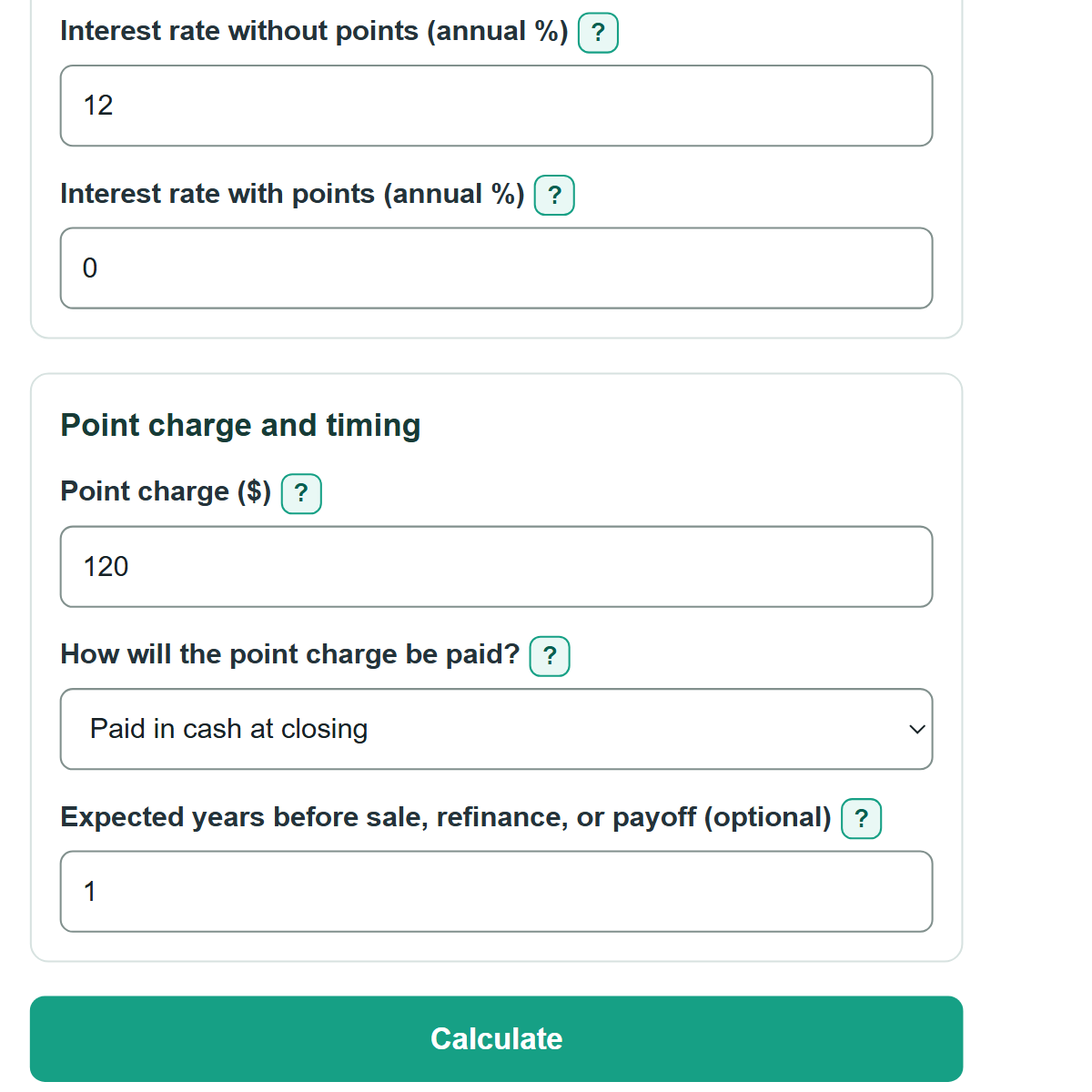
For a $12,000 loan with a 1-year term, a 12% no-points rate, a 0% with-points rate, and a $120 cash-paid point charge, the no-points payment is about $1,066.19 per month. The with-points payment is $1,000.00, so monthly savings are about $66.19. Dividing $120 by $66.19 gives a payment break-even time of about 1.8 months.
Expected loan period
When you enter an expected time before sale, refinance, or payoff, the calculator also calculates the payment cash-flow difference for that period.
payment cash-flow savings = monthly savings * holding years * 12 - cash due at closing
Sources
- Loan estimate explainer | Consumer Financial Protection Bureau - Consumerfinance
- How should I use lender credits and points (also called discount points)? | Consumer Financial Protection Bureau - Consumerfinance
- How do mortgage lenders calculate monthly payments? | Consumer Financial Protection Bureau - Consumerfinance