
Enter a known fuel burn rate or a rough size-and-load estimate, then plan runtime, fuel cost and any extra fuel needed after keeping a reserve.
Usage-based fuel cost for the planned operating time. Separate fixed fees are excluded unless they are included in the entered unit price.
Hourly fuel burn multiplied by planned runtime.
Operating hours using all fuel on hand before setting aside a reserve. The separate covered-time result keeps your reserve untouched.
Balance before setting aside a reserve. A positive number is fuel remaining; a negative number is additional fuel needed. See the separate after-reserve balance below.
Extra fuel to buy at the entered price so the plan can finish and the reserve can remain. This is separate from the total usage cost, not an amount to add to it.
Negative means a shortfall; positive means fuel left above the reserve.
Table of contents
How to use our Generator Fuel Cost Calculator
- Choose "How do you want to estimate fuel use?" Use "I know the fuel burn rate" for a manual or measured rate; select "Fuel measurement basis" and, for liquids, "Fuel volume unit" before entering amounts. "Estimate from size and load" instead uses "Fuel type," rated power, load and efficiency as a rough planning model.
- Under "Time basis," "Actual operating hours" uses "Planned runtime" as switched-on hours. "Clock time with duty cycle" uses "Planned clock time" and "Generator running time each hour" to exclude off-time. Both allow zero planned time.
- Enter "Fuel price" per the selected unit. If you enter "Fuel available," you may also set "Fuel to keep aside." Blank stock omits coverage and shortfall-cost results.
- Select "Calculate." Read "Estimated total fuel cost" as the cost of fuel used. "Cost of additional fuel needed" is the separate purchase shortfall after preserving your reserve, not an amount to add to usage cost.
- Switching US gallons and liters converts valid existing amounts, rates, reserve and price to keep the same physical plan. If a value was entered under the wrong unit, choose the correct unit and re-enter that number. Switching liquid fuel and therms keeps separate entries; it does not convert a volume to gas energy.
Definitions
Fuel burn rate: Fuel used per operating hour at the chosen load, in gal/h or L/h for liquids, or therm/h for natural gas.
Planned runtime: The total hours the generator is expected to run, including separate runs added together.
Fuel needed: The selected fuel quantity required for the planned operating hours at the entered or estimated burn rate.
Usable fuel: Fuel that can actually reach the generator from its tank and storage containers. It can be less than a tank's labeled capacity.
Fuel shortfall: The additional fuel needed when usable fuel on hand is less than fuel needed for the planned runtime.
Common mistakes and quick fixes
Mistake: Entering the generator's watt or kilowatt rating as the fuel burn rate.
Fix: Enter fuel use in gal/h or L/h from the manual or a measurement at a similar load. A power rating alone does not state fuel use.
Mistake: Using a burn rate measured at a very different load than the planned load.
Fix: Use a manufacturer or measured rate closest to the appliances and equipment you expect to run.
Mistake: Mixing gallons with a price per liter, or liters with a price per gallon.
Fix: Set "Fuel volume unit" to the unit used by both entries. The burn rate and fuel price must use the same volume unit.
Mistake: Treating tank capacity as fuel that can all be used.
Fix: Enter only usable fuel in "Fuel available," including stored containers you plan to use.
For natural gas, choose "Natural gas (therms)" in direct mode or "Natural gas" as "Fuel type" in estimate mode, and enter price per therm. Do not enter CCF or MCF as therms; use the supplier-specific energy conversion first.
Limitations & Key Assumptions / Boundary Conditions
- The direct mode uses one entered fuel burn rate; the size-and-load mode is a rough estimate with explicit heat-content and efficiency assumptions. Actual consumption varies with load, equipment, temperature and operating pattern.
- Use a burn rate for the expected load. A rate measured at idle, half load, or full load may not match planned use.
- The cost is fuel used multiplied by the entered price. Separate delivery fees, tank rental, minimum purchases, and similar fixed charges are excluded unless included in the entered unit price.
- Coverage assumes the entered stock is usable and burn rate is constant. The after-reserve results retain "Fuel to keep aside" but do not model refueling delays or inaccessible fuel. The original before-reserve balance and operating runtime remain available as separately labelled results.
- Natural gas uses therms and price per therm. CCF or MCF values are not accepted as therms without the supplier-specific energy conversion. Liquid US gallons/liters are not interchangeable with therms.
Methodology
Calculation method
The calculator uses the same selected fuel unit for burn, price, fuel needed and optional fuel on hand: US gallons or liters for liquids, therms for natural gas.
fuel needed = fuel burn rate * planned runtime
estimated total fuel cost = fuel needed * fuel price
estimated fuel cost per operating hour = fuel burn rate * fuel price
If "Fuel available" is entered, the calculator also finds the runtime supported by that fuel and the balance after the planned runtime.
runtime available = fuel available / fuel burn rate
fuel remaining or shortfall = fuel available - fuel needed
A positive fuel balance means fuel remains. A negative balance means additional fuel is needed.
Worked example
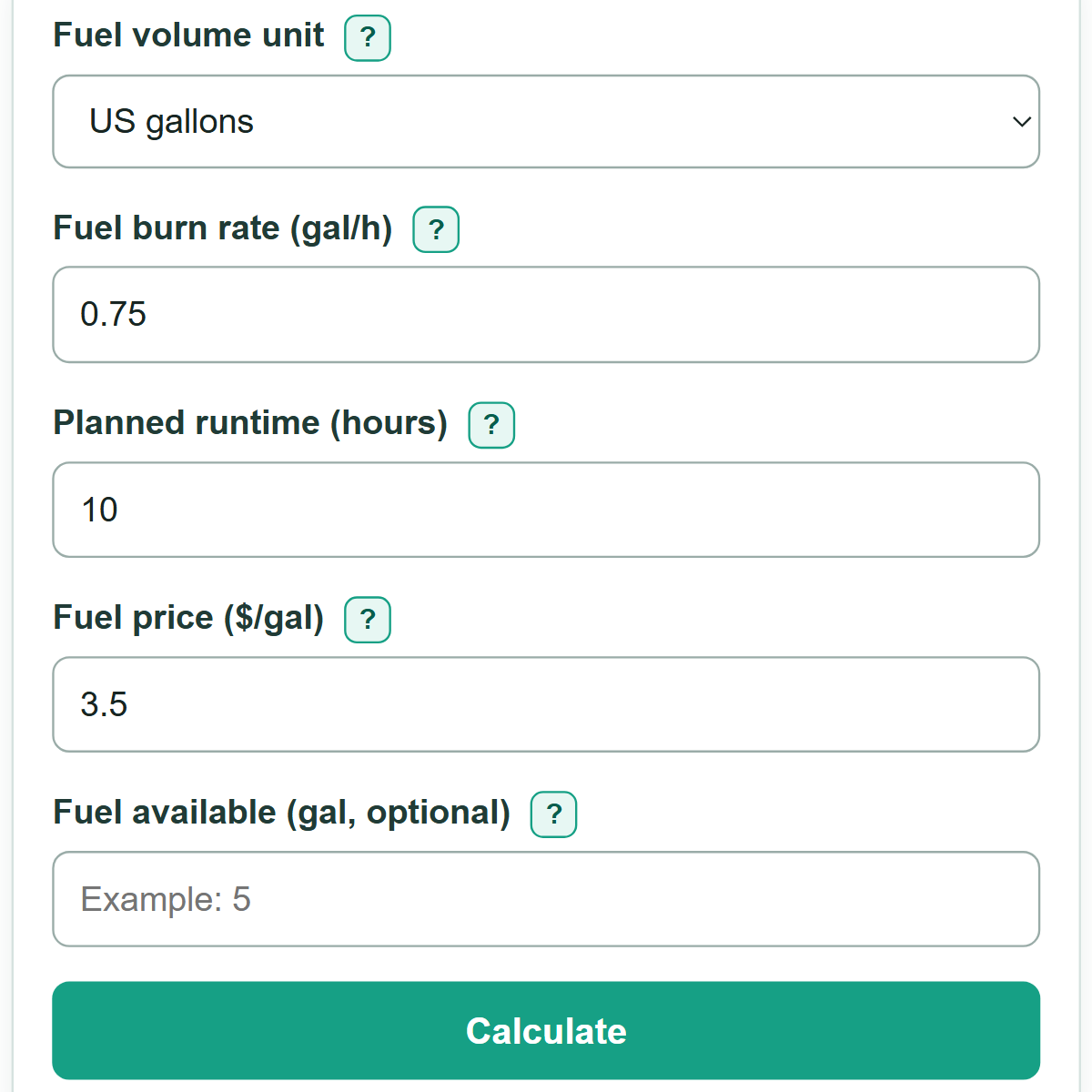
At 0.75 gal/h for 10 hours, fuel needed is 7.5 gal. At $3.50 per gallon, estimated total fuel cost is $26.25. Hourly fuel cost is $2.625, displayed as $2.63.
Changing volume units
When switching between US gallons and liters, the calculator converts valid volume-based entries using 1 US gallon = 3.785411784 liters so the physical plan stays the same. [1]
Clock time, reserve and purchase shortfall
For "Clock time with duty cycle," operating hours = clock hours x running percentage / 100. Clock-hour cost = operating-hour cost x running percentage / 100. After-reserve balance = fuel available - fuel to keep aside - fuel needed. Cost of additional fuel needed = max(0, fuel needed + fuel to keep aside - fuel available) x fuel price. The total usage cost is unchanged by stock or reserve.
Time covered while keeping the reserve = (fuel available - reserve) / burn rate, divided by the running fraction when clock time is selected. If the reserve exceeds stock, no covered time is shown. Therms are energy units, not a gallon/liter conversion; CCF and MCF need supplier-specific conversion before use.
Size-and-load planning model
Electrical output kW = rated kW x load percentage / 100. Estimated fuel rate = output kW x 3,412 Btu per kWh / (fuel heat content x efficiency fraction). This restores the earlier approximate assumptions: gasoline 120,214, diesel 137,381 and propane 91,452 Btu per US gallon; natural gas 100,000 Btu per therm. Liquid rates are converted to liters when selected. Electrical energy = output kW x operating hours; fuel cost per kWh = fuel cost / electrical energy for nonzero operating time, equivalently hourly fuel cost / output kW.
These approximate heat contents and a single efficiency do not model a particular generator or certify its fuel consumption. Use the manufacturer rate or measured consumption at the expected load when possible.