
Estimate Level 2 EV charger wire size, breaker size, ground wire size, and voltage drop before you call an electrician.
Table of contents
How to use our EV Charger Wire Size Calculator
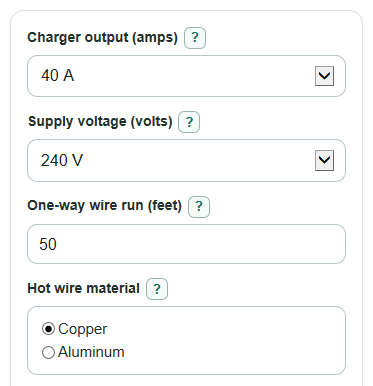
- Choose the Charger output (amps) from the charger setting, not from the breaker you hope to use.
- Select the Supply voltage (volts), enter the One-way wire run (feet), choose the Hot wire material, and pick the Charger connection.
- Open Advanced options if you need to change the Ampacity temperature to use (C), Voltage drop target (percent), voltage-drop upsizing choice, or Ground wire material.
- Click Calculate, then read Recommended hot wire size first, followed by Breaker size, Voltage drop at full charging, and Estimated ground wire size.
- Sanity-check the result: if a 40 A charger does not land near a 50 A breaker, or a long run shows high voltage drop, recheck the charger amps, run length, and temperature setting.
Definitions
Charger output (amps): The maximum charging current setting you plan to use on the EV charger.
Amps used to size the circuit: The charger amps multiplied by 1.25 because EV charging is treated as a continuous load in this estimate.
Breaker size: The standard circuit breaker rating selected at or above the sizing amps.
AWG: American Wire Gauge, a wire size system where a smaller number means a thicker wire, such as 6 AWG being thicker than 8 AWG.
One-way wire run (feet): The path length from the electrical panel to the charger. The voltage-drop math doubles it for the two hot conductors.
Voltage drop at full charging: The percent of supply voltage lost in the wires while the charger is pulling the selected amps.
Ampacity temperature to use (C): The conductor amp limit column used for the hot wires, based on the weakest rated part of the wiring path.
Estimated ground wire size: A planning estimate for the equipment grounding conductor based on the selected breaker and ground material.
Common mistakes and quick fixes
Mistake: Using Breaker size as the Charger output (amps).
Fix: Enter the charger amp setting in Charger output (amps); the calculator will find Breaker size from that.
Mistake: Entering round-trip distance in One-way wire run (feet).
Fix: Enter only the panel-to-charger path; Voltage drop at full charging already uses the out-and-back path.
Mistake: Leaving Hot wire material on Copper when the planned conductors are aluminum.
Fix: Set Hot wire material to Aluminum and check that the charger, lugs, and connectors are aluminum-rated.
Mistake: Choosing NEMA 14-50 outlet or NEMA 6-50 outlet with Charger output (amps) above 40 A.
Fix: Check Connection note and ask about hardwiring or lowering the charger setting.
Mistake: Using 75 C in Ampacity temperature to use (C) when the cable or equipment is limited to 60 C.
Fix: Use 60 C unless the whole path is allowed to use the 75 C ampacity column.
Mistake: Ignoring Important safety note when Recommended hot wire size is larger because of voltage drop.
Fix: Have the electrician review the Estimated ground wire size and any grounding upsize requirement.
Limitations & Key Assumptions / Boundary Conditions
- This is a planning estimate, not a permit drawing or installation approval. The charger manual, local code, inspector, utility rules, and licensed electrician have final say.
- The calculator does not check service capacity, panel space, load calculations, conduit fill, box fill, ambient temperature correction, bundled-wire derating, GFCI rules, trench details, torque specs, or permit requirements.
- The ampacity tables are a simplified NEC-style lookup for the listed copper and aluminum sizes at 60 C or 75 C. Real installations may be limited by cable type, terminal ratings, or local amendments.
- The voltage drop target is a design target, not a universal pass-fail code rule. A lower target can make the recommended hot wire thicker on long runs.
- If hot wires are upsized for voltage drop, the equipment grounding conductor may also need review. The Estimated ground wire size is not a final grounding design.
- Aluminum conductors require terminals, connectors, anti-oxidation practices where required, and installation methods that are rated for aluminum.
- A 50 A receptacle such as a NEMA 14-50 outlet or NEMA 6-50 outlet is usually not a fit for a charger setting above 40 A. Hardwiring or a lower charger setting may be needed.
Methodology
How the estimate is built
The calculator starts with the selected Charger output (amps). It sizes the circuit for continuous load, chooses the next supported standard breaker, chooses the smallest hot wire that meets the selected ampacity table, and then checks voltage drop for the selected One-way wire run (feet).
design_amps = charger_amps * 1.25
breaker_amps = first_standard_breaker_greater_than_or_equal_to(design_amps)
The supported breaker sizes are 15, 20, 25, 30, 35, 40, 45, 50, 60, 70, 80, 90, 100, 110, and 125 A. If the design amps are above the supported range, the calculator stops instead of guessing.
ampacity_wire = smallest_wire_where(table_ampacity(material, terminal_temp_c, wire) >= design_amps)
Voltage drop check
The voltage-drop calculation uses K = 12.9 for copper and K = 21.2 for aluminum. The run length is doubled because current travels through two hot conductors in this 208 V or 240 V circuit estimate.
voltage_drop_volts = 2 * K * charger_amps * run_length_ft / circular_mils
voltage_drop_percent = voltage_drop_volts / supply_voltage * 100
If Upsize wire to meet the voltage drop target? is set to Yes, the Recommended hot wire size is the smallest listed wire that meets both ampacity and the Voltage drop target (percent). If it is set to No, the recommendation follows ampacity only, and the calculator still reports the drop.
recommended_wire = smallest_wire_meeting_ampacity_and_voltage_drop_target
Power and ground estimate
Charging power is the selected supply voltage times the selected charger amps before wire loss and vehicle limits. The ground estimate uses a breaker-based equipment grounding conductor lookup for copper or aluminum.
charger_power_kw = supply_voltage * charger_amps / 1000
ground_wire = table_250_122_lookup(breaker_amps, ground_material_effective)
Mini-example
For a 40 A charger on 240 V, a 50 ft one-way copper run, 75 C ampacity, and a 3 percent voltage-drop target, the design amps are 40 * 1.25 = 50 A. The next supported breaker is 50 A. The ampacity check allows 8 AWG copper at 75 C, and the voltage-drop check is about 3.13 V, or 1.3 percent, so the recommended hot wire stays 8 AWG. The charging power before wire loss is 9.6 kW, and the estimated copper ground wire is 10 AWG.