
Choose a speaker wiring arrangement and enter matching speaker ratings to find the nominal load on one amplifier channel and compare it with the amplifier minimum.
Table of contents
How to use our Series Parallel Speaker Impedance Calculator
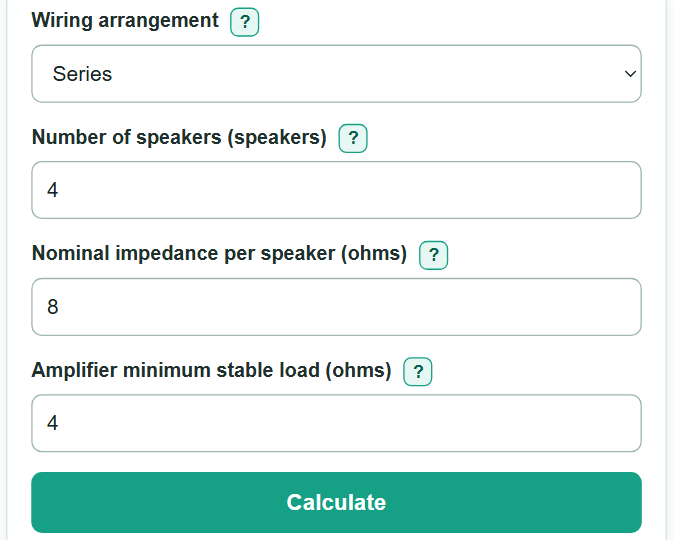
- Choose "Series", "Parallel", or "Series-parallel" under "Wiring arrangement" based on the actual electrical connection.
- Enter the total number of matching passive speakers connected to one amplifier channel.
- Enter the rated value from the speaker label or manual in "Nominal impedance per speaker (ohms)." Use the nominal rating, such as 4 or 8 ohms.
- For "Series-parallel", enter "Speakers in each series string." Every string must have the same number of speakers, and the total speaker count must divide evenly.
- Enter "Amplifier minimum stable load (ohms)" from the manual for the exact channel mode. Check bridged-mode specifications separately if you will use bridged mode.
- Select "Calculate." Read "Total nominal load seen by the amplifier" first, then check whether it is above, at, or below the amplifier minimum.
- Compare "Connection plan" with the wiring you intend to use. Confirm how cabinet link or thru jacks are wired before connecting the amplifier.
Definitions
Nominal impedance: The rated speaker load in ohms, such as 4 ohms or 8 ohms. It is a planning rating, not a fixed resistance at every sound frequency.
Series wiring: Speakers are connected end to end, so their nominal impedances add.
Parallel wiring: All speaker positives connect together and all speaker negatives connect together. For matching speakers, the nominal impedance is one speaker rating divided by the number of speakers.
Series-parallel wiring: Matching speakers are grouped into equal series strings, then the strings are connected in parallel.
Minimum stable load: The lowest nominal speaker impedance an amplifier is specified to handle in a particular channel mode.
Load margin: The calculated nominal load minus the amplifier minimum stable load. A negative margin means the planned load is below that stated minimum.
Common mistakes and quick fixes
Mistake: Treating a chain of speaker cables as series wiring.
Fix: Check the cabinet or speaker manual. Link and thru jacks can be internally parallel even when one cable runs from one cabinet to the next.
Mistake: Entering measured DC resistance instead of nominal impedance.
Fix: Use the nominal ohm rating on the speaker, cabinet, driver, datasheet, or manual. DC resistance is usually a different, lower value.
Mistake: Using the normal channel minimum for a bridged amplifier.
Fix: Use the minimum load listed for the exact amplifier mode. Bridged mode can have a different limit.
Mistake: Making unequal strings in a series-parallel layout.
Fix: Put the same number of matching speakers in every series string and choose a string size that divides the total count evenly.
Limitations & Key Assumptions / Boundary Conditions
- This calculator assumes every included speaker has the same nominal impedance and connects to one amplifier channel.
- Speaker impedance changes with frequency, so the nominal result is not the lowest real-world impedance the amplifier may encounter.
- The calculation does not model phase angle, crossover behavior, cable resistance, amplifier clipping, heat, power handling, or protection circuits.
- A result equal to the amplifier minimum is a caution state, not unconditional equipment approval. Follow the exact amplifier and speaker manuals.
- Do not use this calculator for 70 V or 100 V distributed audio systems, which use a different design method.
Methodology
Load calculation
For matching speakers, series wiring adds the nominal impedance of every speaker.
Total series load = number of speakers x nominal impedance per speaker
For matching speakers in parallel, the total nominal load is one speaker's nominal impedance divided by the number of speakers. This follows the standard parallel-branch relationship. [1]
Total parallel load = nominal impedance per speaker / number of speakers
For series-parallel wiring, the calculator finds one series-string load and divides it by the number of equal strings. It requires at least two speakers in each string and at least two strings.
Number of strings = total speakers / speakers in each series string
Total series-parallel load = nominal impedance per speaker x speakers in each string x speakers in each string / total speakers
Amplifier check
The calculator subtracts the amplifier minimum from the calculated nominal load and keeps the sign.
Load margin = total nominal load - amplifier minimum stable load
A positive margin is above the stated minimum, zero is exactly at it, and a negative margin is below it.
Worked example
Twelve 8-ohm speakers arranged as four strings of three speakers have 24 ohms in each series string. Four equal 24-ohm strings in parallel produce a 6.00-ohm nominal load. With a 4-ohm amplifier minimum, the load margin is +2.00 ohms.