
Enter your RV's daily electricity use and sun hours to estimate the solar array, panel count, and battery capacity needed for your trip.
Table of contents
How to use our RV Solar Calculator
- Choose "Enter measured daily energy" if your battery monitor shows a typical Wh-per-day total, or choose "Build it from appliances" to enter each appliance's watts, hours used per day, and quantity.
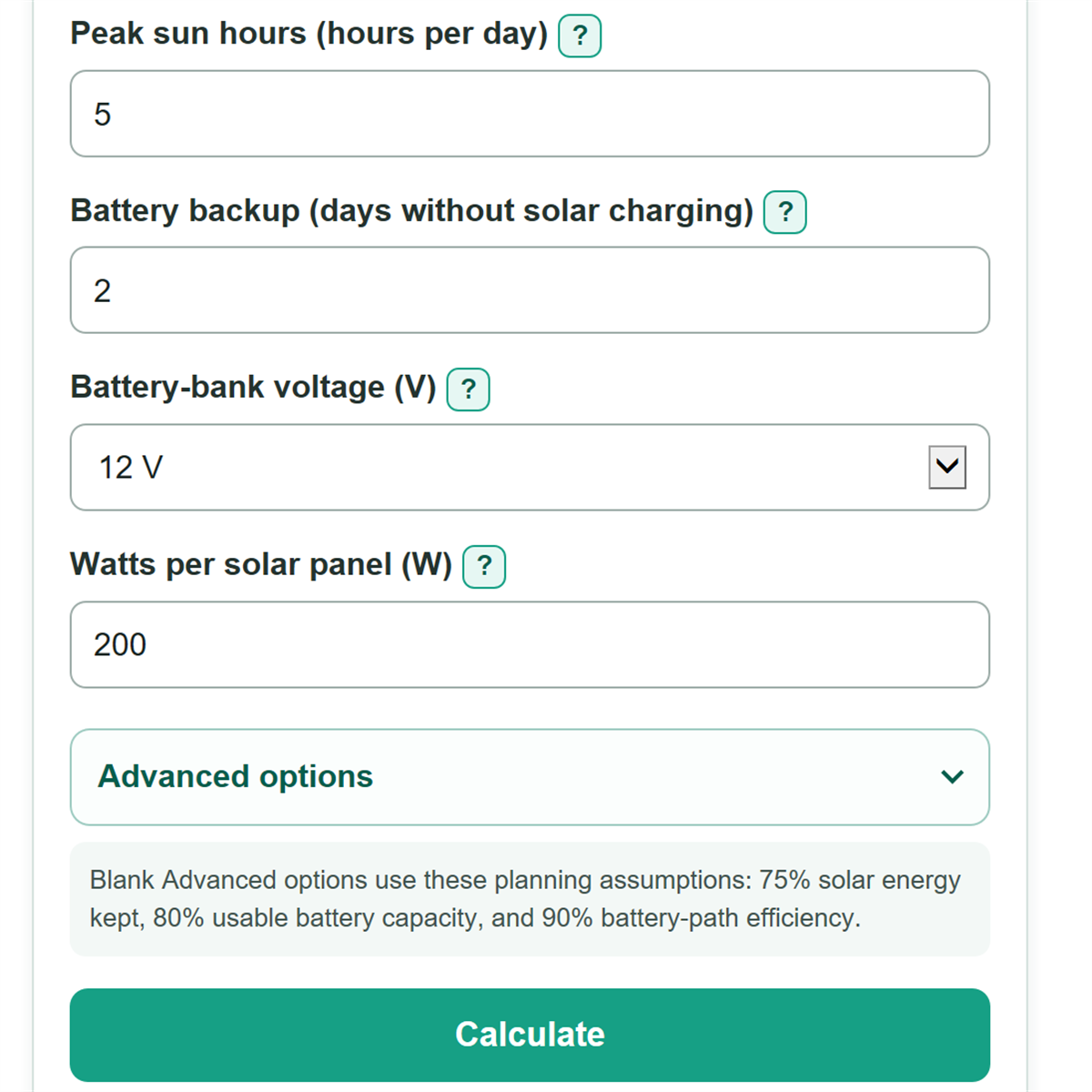
- Enter peak sun hours for the place and season you expect to camp, then enter the number of days you want the battery to run without solar charging.
- Select the battery-bank voltage shown on your battery or system label and enter the rated watts for one panel you are considering.
- Select "Calculate" to see the recommended installed solar array first, followed by panel count and battery capacity at the selected voltage.
- Check "Daily energy used for sizing" before using the estimate. If it seems too high or low, review appliance run times or use a longer battery-monitor average.
Definitions
Watt (W): A measure of electrical power at one moment.
Watt-hour (Wh): A measure of electrical energy used or stored. A 100 W device running for 3 hours uses 300 Wh.
Peak sun hours: Daily solar energy expressed as equivalent hours of full rated sunlight. This is different from daylight hours.
Solar energy kept after losses: The share of panel nameplate energy expected after effects such as shade, temperature, wiring, controller losses, panel angle, and dirt.
Battery backup: The number of days the battery bank should run the entered load without solar, shore power, or alternator charging.
Battery capacity allowed for use: The share of a battery bank's labeled capacity planned for use before recharging.
Battery-path efficiency: The share of energy expected to remain after charging, storing, and delivering energy through the battery system.
Amp-hour (Ah): Battery capacity stated at a specific voltage. Nominal battery Wh divided by voltage equals Ah.
Common mistakes and quick fixes
Mistake: Treating watts and watt-hours as the same measurement.
Fix: Enter watts for an appliance row and hours per day separately. Watts multiplied by hours equals watt-hours of daily energy.
Mistake: Entering daylight hours as "Peak sun hours."
Fix: Use a solar resource estimate for the camping location and season. Peak sun hours are equivalent full-sun hours, not the time from sunrise to sunset.
Mistake: Counting a refrigerator's nameplate watts for 24 hours even though it cycles on and off.
Fix: Enter its realistic total daily run time from observation, a battery monitor, or a plug-in power measurement.
Mistake: Comparing battery amp-hours at different voltages.
Fix: Compare battery energy in Wh first, or compare Ah only when both battery banks use the same voltage.
Mistake: Rounding the solar array down to fewer panels.
Fix: Use the displayed panel count. The calculator rounds upward because part of a panel cannot be installed.
Mistake: Treating the estimate as proof that an installation will fit or connect safely.
Fix: Confirm roof space, panel voltage, controller limits, wire size, fuses, and battery instructions before installation.
Limitations & Key Assumptions / Boundary Conditions
- This is an early sizing estimate based on the daily load, peak sun hours, backup days, panel rating, and planning percentages entered.
- The 75% solar-output, 80% usable-battery-capacity, and 90% battery-path assumptions are editable planning values, not ratings for every RV or product.
- Solar production changes with season, weather, shade, panel angle, temperature, dirt, and parking location. The array may not fully recharge the battery after a low-sun day.
- The calculation does not check roof area, mounting layout, panel open-circuit voltage, cold-weather voltage rise, charge-controller limits, inverter demand, wire size, fuses, disconnects, or electrical-code requirements.
- Battery usable capacity and efficiency can change with battery chemistry, temperature, age, discharge rate, battery-management settings, and inverter use.
- A daily energy value of zero returns zero solar and battery requirements. A backup value of zero returns zero battery storage, while the solar array can still be needed for daily energy.
Methodology
Daily energy
In "Enter measured daily energy," the battery-monitor total becomes the daily load. In "Build it from appliances," each complete row adds appliance watts multiplied by hours used per day and quantity.
daily energy (Wh/day) = sum of (watts x hours/day x quantity)
Solar array
The calculator divides daily energy by peak sun hours and the retained solar-output share. It rounds the resulting panel count up, then multiplies that whole count by watts per panel for the recommended installed array.
minimum array (W) = daily energy / (peak sun hours x solar energy kept after losses / 100)
panel count = round up(minimum array / watts per panel)
installed array (W) = panel count x watts per panel
Battery bank
The storage calculation finds the energy needed through the battery path for the requested backup period. It increases that amount for the allowed usable share, then converts nominal Wh to Ah at the selected battery-bank voltage.
usable battery energy (Wh) = daily energy x backup days / (battery path efficiency / 100)
nominal battery energy (Wh) = usable battery energy / (battery capacity allowed for use / 100)
battery capacity (Ah) = nominal battery energy / battery-bank voltage
Worked example
For 1,200 Wh/day, 5 peak sun hours, 75% solar energy kept after losses, and 200 W panels, the minimum array is 320 W. Rounding up gives 2 panels and a 400 W installed array. With 2 backup days, 90% battery-path efficiency, 80% allowed battery use, and a 12 V bank, the estimate is 3,333.3 Wh nominal, or 277.8 Ah.