
Estimate a motor's full-load line current from the rating plate values you already have.
Advanced options
Table of contents
How to use our Motor Full Load Amps Calculator
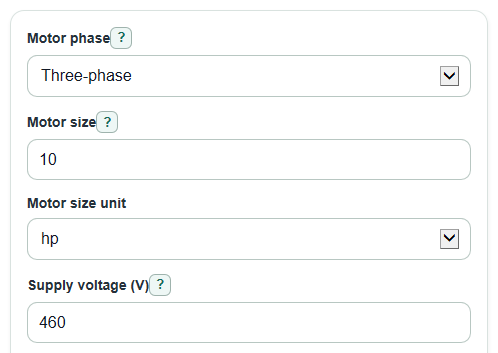
- Choose Motor phase, then enter Motor size and Motor size unit from the motor label.
- Enter Supply voltage, Efficiency, and Power factor. Use 90 for 90 percent efficiency, not 0.90.
- Open Advanced options only if you want to compare Nameplate full-load amps or apply a Current margin for planning.
- Click Calculate and read Estimated full-load amps first, then check Amps after your margin, input power, and apparent power.
- Sanity-check the result: if Estimate compared with nameplate is far from the label value, recheck hp vs kW, voltage, efficiency, and phase before using the estimate.
Definitions
Full-load amps: The line current, in amps, when the motor is doing its rated work.
Motor size: The rated shaft output power from the motor label, entered in hp or kW.
Supply voltage: The voltage feeding the motor. For three-phase motors, this calculator uses line-to-line voltage.
Efficiency: The percent of electrical input power that becomes useful shaft output power.
Power factor: A decimal that shows how effectively AC current supplies real power to the motor.
Estimated electrical input power: The real electrical power in kW needed to produce the entered motor output at the entered efficiency.
Estimated apparent power: The supply loading in kVA based on voltage, current, phase, and power factor.
Nameplate full-load amps: The amp value printed on the motor label. Use it as the better value when it is available for the exact motor.
Common mistakes and quick fixes
Mistake: Entering Efficiency as 0.90 when the label means 90 percent.
Fix: Put 90 in Efficiency, because the calculator expects a percent.
Mistake: Mixing up Motor size and Motor size unit, such as entering 10 kW when the motor is 10 hp.
Fix: Match Motor size unit to the rating plate before calculating.
Mistake: Using the wrong Supply voltage for a three-phase motor.
Fix: For Motor phase set to three-phase, enter the line-to-line Supply voltage.
Mistake: Leaving Power factor blank or entering a percent like 85.
Fix: Enter Power factor as a decimal from above 0 to 1, such as 0.85.
Mistake: Treating Amps after your margin as a code-approved breaker or wire size.
Fix: Use Current margin only as a planning multiplier, then follow the required electrical code and nameplate rules.
Mistake: Ignoring Nameplate full-load amps when it is available.
Fix: Enter Nameplate full-load amps and review Estimate compared with nameplate to catch bad inputs.
Limitations & Key Assumptions / Boundary Conditions
- This is an estimate for rated full-load operation. Starting current, overload settings, breaker size, wire size, voltage drop, and local code rules are not calculated.
- The result depends on the entered Efficiency and Power factor. If those values are guesses, the amp result is also a guess.
- For three-phase motors, the formula assumes a balanced load and line-to-line Supply voltage.
- Nameplate full-load amps should take priority for an actual installed motor because the manufacturer value includes the motor design and rating conditions.
- The Current margin is only a user-chosen multiplier. It is not the 125 percent or other rule used by any specific electrical code section.
- The formulas do not model low voltage, high temperature, service factor, variable-frequency drives, harmonics, or motor slip.
Methodology
Calculation steps
The calculator first converts Motor size to rated shaft output power in watts. It uses 745.699872 watts per mechanical horsepower and 1000 watts per kW.
P_out_W = Motor size * 745.699872, when Motor size unit is hp
P_out_W = Motor size * 1000, when Motor size unit is kW
Efficiency is changed from a percent to a decimal.
eff_decimal = Efficiency / 100
For single-phase power, line current is found from output power, voltage, efficiency, and power factor.
I_A = P_out_W / (Supply voltage * eff_decimal * Power factor)
For three-phase power, the calculator uses the balanced three-phase relationship with sqrt(3), line-to-line voltage, line current, and power factor [1].
I_A = P_out_W / (sqrt(3) * Supply voltage * eff_decimal * Power factor)
Estimated electrical input power is based on output power and efficiency. Power factor does not change this real kW value for the same output and efficiency.
input_power_kw = P_out_W / eff_decimal / 1000
Estimated apparent power is calculated from voltage and current. With the same inputs, it also equals input_power_kw divided by Power factor.
apparent_power_kva = Supply voltage * I_A / 1000, for single-phase
apparent_power_kva = sqrt(3) * Supply voltage * I_A / 1000, for three-phase
The planning margin multiplies the estimated amps by Current margin. A Current margin of 100 percent leaves the amps unchanged.
margin_amps = I_A * Current margin / 100
If Nameplate full-load amps is entered, the comparison is signed. A negative percent means the estimate is lower than the nameplate value.
nameplate_difference_percent = (I_A - Nameplate full-load amps) / Nameplate full-load amps * 100
Worked mini-example
For a 10 hp three-phase motor at 460 V, 90 percent efficiency, and 0.85 power factor, output power is 10 * 745.699872 = 7456.99872 W. The full-load amps are 7456.99872 / (sqrt(3) * 460 * 0.90 * 0.85) = 12.23 A. Estimated electrical input power is 8.29 kW, and estimated apparent power is 9.75 kVA.
Validation
Motor size, Supply voltage, Efficiency, and Power factor must be valid positive numbers. Efficiency must be no more than 100 percent, Power factor must be no more than 1, and optional Nameplate full-load amps must be greater than 0 when entered.