
Estimate your electric dryer's cost per load, month, and year from watts, kWh per load, or a yearly label.
Advanced options
Table of contents
How to use our Dryer Electricity Cost Calculator
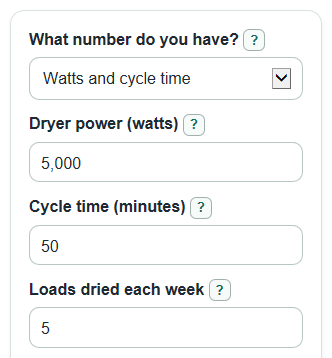
- Choose What number do you have? so the calculator uses watts and cycle time, kWh per load, or a yearly kWh label, but not more than one method at once.
- Enter the matching energy fields, then enter Loads dried each week and Electricity price ($ per kWh). For the best rate, divide your total electric bill charges by total kWh used.
- Open Advanced options only if you want to use Compare with another dryer?, then enter the other dryer's matching energy number and any Extra upfront cost ($).
- Click Calculate and read Cost per load first, then Cost per month, Cost per year, Energy per load, and Yearly energy use.
- Sanity-check the answer: if Cost per load is much higher than expected, check whether Electricity price ($ per kWh) was entered as dollars, such as 0.17, not cents, such as 17.
Definitions
kWh: A kilowatt-hour is a unit of electrical energy. Electric bills usually charge by kWh.
Dryer power (watts): The rate at which the dryer uses electricity while running. Higher watts usually means higher cost for the same time.
Cycle time (minutes): The full drying time for one normal load.
Energy per load (kWh): The electricity used by one dryer load.
Yearly energy from label (kWh per year): A listed annual energy number from a product label or data sheet. EnergyGuide-style labels are meant to help compare yearly appliance energy use and cost [1].
Loads dried each week: The number of loads that actually go through the dryer each week.
Electricity price ($ per kWh): The cost for each kWh of electricity. Your all-in bill rate is usually better than a basic energy-only rate.
Yearly savings with other dryer: Current dryer yearly cost minus other dryer yearly cost. Positive means the other dryer costs less to run.
Years to earn back extra cost: The extra upfront cost divided by yearly savings. It is shown only when the other dryer saves money.
Common mistakes and quick fixes
Mistake: Entering both Dryer power (watts) and Energy per load (kWh) as if the calculator adds them together.
Fix: Use What number do you have? to pick one path, then fill only the rows that match that path.
Mistake: Typing 17 in Electricity price ($ per kWh) when your rate is 17 cents per kWh.
Fix: Enter 0.17 for 17 cents per kWh, or divide cents by 100 before entering the rate.
Mistake: Counting every washer load in Loads dried each week, even loads that are air-dried.
Fix: Count only loads that actually run through the electric dryer.
Mistake: Putting a yearly label value in Energy per load (kWh).
Fix: Select Yearly kWh from label in What number do you have? and put that number in Yearly energy from label (kWh per year).
Mistake: Using Other dryer yearly energy (kWh per year) while Compare with another dryer? is set to Other dryer kWh per load.
Fix: Match the comparison choice to the number you have, then use either Other dryer energy (kWh per load) or Other dryer yearly energy (kWh per year).
Mistake: Treating a negative Yearly savings with other dryer as a calculator error.
Fix: A negative value means the other dryer costs more to run each year than the current estimate.
Limitations & Key Assumptions / Boundary Conditions
- The watts and cycle time path is a rough estimate. A dryer may cycle its heater on and off, so nameplate watts can be higher than the average power used during a full load.
- The kWh per load path is usually better when the number comes from a meter, manual, or product data sheet for a load size close to yours.
- The yearly label path uses the label's kWh per year directly. It does not adjust for your exact cycle settings, fabric type, moisture level, vent condition, or load size.
- Loads dried each week is treated as the same every week of the year. Seasonal laundry changes can make the real yearly cost higher or lower.
- Electricity price ($ per kWh) is treated as one flat rate. Tiered rates, time-of-use rates, taxes, fees, and solar credits can change the real bill effect.
- This calculator covers electric dryer electricity use only. It does not estimate natural gas use, washer energy, vent cleaning costs, or repair costs.
- Comparison savings are energy-cost savings only. Comfort, drying speed, installation changes, rebates, maintenance, and product lifespan are not included.
Methodology
How the main estimate is calculated
The calculator first turns the selected input path into energy per load and yearly energy. Only the selected path is used, so a yearly label is not multiplied by watts or cycle time.
energy_per_load_kwh = (dryer_power_w / 1000) * (cycle_minutes / 60)
energy_per_load_kwh = yearly_energy_kwh / (loads_per_week * 52)
annual_kwh = energy_per_load_kwh * loads_per_week * 52
annual_kwh = yearly_energy_kwh
Then the calculator multiplies energy by your electricity price to get dollar costs.
cost_per_load = energy_per_load_kwh * electric_rate
cost_per_year = annual_kwh * electric_rate
cost_per_month = cost_per_year / 12
Comparison calculation
If you compare another dryer, the other dryer's yearly energy is found from its kWh per load and your weekly loads, or from its yearly kWh label.
other_annual_kwh = compare_kwh_load * loads_per_week * 52
other_cost_per_year = other_annual_kwh * electric_rate
annual_savings = cost_per_year - other_cost_per_year
payback_years = extra_upfront_cost / annual_savings
Yearly savings is signed. A positive value means the other dryer costs less to run. A negative value means it costs more to run. Payback years is shown only when yearly savings is positive and Extra upfront cost ($) is greater than 0.
Worked example
Using Dryer power (watts) of 5000, Cycle time (minutes) of 50, Loads dried each week of 5, and Electricity price ($ per kWh) of 0.17, one load uses about 4.17 kWh. That equals about $0.71 per load, $15.35 per month, and $184.17 per year.
Calculation choices
Internal math uses unrounded numbers, then rounds the displayed result for readability. The calculator uses 1000 watts per kilowatt, 60 minutes per hour, 52 weeks per year, and 12 months per year.
Sources
- EnergyGuide Labeling: FAQs for Appliance Manufacturers | Federal Trade Commission - FTC
- U.S. DOE (EERE) - Clothes Dryers Test Procedure NOPR (per-cycle energy expressed in kWh) - Energy
- ENERGY STAR (PDF) - Draft 1 Residential Clothes Dryers Comment Response Matrix (kWh/year, loads/year example) - Energystar
- 399397 - Illinois