
Estimate the demand charge on a commercial electric bill from peak demand, a $ per kW rate, and optional tariff floors.
Advanced options
Table of contents
How to use our Commercial Electricity Demand Charge Calculator
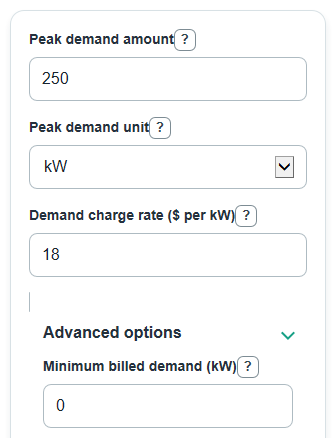
- Enter the Peak demand amount from the bill or meter report, then choose the matching Peak demand unit: W, kW, or MW.
- Enter the Demand charge rate in $ per kW, not the energy rate in $ per kWh.
- Open Advanced options only if the tariff lists a Minimum billed demand, Past high demand for ratchet, or Ratchet percent.
- Click Calculate and compare Estimated demand charge for this bill with Charge if only measured peak counted.
- Sanity-check the result by reviewing Measured peak demand after unit conversion; a W or MW unit mistake can change the answer by 1,000 times.
Definitions
Demand charge: A bill charge based on the highest power demand during the billing period, usually priced in $ per kW.
Peak demand: The largest demand amount used for the bill period before any optional tariff floor is applied.
kW: Kilowatt, a unit of power equal to 1,000 watts.
MW: Megawatt, a unit of power equal to 1,000 kW.
Minimum billed demand: A tariff floor that can make the billed demand higher than the measured peak demand.
Ratchet percent: A tariff percent applied to a past high demand to create a demand floor for the current bill.
Billed demand used: The demand in kW used for the estimated demand charge after checking measured peak, minimum billed demand, and ratchet floor.
Common mistakes and quick fixes
Mistake: Entering the energy price in Demand charge rate instead of the demand price.
Fix: Use the bill line or tariff rate shown in $ per kW, not $ per kWh.
Mistake: Typing 0.5 in Peak demand amount while Peak demand unit is set to kW, even though the bill says 0.5 MW.
Fix: Change Peak demand unit to MW or enter 500 with kW selected.
Mistake: Putting the bill's already billed kW into Peak demand amount and also entering a Minimum billed demand or ratchet values.
Fix: If the amount is already billed demand, leave Minimum billed demand , Past high demand for ratchet , and Ratchet percent at 0.
Mistake: Entering 0.80 in Ratchet percent for an 80 percent ratchet.
Fix: Enter 80, because the calculator converts percent to a decimal internally.
Mistake: Treating Extra charge from minimum or ratchet as a tax or rider.
Fix: Read it as the added demand charge caused by Minimum billed demand or the ratchet floor, before taxes and other bill items.
Limitations & Key Assumptions / Boundary Conditions
- The calculator estimates only the demand charge line. It does not include energy charges, customer charges, taxes, riders, late fees, or power factor adjustments.
- It uses the user-entered demand rate as a flat $ per kW rate. Tiered demand rates, seasonal rates, time-of-use demand periods, and separate on-peak and off-peak demand charges must be calculated separately.
- The optional ratchet check is utility-agnostic. Real tariffs may define the past high period, seasons, contract demand, or rounding rules differently.
- Only Peak demand amount uses the selected W, kW, or MW unit. Minimum billed demand and Past high demand for ratchet are always entered in kW.
- If the bill already shows billed demand, enter that value as Peak demand amount and leave the Advanced options at 0 to avoid applying tariff floors twice.
- The calculator does not inspect interval meter data, so it cannot identify the exact time interval that created the peak demand.
Methodology
Calculation steps
The calculator first converts the entered peak demand to kW, because the demand rate is entered as $ per kW. Unit factors are 0.001 for W, 1 for kW, and 1000 for MW.
measured_peak_kw = peak_demand_value * unit_factor_to_kw
If a ratchet is entered, the past high demand is multiplied by the ratchet percent. A blank optional value is treated as 0, but a negative optional value is an error.
ratchet_floor_kw = prior_high_kw * (ratchet_percent / 100)
The billed demand used for the estimate is the largest of the measured peak, the minimum billed demand, and the ratchet demand floor.
billed_demand_kw = max(measured_peak_kw, minimum_billed_kw, ratchet_floor_kw)
The main charge is then billed demand multiplied by the demand charge rate.
estimated_demand_charge = billed_demand_kw * demand_rate_per_kw
The comparison charge ignores the optional floors and uses only the converted measured peak.
measured_peak_charge = measured_peak_kw * demand_rate_per_kw
The extra charge shows how much the optional minimum or ratchet rule adds compared with the simple peak-times-rate calculation.
extra_charge_from_min_or_ratchet = estimated_demand_charge - measured_peak_charge
Mini example
Suppose Peak demand amount is 250, Peak demand unit is kW, and Demand charge rate is $18 per kW. With no Advanced options, measured peak is 250 kW, billed demand is 250 kW, and the estimated demand charge is 250 * 18 = $4,500.
If Past high demand for ratchet is 400 kW and Ratchet percent is 80, the ratchet floor is 400 * 0.80 = 320 kW. The billed demand becomes 320 kW, so the estimated demand charge is 320 * 18 = $5,760. The extra charge from minimum or ratchet is $5,760 - $4,500 = $1,260.