
Enter each speaker's nominal ohm rating to calculate the total load on one amplifier channel for series or parallel wiring.
This compares the nominal result with the minimum you entered. Confirm the exact amplifier model and operating mode in its manual.
A negative value is below the entered minimum. This comparison does not model changes with frequency or phase angle.
Table of contents
How to use our Speaker Impedance Calculator
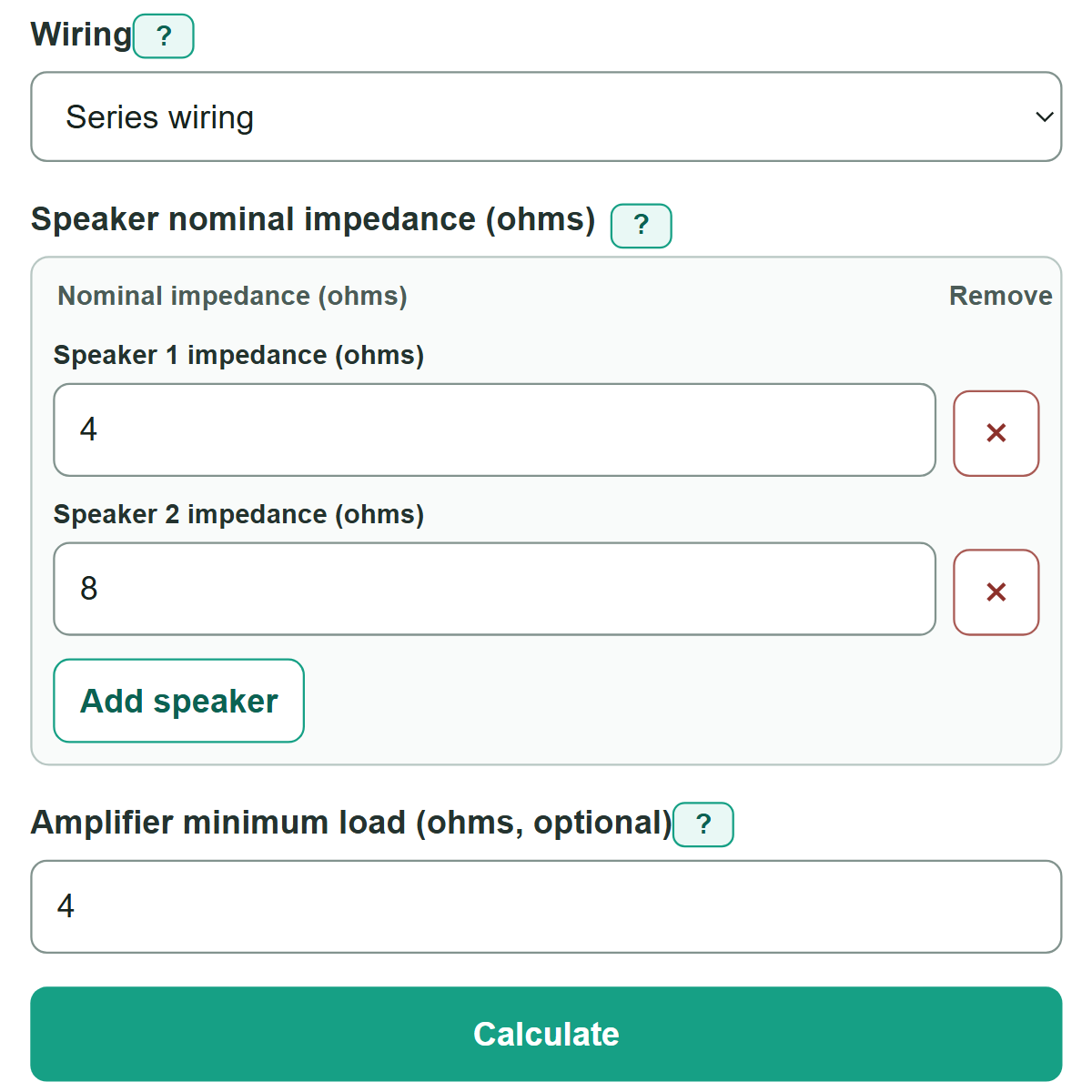
- Choose "Parallel" or "Series" from your planned electrical wiring, not only from the path the speaker cables take.
- Enter the nominal impedance in ohms for each speaker or cabinet. Copy this rating from its label, manual, or specification sheet.
- If you know it, enter the minimum load for the exact amplifier channel and operating mode. Leave it blank if you only need the combined speaker load.
- Select "Calculate." Check that the wiring choice matches your connection plan, then compare the total nominal load with the amplifier minimum-load check when shown.
Definitions
Nominal impedance: The published speaker load rating in ohms. A loudspeaker's actual impedance changes with frequency, so nominal impedance is a planning value. [2]
Ohm: The unit used for electrical resistance and impedance. Its symbol is Ω.
Series wiring: A connection with one electrical path through each speaker. The nominal impedances add.
Parallel wiring: A connection where each speaker is connected across the same amplifier output. The combined nominal load is lower than each individual speaker load. [1]
Minimum load: The lowest nominal impedance allowed by an amplifier's documentation for a particular channel setup and operating mode.
Load margin: The total nominal speaker load minus the entered amplifier minimum load. A positive margin is above the entered minimum, zero equals it, and a negative margin is below it.
Common mistakes and quick fixes
Mistake: Entering a DC resistance meter reading as speaker impedance.
Fix: Enter the published nominal impedance from the speaker label or specifications, such as 4 ohms or 8 ohms.
Mistake: Assuming cabinets connected in a chain are wired in series.
Fix: Check the connector diagram or manual. Speaker link and thru connectors are often parallel connections.
Mistake: Adding impedances for speakers wired in parallel.
Fix: Select "Parallel." The calculator uses the reciprocal calculation, and the combined load is lower than the smallest individual nominal impedance.
Mistake: Using an amplifier minimum load from a different operating mode.
Fix: Use the rating for the exact channel setup. Bridged operation can have a different minimum load than normal stereo operation.
Mistake: Treating a zero-ohm margin as room to add another speaker.
Fix: A zero-ohm margin means the calculated nominal load equals the entered minimum. Recalculate before adding or changing speakers.
Limitations & Key Assumptions / Boundary Conditions
- Use this calculator only for ordinary low-impedance speaker wiring with published nominal ohm ratings. It does not apply to 70 V or 100 V distributed speaker systems.
- All entered speakers must be wired entirely in series or entirely in parallel. Mixed series-parallel branches are outside this model.
- Actual loudspeaker impedance changes with frequency and can be affected by phase angle and crossover parts. The result is not an impedance-curve simulation.
- The amplifier check compares the calculated nominal load only with the minimum load you enter. Confirm the exact amplifier model, channel configuration, and operating mode in its documentation.
- Cable resistance, amplifier protection behavior, voltage limits, power handling, and sound level are not calculated.
Methodology
Calculation method
Enter at least two positive nominal speaker impedances. For series wiring, the calculator adds the entered values. For parallel wiring, it adds the reciprocal of each entered value, then takes the reciprocal of that total. These are ideal nominal-load relationships for series and parallel speaker wiring. [1]
Z_total = Z_1 + Z_2 + ... + Z_n (series)
1 / Z_total = 1 / Z_1 + 1 / Z_2 + ... + 1 / Z_n (parallel)
Amplifier comparison
When an amplifier minimum load is entered, the calculator subtracts it from the calculated nominal speaker load. A margin of zero or more is within the entered minimum. A negative margin means the calculated nominal load is below it.
load margin = total nominal speaker load - amplifier minimum load
Mini-example
A 4-ohm speaker and an 8-ohm speaker total 12 ohms in series. In parallel, the total is 1 divided by (1/4 + 1/8), or about 2.67 ohms. With an entered amplifier minimum of 4 ohms, the parallel setup has a -1.33 ohm margin and is below the entered minimum.