
Convert voltage gain between V/V, dB, and input/output voltage, with an impedance check for estimated power gain.
Advanced options
Table of contents
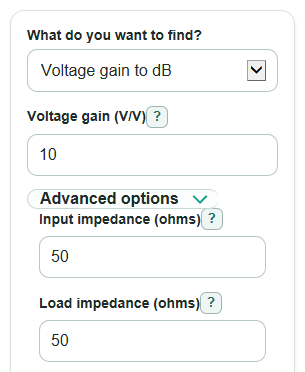
How to use our Decibel Voltage Gain Calculator
- Choose What do you want to find? based on whether you have a Voltage gain (Vout/Vin), a Voltage gain in dB, or input and output voltages.
- Enter only the values needed for that mode, using the same voltage unit for Input voltage and Output voltage when both are shown.
- Open Advanced options only if you want the power check, then enter Input impedance and Load impedance in ohms.
- Click Calculate and read Voltage gain in dB first, then check Voltage gain ratio, Output voltage if shown, and the Quick meaning note.
- Sanity-check the result: a 10 V/V gain should be about 20 dB, a 0.5 V/V gain should be about -6.02 dB, and unequal impedances can make Estimated power gain in dB different from voltage gain in dB.
Definitions
Voltage gain ratio: Output voltage divided by input voltage, shown as V/V. A ratio of 10 means the output voltage size is 10 times the input voltage size.
Voltage gain in dB: A compact log-scale way to write a voltage ratio. Positive dB means voltage gain, negative dB means voltage loss, and 0 dB means the voltage size is unchanged.
Input voltage: The signal voltage before the gain stage. In ratio mode, it must use the same unit as Output voltage.
Output voltage: The signal voltage after the gain stage. In find-output mode, it uses the same voltage unit as Input voltage.
Input impedance: The resistance-like load seen at the input, in ohms.
Load impedance: The resistance-like load at the output, in ohms. It affects the estimated power gain.
Estimated power gain ratio: Estimated output power divided by estimated input power, using the voltage ratio and the two impedance values.
Common mistakes and quick fixes
Mistake: Entering 10 in Voltage gain (Vout/Vin) when you meant 10 dB.
Fix: Change What do you want to find? to dB to voltage gain, then enter 10 in Voltage gain.
Mistake: Mixing volts and millivolts in Input voltage and Output voltage.
Fix: Use the same voltage unit for both labels, such as 0.1 and 1 volts or 100 and 1000 millivolts.
Mistake: Using 0 for Input voltage when the calculator must divide Output voltage by Input voltage.
Fix: Enter a nonzero Input voltage, or use a different mode if the input is truly zero.
Mistake: Treating Voltage gain in dB as the same as Estimated power gain in dB when Input impedance and Load impedance are different.
Fix: Enter both impedance values and use the Estimated power gain in dB result for the impedance-aware power estimate.
Mistake: Typing 0 in Voltage gain (Vout/Vin) and expecting a normal dB answer.
Fix: Use a nonzero Voltage gain (Vout/Vin); a zero output is a complete null and does not have a finite dB gain.
Limitations & Key Assumptions / Boundary Conditions
- The main answer is voltage gain, not an absolute voltage level such as dBV or dBm.
- The dB value uses the size of the voltage ratio. If the voltage ratio is negative, the calculator keeps the negative sign in the ratio and explains the inversion separately.
- Input voltage cannot be 0 in modes that divide by input voltage, because division by zero is not valid.
- A voltage gain ratio of 0 cannot be converted to a finite dB value, because log10(0) is not finite.
- The power check assumes RMS-style voltage values and resistive impedance values. Real circuits with complex impedance, frequency response, clipping, or noise can differ.
- If Input impedance and Load impedance are left blank, the calculator uses 50 ohms for the optional power estimate.
- Voltage gain dB and estimated power gain dB match only when the input and load impedances are equal.
Methodology
Core voltage gain math
The calculator first finds the voltage gain ratio, often written as Av. A voltage ratio compares output voltage to input voltage.
Av = Vout / Vin
For a voltage ratio, decibels use 20 times the base-10 logarithm of the ratio size [1].
GdB = 20 * log10(abs(Av))
If the dB value is known first, the calculator reverses that formula.
abs_Av = 10^(GdB / 20)
In find-output mode, it multiplies the input voltage by the gain size.
Vout = Vin * 10^(GdB / 20)
Impedance-aware power check
Power gain uses a 10 log formula, not a 20 log formula. When the input and load impedances differ, voltage gain dB and power gain dB are not the same [2].
Ap = abs(Av)^2 * (Zin / Zload)
Gp_dB = 10 * log10(Ap)
The same power result can also be written as the voltage-gain dB plus an impedance adjustment.
Gp_dB = GdB + 10 * log10(Zin / Zload)
Mini example
If Voltage gain (Vout/Vin) is 10, then GdB = 20 * log10(10) = 20 dB. With Input impedance = 50 ohms and Load impedance = 50 ohms, Ap = 10^2 * (50 / 50) = 100, so Gp_dB = 10 * log10(100) = 20 dB. If the same 10 V/V gain used 10000 ohms input impedance and 1000 ohms load impedance, the estimated power gain would be Ap = 1000 and Gp_dB = 30 dB.