
Find the series and parallel resistors for a fixed speaker L-pad, plus heat ratings and the real cut after rounding.
Advanced options
Table of contents
How to use our L Pad Attenuator Calculator
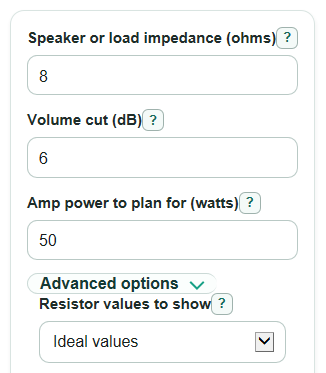
- Enter Speaker or load impedance (ohms), using the rated speaker value such as 4, 6, 8, or 16 ohms.
- Enter Volume cut (dB) as a positive number, then enter Amp power to plan for (watts) using continuous or RMS power when you know it.
- Open Advanced options if you want Resistor values to show as nearest E12 or E24 parts, or if you want to change Heat safety factor (times).
- Select Calculate and read Series resistor to use and Parallel resistor to use first, then check Actual volume cut and Load the amp sees.
- Sanity-check the output: rounded values should keep Load the amp sees close to your speaker impedance, and Recommended series resistor wattage plus Recommended parallel resistor wattage should be ratings you can actually buy.
Definitions
L-pad: A two-resistor pad with one series resistor and one parallel resistor that lowers the voltage sent to a speaker or resistive load.
Speaker or load impedance (ohms): The electrical load the amplifier is expected to drive. Ohms measure electrical resistance or impedance.
Volume cut (dB): The requested drop in level. A larger positive dB number means a quieter output.
Series resistor to use: The resistor placed in line between the amplifier and the speaker branch.
Parallel resistor to use: The resistor connected across the speaker or load after the series resistor.
Load the amp sees: The total resistance looking into the finished L-pad and speaker. A value close to the speaker rating is usually easier on the amplifier.
Resistor values to show: The choice between ideal math values and rounded E12 or E24 resistor values that are easier to buy.
Heat safety factor (times): The multiplier applied to calculated resistor heat to suggest a safer minimum wattage rating.
Common mistakes and quick fixes
Mistake: Entering the speaker's DC ohm-meter reading as Speaker or load impedance (ohms).
Fix: Use the rated Speaker or load impedance (ohms), such as 8 ohms, unless you are designing for a measured resistance at one frequency.
Mistake: Typing a negative number in Volume cut (dB) because you think lower volume should be negative.
Fix: Enter Volume cut (dB) as a positive cut, such as 3, 6, or 10.
Mistake: Using peak marketing power for Amp power to plan for (watts).
Fix: Use continuous or RMS Amp power to plan for (watts) when possible, because Heat in the series resistor and Heat in the parallel resistor are heat planning numbers.
Mistake: Choosing Resistor values to show as E12 or E24, then buying parts without checking Actual volume cut.
Fix: Compare Actual volume cut with your requested cut and make sure the Rounding note does not show a load problem.
Mistake: Treating Recommended series resistor wattage as the exact part rating you must buy.
Fix: Choose a resistor rated at least Recommended series resistor wattage, and usually the next higher standard wattage rating.
Mistake: Leaving Heat safety factor (times) too low for a small sealed speaker box.
Fix: Increase Heat safety factor (times) if airflow is poor or the resistor will sit near insulation, wood, or plastic.
Limitations & Key Assumptions / Boundary Conditions
- This calculator assumes the speaker or load acts like a resistor at the frequency you care about. Real speaker impedance changes with frequency, so the real cut can change across bass, midrange, and treble.
- The heat check uses Amp power to plan for (watts) and treats the amplifier as producing the voltage that would make that power in the entered load impedance.
- Recommended resistor wattage values are planning numbers. Resistor temperature also depends on airflow, part style, mounting, nearby materials, and music duty cycle.
- Very small Volume cut (dB) can make the ideal parallel resistor extremely large. Very large cuts can make the parallel resistor very small and hard to buy or cool.
- E12 and E24 rounding can move Actual volume cut and Load the amp sees away from the ideal design. Check the Rounding note before buying parts.
- This fixed L-pad is for a resistive load model. It is not a complete safety check for tube amps, guitar amps, reactive crossover networks, or high-power PA systems.
Methodology
Core idea
An L-pad is a passive resistive voltage divider: it uses a resistor in series with the load and another resistor across the load to reduce voltage while aiming to keep the input load near the target impedance [1]. This calculator uses the speaker-style L-pad equations for a resistive load.
Ideal resistor values
The requested Volume cut (dB) is first changed into a voltage ratio. The calculator uses 20 log rules because the pad reduces voltage across a resistive load.
k = 10^(-A_db / 20)
R_series_ideal = Z_load * (1 - k)
R_parallel_ideal = Z_load * k / (1 - k)
Here, k is the load voltage divided by input voltage, A_db is the positive dB cut, and Z_load is Speaker or load impedance (ohms).
Rounded resistor check
If Resistor values to show is set to E12 or E24, the calculator replaces each ideal resistor with the nearest preferred value in that series. The nearest value is chosen by the smallest absolute log ratio, which treats percent changes above and below the ideal value fairly.
selected_value = preferred_value_with_smallest_abs(log10(preferred_value / ideal_value))
After that, all final results use the selected resistor values, not the unrounded ideal values.
Actual cut and amplifier load
The parallel resistor and speaker form a branch. The input load is the series resistor plus that branch.
R_branch = (R_parallel * Z_load) / (R_parallel + Z_load)
Z_in = R_series + R_branch
A_actual_db = -20 * log10(R_branch / Z_in)
For ideal values, Z_in should match the entered Speaker or load impedance (ohms), except for small display rounding.
Heat and wattage
The heat check starts from the amplifier voltage that would produce Amp power to plan for (watts) into the entered load impedance.
V_amp = sqrt(P_amp * Z_load)
I_in = V_amp / Z_in
V_load = I_in * R_branch
P_series = I_in^2 * R_series
P_parallel = V_load^2 / R_parallel
P_load = V_load^2 / Z_load
W_series_rec = P_series * safety_factor
W_parallel_rec = P_parallel * safety_factor
Heat in the series resistor and Heat in the parallel resistor are the calculated power turned into heat. Recommended series resistor wattage and Recommended parallel resistor wattage multiply those heat values by Heat safety factor (times).
Mini-example
For an 8 ohm speaker, a 6 dB cut, 50 watts of amp power, ideal values, and a 2 times heat safety factor, the voltage ratio is about 0.501. The ideal Series resistor to use is about 3.99 ohms and the ideal Parallel resistor to use is about 8.04 ohms. The Load the amp sees is 8.00 ohms, Actual volume cut is 6.00 dB, Heat in the series resistor is about 24.94 watts, Heat in the parallel resistor is about 12.50 watts, and Power left for the speaker or load is about 12.56 watts.