
Calculate the op amp slew rate needed for a sine wave, or check a data sheet value against your frequency and output swing.
Advanced options
Table of contents
How to use our Op Amp Slew Rate Calculator
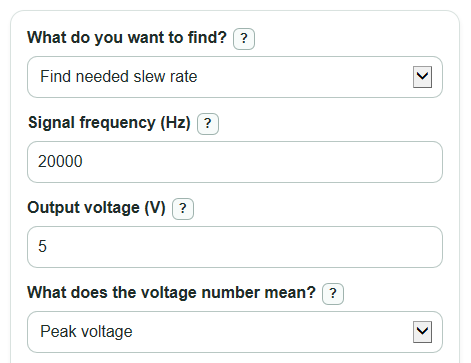
- Choose What do you want to find? based on your goal: needed slew rate, op amp check, highest frequency, or highest output voltage.
- Enter Signal frequency (Hz), Output voltage (V), and What does the voltage number mean? using the actual output signal, not the input signal unless gain is 1.
- If you are checking a part or solving backward from a part, enter Op amp slew rate (V/us) from the data sheet.
- Open Advanced options only if you want Extra safety margin (percent) or a rough gain bandwidth check using Op amp gain bandwidth product (MHz, optional) and Noise gain for bandwidth check (V/V).
- Sanity-check the result: a higher Signal frequency (Hz), larger Output voltage (V), or larger Extra safety margin (percent) should increase the needed slew rate or lower the allowed voltage or frequency.
Definitions
Slew rate: How fast an op amp output voltage can change, usually written in volts per microsecond (V/us). Data sheet slew rate is a large-signal output speed rating [2].
Peak voltage: The distance from the sine wave center line to its highest point.
Peak-to-peak voltage: The full top-to-bottom height of the wave. For a sine wave, peak voltage is half of peak-to-peak voltage.
RMS voltage: The effective sine-wave voltage often used in audio and AC measurements. For a sine wave, peak voltage equals RMS voltage times sqrt(2).
Extra safety margin: A percent added above the math-only minimum so the chosen op amp is not right at the limit.
Gain bandwidth product: A rough small-signal speed rating. In this calculator, the minimum check is signal frequency times noise gain.
Noise gain: The gain used for the bandwidth check. For many non-inverting circuits, it is the closed-loop gain.
Slew-rate headroom: How far the entered op amp slew rate is above or below the recommended slew rate. Positive is extra room. Negative is a shortage.
Common mistakes and quick fixes
Mistake: Entering an input signal in Output voltage (V) when the op amp has gain.
Fix: Use the expected output swing at the op amp output for Output voltage (V).
Mistake: Leaving What does the voltage number mean? on Peak voltage when the oscilloscope reading is peak-to-peak.
Fix: Change What does the voltage number mean? to Peak-to-peak voltage for a top-to-bottom scope reading.
Mistake: Using RMS mode in What does the voltage number mean? for a square wave, triangle wave, or pulse.
Fix: Use RMS voltage for a sine wave only, or convert the waveform to the peak value before using Output voltage (V).
Mistake: Treating Op amp slew rate (V/us) as if it guarantees a clean signal at every load and output level.
Fix: Add Extra safety margin (percent) and check the data sheet conditions near your supply voltage, load, and output swing.
Mistake: Reading a negative Slew-rate headroom as zero margin.
Fix: A negative Slew-rate headroom means the op amp is short; lower the frequency, lower the output swing, or choose a faster op amp.
Mistake: Passing Op amp check but ignoring Bandwidth check.
Fix: If Op amp gain bandwidth product (MHz, optional) is known, enter it with Noise gain for bandwidth check (V/V) to catch a small-signal speed limit.
Limitations & Key Assumptions / Boundary Conditions
- The formulas are for sine waves. RMS conversion in What does the voltage number mean? assumes a sine wave, not a square, triangle, pulse, or clipped signal.
- Slew rate is a large-signal limit. Real op amps can distort before the exact math limit, especially near output swing limits, with heavy loads, or with supply voltages different from the data sheet test.
- The gain bandwidth check is a rough small-signal check. It does not replace data sheet gain and phase plots, output swing curves, or stability checks.
- Output voltage must be the op amp output swing. If your circuit has gain, do not enter the input signal unless the gain is 1.
- Extra safety margin (percent) increases the recommended slew rate and lowers the calculated maximum frequency or maximum output voltage.
- The calculator does not check output current, capacitive-load stability, input common-mode range, power dissipation, or supply rail limits.
Methodology
How the calculator turns voltage into peak voltage
The slew-rate formula uses peak output voltage, so the entered voltage is first converted to a sine-wave peak value.
Vpeak = Ventered for peak voltage
Vpeak = Vpp / 2 for peak-to-peak voltage
Vpeak = Vrms * sqrt(2) for RMS sine-wave voltage
Sine-wave slew rate
For a sine wave, the fastest slope happens at the center crossing. The standard minimum slew-rate relationship is based on the maximum slope of Vout = Vpeak * sin(2 * π * f * t).
SR_min_V_per_us = 2 * π * f_hz * Vpeak * 0.000001
The 0.000001 factor converts volts per second to volts per microsecond. If the op amp cannot change fast enough, a sine wave can start to look triangle-like [1].
Margin and op amp check
Extra safety margin raises the target above the math-only minimum.
SR_recommended = SR_min_V_per_us * (1 + margin_percent / 100)
When checking a data sheet value, the calculator compares the entered Op amp slew rate (V/us) with the recommended value and keeps signed headroom.
headroom_percent = (SR_available / SR_recommended - 1) * 100
A positive headroom means the data sheet slew rate is above the recommendation. A negative headroom means it is below the recommendation.
Solving backward
For highest sine-wave frequency, the calculator rearranges the same formula and includes the safety margin.
f_max_hz = (SR_available * 1000000) / (2 * π * Vpeak * (1 + margin_percent / 100))
For highest output voltage, it solves for peak voltage first, then also reports peak-to-peak and RMS sine-wave values.
Vpeak_max = (SR_available * 1000000) / (2 * π * f_hz * (1 + margin_percent / 100))
Vpp_max = 2 * Vpeak_max
Vrms_max = Vpeak_max / sqrt(2)
Bandwidth check
If Op amp gain bandwidth product (MHz, optional) is entered, the calculator also computes a rough minimum gain bandwidth product.
required_GBW_MHz = (f_hz * noise_gain) / 1000000
Bandwidth check passes when the entered gain bandwidth product is at least this value.
Mini-example
For a 20,000 Hz sine wave with 5 V peak output and 0 percent margin, the minimum slew rate is:
SR_min = 2 * π * 20000 * 5 * 0.000001 = 0.6283185 V/us
So a part rated at 1 V/us has about (1 / 0.6283185 - 1) * 100 = 59.2 percent slew-rate headroom before any added margin.