
Enter your op-amp's gain-bandwidth product and gain or resistor values to estimate its closed-loop -3 dB bandwidth.
First-order small-signal estimate from GBW divided by noise gain.
This estimate is for a suitable internally compensated voltage-feedback op-amp. It is not a full-power bandwidth or slew-rate calculation. Check the device datasheet and simulation for current-feedback, uncompensated, or non-first-order devices.
Table of contents
How to use our Op Amp Bandwidth Calculator
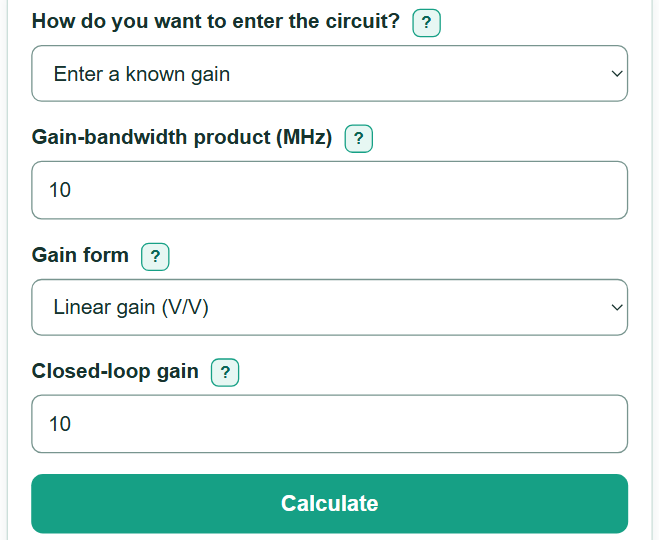
- Choose "Enter a known gain" if you know the gain used for the bandwidth estimate, or choose "Use circuit resistors" to calculate the gain from a standard feedback circuit.
- Enter the datasheet gain-bandwidth product. A number without a suffix is MHz; you can also type Hz, kHz, MHz, or GHz.
- For "Enter a known gain," select "Linear gain (V/V)" or "Gain (dB)," then enter the gain in that form.
- For "Use circuit resistors," choose the amplifier setup and enter Rf and Rg from the schematic. A resistor number without a suffix is kOhm.
- Click "Calculate." Start with the estimated closed-loop -3 dB bandwidth, then check the noise gain and the explanation of why that gain was used.
- Compare the estimate with the op-amp datasheet or simulation if your circuit has capacitive loading, high-frequency parts, or a large output signal.
Definitions
Gain-bandwidth product (GBW): A frequency rating that approximately equals closed-loop gain times bandwidth for a suitable first-order voltage-feedback op-amp circuit.
-3 dB bandwidth: The frequency where voltage gain has dropped to about 0.707 of its low-frequency value.
Noise gain: The gain used for this GBW bandwidth estimate. In the supported resistor circuits, it is 1 + Rf/Rg.
Signal gain: The voltage gain from circuit input to output. A standard inverting stage has negative signal gain because the output reverses phase.
V/V: Volts per volt, a unitless linear voltage-gain ratio.
dB: Decibels. For voltage gain, dB equals 20 times the base-10 logarithm of the gain magnitude.
Common mistakes and quick fixes
Mistake: Entering a dB value while "Linear gain (V/V)" is selected.
Fix: Select "Gain (dB)" for a dB value. For example, 20 dB is 10 V/V, not 20 V/V.
Mistake: Using the magnitude of an inverting stage's signal gain as the bandwidth gain.
Fix: Choose "Use circuit resistors." For an inverting stage, bandwidth uses noise gain 1 + Rf/Rg, not the signal-gain magnitude Rf/Rg.
Mistake: Treating the small-signal bandwidth estimate as full-power bandwidth.
Fix: Check the datasheet for slew rate and large-signal frequency behavior separately.
Mistake: Entering resistor values with different units without marking the unit.
Fix: Use the same unit for both values, or type a supported suffix such as ohm, kOhm, or MOhm so the calculator can convert it.
Limitations & Key Assumptions / Boundary Conditions
- This is a first-order, small-signal estimate for an internally compensated voltage-feedback op-amp.
- It does not calculate slew-rate limits, full-power bandwidth, settling time, distortion, noise, or stability margin.
- Capacitive loads, source resistance, feedback capacitors, parasitic capacitance, and extra circuit poles can change actual bandwidth.
- Use the device datasheet and an appropriate circuit analysis method for current-feedback, decompensated, uncompensated, or non-first-order devices.
- The quick method assumes the entered closed-loop gain is the applicable noise gain. The resistor method covers standard inverting and non-inverting stages only.
Methodology
Bandwidth estimate
The calculator converts GBW to Hz and divides it by linear noise gain. A GBW entry without a frequency suffix is treated as MHz.
GBW in Hz = GBW in MHz × 1,000,000
Estimated bandwidth = GBW in Hz / noise gain
Gain used by each method
With "Enter a known gain," the entered gain is treated as noise gain. A dB entry is converted to a linear voltage ratio before the bandwidth calculation.
Linear gain = 10^(gain in dB / 20)
With "Use circuit resistors," Rf and Rg set the gains. Their units cancel in the ratio, so matching resistance units give the same answer.
Noise gain = 1 + Rf / Rg
Inverting signal gain = -Rf / Rg
Non-inverting signal gain = 1 + Rf / Rg
The signal-gain dB result uses the gain magnitude, so an inverting minus sign is not shown there.
Signal gain in dB = 20 × log10(abs(signal gain))
Worked example
Suppose GBW is 10 MHz, Rf is 90 kOhm, and Rg is 10 kOhm in an inverting stage. Signal gain is -9 V/V, but noise gain is 10 V/V. The estimated bandwidth is 10,000,000 Hz divided by 10, which is 1,000,000 Hz, or 1 MHz.