
Use this transformer turns ratio calculator to find voltage change, coil turns, current, and reflected load with both ratio directions shown.
Advanced options
Table of contents
How to use our Transformer Turns Ratio Calculator
- Choose What do you want to find? so the calculator shows only the required rows for that job.
- Enter the visible coil turns or voltages, using Primary for the input winding and Secondary for the output winding.
- If you want ideal current, power, or load checks, open Advanced options and enter Primary current and/or Secondary load.
- Select Calculate, then compare Primary-to-secondary ratio with Secondary-to-primary ratio so you do not flip the convention.
- Sanity-check Voltage change type: a step-down result should have a lower Ideal secondary voltage than Primary voltage, and a step-up result should have a higher one.
Definitions
Primary coil turns: The number of wire loops on the input winding.
Secondary coil turns: The number of wire loops on the output winding.
Primary-to-secondary ratio: Primary coil turns divided by secondary coil turns, also matching primary voltage divided by secondary voltage in the ideal model.
Secondary-to-primary ratio: The inverse ratio, secondary divided by primary, useful when a book or datasheet uses the opposite direction.
Voltage change type: Step-down means the ideal secondary voltage is lower, step-up means it is higher, and 1-to-1 means the voltages match.
Apparent power: Voltage times current in volt-amperes, shortened to VA, for an AC circuit.
Secondary load seen from primary: The ideal load resistance on the secondary side as it appears from the primary side.
RMS voltage: A common AC voltage value that matches the heating effect of an equivalent DC voltage.
Common mistakes and quick fixes
Mistake: Flipping Primary-to-secondary ratio and Secondary-to-primary ratio.
Fix: Use Primary-to-secondary ratio for primary divided by secondary, and use Secondary-to-primary ratio only when a source uses the inverse.
Mistake: Entering Primary voltage as RMS and Secondary voltage as peak voltage.
Fix: Use the same voltage basis for Primary voltage and Secondary voltage, such as RMS to RMS or peak to peak.
Mistake: Leaving Primary coil turns or Secondary coil turns at 0 in a turns-based mode.
Fix: Enter a positive number greater than 0 for each visible coil-turn row.
Mistake: Treating Ideal secondary current as a real current rating.
Fix: Use Ideal secondary current as an ideal estimate only, then check the real transformer's VA rating, heating, and load limits.
Mistake: Entering Secondary load in kilo-ohms while the label expects ohms.
Fix: Convert Secondary load to ohms before using Secondary load seen from primary.
Limitations & Key Assumptions / Boundary Conditions
- This calculator uses ideal AC transformer relationships. Real transformers have winding resistance, core losses, leakage, heating, and voltage drop under load.
- Primary voltage and Secondary voltage must use the same basis. Do not mix RMS, peak, and peak-to-peak values.
- Optional Primary current and Secondary load outputs are estimates. They do not prove that a real transformer can safely handle that current, VA, frequency, or load.
- Primary coil turns needed and Secondary coil turns needed may be fractional. Real windings use whole turns and also depend on core size, frequency, flux density, insulation, and cooling.
- All inputs are treated as positive magnitudes. Phase angle, power factor, winding polarity dots, regulation, and saturation are not modeled.
- The 1-to-1 label uses display rounding tolerance, so a ratio extremely close to 1 may be shown as 1-to-1 for readability.
Methodology
Core math
The calculator uses the primary-to-secondary ratio a (primary divided by secondary) as its main convention. The selected mode decides which required values are read, and hidden mode-specific inputs are not used.
a = Np / Ns
a = Vp / Vs
inverse_ratio = 1 / a
For an ideal lossless transformer, the primary-to-secondary voltage ratio equals the primary-to-secondary turns ratio [2]. After the ratio is known, the calculator rearranges the same relationship for the requested value.
Vs = Vp / a
Vp = Vs * a
Np = Ns * (Vp / Vs)
Ns = Np * (Vs / Vp)
Optional current and load checks
If Primary current is entered, ideal secondary current is estimated with current changing in the opposite direction from voltage. If Secondary load is entered, the ideal load seen from the primary side is scaled by the square of the turns ratio.
Is = Ip * a
S = Vp * Ip = Vs * Is
Zp = Zs * a^2
Worked mini-example
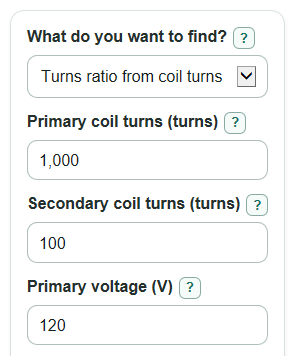
Suppose Primary coil turns is 1000, Secondary coil turns is 100, Primary voltage is 120 V, Primary current is 2 A, and Secondary load is 8 ohms. The ratio is 10 primary-to-secondary and 0.1 secondary-to-primary, so the transformer is step-down. Ideal secondary voltage is 12 V, ideal secondary current is 20 A, ideal apparent power is 240 VA, and the secondary load seen from primary is 800 ohms.
a = 1000 / 100 = 10
Vs = 120 / 10 = 12 V
Is = 2 * 10 = 20 A
S = 120 * 2 = 240 VA
Zp = 8 * 10^2 = 800 ohms