
Enter two or more series capacitors to find their equivalent capacitance, then optionally calculate each capacitor's ideal voltage share.
Advanced options
Table of contents
How to use our Series Capacitor Calculator
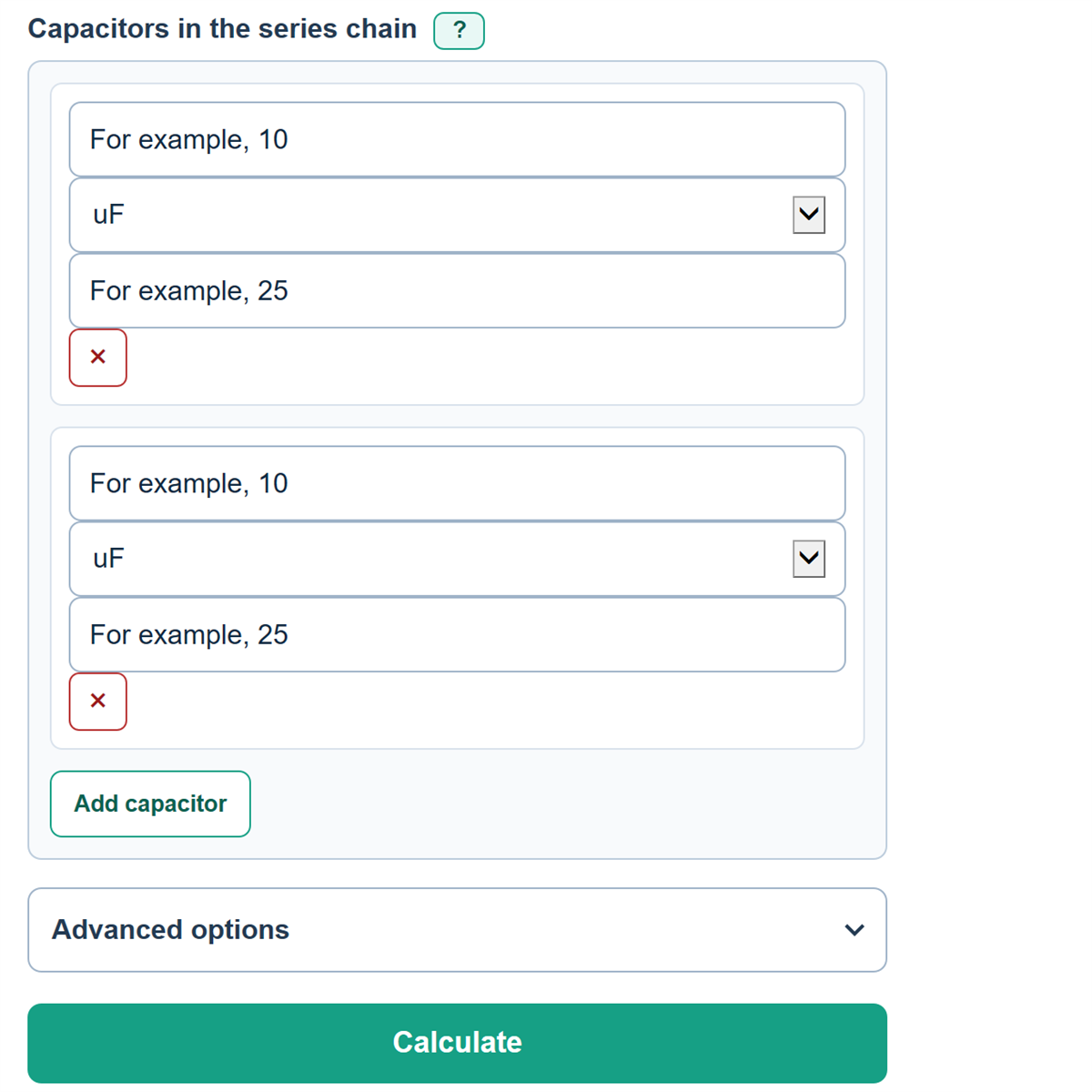
- Enter the capacitance for each capacitor and select the unit shown on its marking, schematic, parts list, or datasheet.
- Add a row for every capacitor in the same unbranched series chain. Enter a voltage rating in a row only if you want to compare it with that capacitor's ideal voltage share.
- Open "Advanced options" and enter the voltage across the full chain if you need ideal voltage shares, charge, or a rating check.
- Click "Calculate". The first result is the equivalent series capacitance, which should be lower than the smallest positive capacitance entered.
- Check that the listed ideal voltage shares add up to the applied chain voltage, allowing for display rounding. Treat any rating check as an ideal-model screen, not a real-circuit safety approval.
Definitions
Capacitance: A capacitor's ability to store electric charge. Its base unit is the farad (F).
pF, nF, and uF: Capacitance units. 1 uF equals 1,000 nF and 1,000,000 pF.
Series chain: Capacitors connected end-to-end with no branch at the connections between them.
Equivalent series capacitance: The capacitance of one ideal capacitor that acts like the full series chain. It is lower than the smallest positive capacitor value in the chain.
Ideal voltage share: The calculated voltage across one capacitor in an ideal series chain. A smaller capacitance gets a larger share.
Voltage rating: The maximum voltage a capacitor is marked or specified to withstand under stated conditions.
Common mistakes and quick fixes
Mistake: Adding capacitance values directly as if the capacitors were in parallel.
Fix: Use this calculator only for a series chain. It adds reciprocal capacitances, then takes the reciprocal of that total.
Mistake: Entering a value in nF while selecting uF.
Fix: Select the unit printed for that specific part. For example, 100 nF equals 0.1 uF, not 100 uF.
Mistake: Including capacitors that are not in one unbranched series chain.
Fix: Use this calculation only for capacitors connected end-to-end with no branch at their shared connection.
Mistake: Expecting unequal capacitors to split the applied voltage equally.
Fix: Enter the voltage across the full chain to see ideal shares. The smaller capacitance receives the larger ideal voltage share.
Mistake: Treating a passed ideal voltage-rating check as proof that the circuit is safe.
Fix: Also evaluate leakage, tolerance, transients, capacitor type, polarity, ripple current, and any balancing parts.
Limitations & Key Assumptions / Boundary Conditions
- This calculation applies only to a true unbranched series chain with at least two positive capacitances.
- Ideal voltage sharing assumes equal charge on ideal capacitors. Real sharing can change with leakage, tolerance, dielectric behavior, temperature, aging, and frequency.
- The rating check compares only an ideal calculated share with the rating entered for that capacitor. It does not evaluate transients, surge limits, polarity, ripple current, ESR, insulation resistance, or failure modes.
- If applied voltage is blank, equivalent capacitance is still calculated, but charge, voltage shares, highest voltage, and rating results are omitted.
- Zero applied voltage is valid and produces zero ideal charge and zero ideal voltage shares.
Methodology
Series calculation
Each entered capacitance is converted to microfarads (uF). For capacitors in one series chain, the reciprocal of the equivalent capacitance is the sum of the reciprocal values for the individual capacitors. This makes the equivalent capacitance lower than the smallest positive capacitor in the chain. [1]
1 / Ceq = Σ(1 / Ci)
When an applied chain voltage is entered, the calculator uses the ideal rule that every capacitor in the series chain has the same charge magnitude. With capacitance in uF and voltage in V, charge is in microcoulombs (uC).
Q = Ceq * Vtotal
The ideal voltage across each capacitor is the shared charge divided by that capacitor's capacitance. The displayed shares should add to the applied voltage apart from rounding.
Vi = Q / Ci
For the optional rating check, the calculator subtracts each ideal voltage share from the voltage rating entered in that row. A negative margin means the ideal share is above the entered rating.
rating margini = ratingi - Vi
Worked example
For 10 uF and 20 uF in series, 1 / Ceq = 1 / 10 + 1 / 20 = 0.15 per uF, so Ceq = 6.666667 uF. With 12 V across the chain, Q = 6.666667 * 12 = 80 uC. The ideal shares are 80 / 10 = 8 V across the 10 uF capacitor and 80 / 20 = 4 V across the 20 uF capacitor.