
Calculate battery bank amp-hours, voltage, stored energy, usable energy, and optional runtime from your series and parallel battery setup.
Enter 1 for one battery or one series chain; enter 2 for two matching chains in parallel.
Advanced options
Table of contents
How to use our Battery Bank Amp Hours Calculator
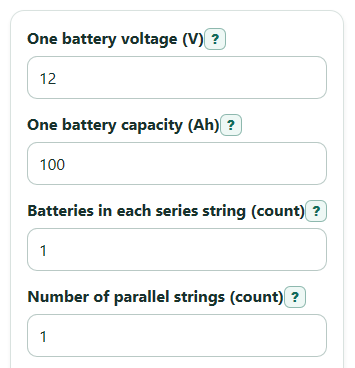
- Enter One battery voltage (V) and One battery capacity (Ah) from the label on one battery.
- Enter Batteries in each series string (count) and Number of parallel strings (count) to match your wiring plan.
- Set Usable battery limit (%) and System efficiency (%) for a more realistic planned energy number.
- If you want a runtime estimate, enter Load power (W); leave it blank if you only need capacity and energy.
- Click Calculate, then sanity-check that Battery bank voltage matches your inverter or DC gear and that Rated stored energy is higher than Planned usable energy.
Definitions
One battery voltage (V): The nominal voltage printed on one battery, such as 12 V, 12.8 V, 24 V, or 48 V.
One battery capacity (Ah): The amp-hour rating of one battery. Amp-hours describe charge capacity, but energy also depends on voltage.
Series string: Batteries wired end-to-end so their voltages add. Amp-hours stay the same within one string.
Parallel strings: Matching series strings connected side-by-side so amp-hours add. Voltage stays the same as one string.
Rated stored energy: The full battery-bank energy in watt-hours before usable-limit and efficiency adjustments.
Planned usable energy: The energy you plan to deliver after applying Usable battery limit (%) and System efficiency (%).
Wh and kWh: Watt-hours and kilowatt-hours measure energy. 1 kWh equals 1,000 Wh.
Load power (W): The average power used by the device or group of devices for the runtime estimate.
Common mistakes and quick fixes
Mistake: Comparing Battery bank capacity in Ah between banks with different Battery bank voltage values.
Fix: Compare Rated stored energy in Wh or kWh when voltages are different.
Mistake: Putting the total number of batteries into Batteries in each series string (count) instead of the number in one series chain.
Fix: Enter only the count wired end-to-end in one string, then put the number of matching strings in Number of parallel strings (count) .
Mistake: Treating Planned usable energy as the same as Rated stored energy .
Fix: Use realistic values for Usable battery limit (%) and System efficiency (%) before planning loads.
Mistake: Entering a peak surge value in Load power (W) when you want Estimated runtime .
Fix: Use the average watts the load uses over time, not the short startup surge.
Mistake: Mixing old and new batteries while trusting Total batteries needed as a full wiring plan.
Fix: Use identical batteries with the same voltage, capacity, chemistry, age, and state of charge, and check fuses and cable ratings before building.
Limitations & Key Assumptions / Boundary Conditions
- The calculator assumes all batteries are identical in voltage, capacity, chemistry, age, health, and state of charge.
- Battery voltage changes during discharge, so Wh estimates based on nominal voltage are planning estimates, not lab-test measurements.
- Estimated runtime uses average Load power (W). Real loads that cycle on and off, surge, or change speed can run for a different time.
- System efficiency (%) is a single user-entered estimate. Inverters, cables, charge controllers, and high current can all change delivered energy.
- The calculator does not size fuses, breakers, bus bars, wire gauge, battery management systems, chargers, or ventilation.
- Large series or parallel counts need extra design checks for current sharing, fault current, balance, and equipment voltage limits.
Methodology
How the bank is calculated
The calculator treats the bank as identical batteries arranged into series strings, then connected in parallel. Series wiring raises voltage. Parallel wiring raises amp-hours. Watt-hours are used because Ah alone can be misleading when battery voltages differ [2].
total_batteries = series_count * parallel_count
bank_voltage_v = battery_voltage * series_count
bank_capacity_ah = battery_capacity_ah * parallel_count
rated_energy_wh = bank_voltage_v * bank_capacity_ah
rated_energy_kwh = rated_energy_wh / 1000
Usable energy and runtime
For planning, the calculator applies the user-entered battery-use limit and system efficiency. This keeps the rated size separate from the energy you expect to actually use.
usable_energy_wh = rated_energy_wh * (usable_battery_limit_percent / 100) * (system_efficiency_percent / 100)
usable_energy_kwh = usable_energy_wh / 1000
If Load power (W) is entered, runtime is found by dividing usable watt-hours by average watts.
estimated_runtime_hours = usable_energy_wh / load_power_watts
Worked example
For eight 12.8 V, 100 Ah batteries wired as 4 in series and 2 parallel strings, the bank voltage is 12.8 * 4 = 51.2 V and the bank capacity is 100 * 2 = 200 Ah. Rated stored energy is 51.2 * 200 = 10,240 Wh, or 10.24 kWh. With an 80% usable battery limit and 90% system efficiency, planned usable energy is 10,240 * 0.80 * 0.90 = 7,372.8 Wh. With a 500 W load, estimated runtime is 7,372.8 / 500 = 14.7456 hours.
Input checks
Voltage, capacity, series count, parallel count, usable battery limit, and system efficiency must be positive valid numbers. Series and parallel counts must be whole numbers. Percent settings must be greater than 0 and no more than 100. Load power (W) may be blank, but if entered it must be greater than 0.