
Enter a battery's nominal voltage and the number in one series string to find your battery bank's nominal voltage.
Table of contents
How to use our Battery Bank Voltage Calculator
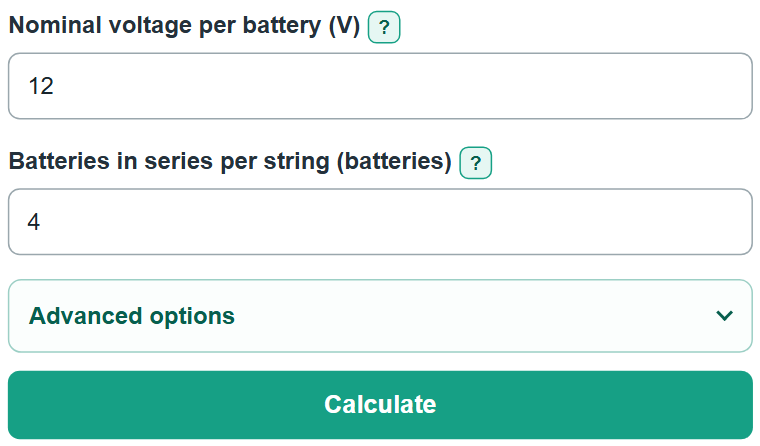
- Find the nominal voltage on one matching battery or module label, or in its manufacturer datasheet.
- Enter that label value in "Nominal voltage per battery (V)." Do not use a live meter reading.
- Count one positive-to-negative battery path and enter the count in "Batteries in series per string."
- Select "Calculate" to see the nominal bank voltage and the multiplication used.
- For full-bank details, open "Advanced options." Enter "Parallel strings" for equal series strings connected positive-to-positive and negative-to-negative.
- Enter "Capacity per battery (Ah)" if you want nominal bank capacity and nameplate stored energy. Check that parallel strings increase Ah capacity, not nominal voltage.
Definitions
Nominal voltage: The labeled design voltage of a battery or module. It can differ from a terminal-voltage reading at a particular moment.
Series connection: Batteries connected positive-to-negative in one path. Their nominal voltages add.
Parallel string: A complete series string connected positive-to-positive and negative-to-negative with another equal-voltage string. Parallel strings add amp-hour capacity but do not add nominal voltage. [2]
Amp-hour (Ah): A capacity rating. For matching batteries, series wiring keeps the Ah rating of one battery, while equal parallel strings add Ah.
Watt-hour (Wh): A unit of energy. Nominal volts multiplied by amp-hours gives nameplate watt-hours.
Common mistakes and quick fixes
Mistake: Entering the total number of batteries instead of the count in one series string.
Fix: Count one positive-to-negative path for "Batteries in series per string." Enter separate equal paths as "Parallel strings."
Mistake: Using a voltage measured while the battery is charging or powering equipment.
Fix: Enter the nominal voltage printed on the battery or module label. The calculated voltage is a design value, not a live terminal reading.
Mistake: Expecting parallel strings to increase voltage.
Fix: Parallel strings keep the nominal voltage of one series string. With matching batteries, they add amp-hour capacity.
Mistake: Treating nameplate Wh as guaranteed usable energy or runtime.
Fix: Use the Wh result as a nameplate calculation only. Delivered energy changes with load, temperature, battery condition, state of charge, and equipment limits.
Limitations & Key Assumptions / Boundary Conditions
- The calculation assumes matching batteries or modules with the same nominal voltage and, when parallel strings are used, the same number of batteries in each string.
- Nominal bank voltage is a design value. Actual terminal voltage changes with state of charge, charging, load, temperature, and battery condition.
- Nameplate stored energy is not a runtime prediction or a guarantee of usable energy.
- This calculator does not determine safe current limits, fuse size, wire size, charging settings, battery-management-system compatibility, or whether a wiring plan is safe.
- Follow the battery manufacturer instructions and use qualified electrical help for installation, protection, and high-current wiring.
Methodology
Voltage calculation
The calculator multiplies one battery or module's nominal voltage by the number connected in series. Parallel strings are not included because they do not raise nominal voltage.
nominal bank voltage (V) = nominal voltage per battery (V) x batteries in series per string
For example, four 12 V batteries in one series string have a nominal bank voltage of 48 V.
12 V x 4 = 48 V
Optional full-bank details
When capacity is entered, the calculator multiplies one battery's rated capacity in Ah by the number of equal parallel strings. If "Parallel strings" is blank, it uses one string for these optional details.
nominal bank capacity (Ah) = capacity per battery (Ah) x parallel strings
It then calculates nameplate stored energy from nominal bank voltage and nominal bank capacity.
nameplate stored energy (Wh) = nominal bank voltage (V) x nominal bank capacity (Ah)
Example: two parallel strings of four 12 V, 100 Ah batteries produce 48 V, 200 Ah, and 9,600 Wh of nameplate energy.
48 V x 200 Ah = 9,600 Wh
Total battery count equals batteries in each series string times parallel strings. Parallel strings are assumed to be equal matching strings. [1]