
Estimate yearly AC electricity savings, bill savings, payback time, and a simple range for run-hour or rate uncertainty.
Old yearly AC cost minus new yearly AC cost. Negative savings mean the new setup costs more to run.
Positive means the new AC uses fewer kWh. Negative means it uses more.
This is only the cooling part of the bill.
This is only the cooling part of the bill.
Positive means lower cooling cost. Negative means higher cooling cost.
N/A means yearly savings are zero or lower, or no extra cost was entered.
This range changes the yearly savings by your chosen percent.
Table of contents
How to use our AC Energy Savings Calculator
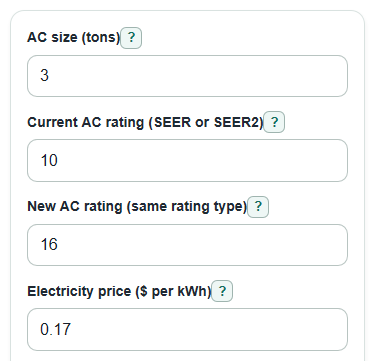
- Enter AC size (tons), Current AC rating (SEER or SEER2), and New AC rating (same rating type).
- Enter Electricity price ($ per kWh) from your bill and AC run time (hours per year) for compressor run time, not thermostat-on time.
- Open Advanced options if you want Savings over chosen years, Simple payback time, or a Likely savings range per year.
- Click Calculate, then read Estimated savings per year first and Electricity saved per year next.
- Sanity-check the result: if AC run time (hours per year) or Electricity price ($ per kWh) is a rough guess, use the Likely savings range per year instead of treating one number as exact.
Definitions
AC size (tons): The cooling capacity of the air conditioner. One ton is treated as 12,000 Btu per hour.
Btu per Wh: British thermal units of cooling per watt-hour of electricity. Higher means more cooling for each unit of electricity.
SEER or SEER2: Seasonal efficiency ratings for central air conditioners. SEER2 uses a newer test method, so avoid mixing SEER and SEER2 in the same comparison unless you know the conversion.
Electricity price ($ per kWh): The cost for one kilowatt-hour of electricity. Your all-in bill cost divided by kWh used is often better than the energy-only line item.
AC run time (hours per year): Estimated compressor run hours during cooling season, not the number of hours the thermostat is turned on.
kWh: Kilowatt-hour, the energy unit used on electric bills.
Simple payback time: The extra installed cost divided by yearly savings. It is N/A when the yearly savings are zero or negative.
Savings range width (percent): The plus-or-minus width used to show how much yearly savings could move if run time or electric price is off.
Common mistakes and quick fixes
Mistake: Mixing Current AC rating (SEER or SEER2) with New AC rating (same rating type).
Fix: Use the same rating type for both ratings when possible, or treat the result as a rough estimate.
Mistake: Entering thermostat schedule time in AC run time (hours per year).
Fix: Use estimated compressor run hours, because the compressor is not running every minute the thermostat is set to cool.
Mistake: Using only the energy-charge line for Electricity price ($ per kWh).
Fix: Divide the total bill by total kWh when you want a rate that better includes delivery and other per-kWh charges.
Mistake: Putting the full system price in Extra installed cost for the new option ($).
Fix: If comparing two new quotes, enter only the extra cost of the higher-efficiency option.
Mistake: Expecting Simple payback time when Estimated savings per year is zero or negative.
Fix: Check whether New AC rating (same rating type) is higher than Current AC rating (SEER or SEER2); payback is N/A when yearly savings are not positive.
Limitations & Key Assumptions / Boundary Conditions
- The calculator compares cooling electricity only. It does not estimate heating, fan-only use, maintenance, repairs, rebates, taxes, or financing.
- Current AC rating (SEER or SEER2) and New AC rating (same rating type) should use the same rating type. Mixing SEER and SEER2 can shift the answer.
- AC run time (hours per year) is a simplified full-capacity equivalent estimate. Real systems cycle on and off and can perform differently at part load.
- Electricity price ($ per kWh) is assumed constant over the comparison period. Real rates can change by season, time of day, or year.
- Savings over chosen years is simple yearly savings multiplied by years. It does not discount future cash flows or include energy price inflation.
- Simple payback time uses Extra installed cost for the new option ($). It is not a full life-cycle cost analysis.
- Likely savings range per year changes only the final savings by the chosen percent. It does not model weather, duct losses, installation quality, or equipment degradation separately.
Methodology
How the calculator estimates AC use
The calculator first converts AC size from tons to cooling capacity. One refrigeration ton is treated as 12,000 Btu per hour.
cooling_btu_per_hour = ac_tons * 12000
It then estimates the yearly cooling load from compressor run time.
yearly_cooling_btu = cooling_btu_per_hour * cooling_hours
For each system, electricity use is estimated from the rating. SEER and SEER2 are seasonal cooling efficiency ratings in Btu per watt-hour under test procedures and specifications [1].
kwh = yearly_cooling_btu / (rating * 1000)
Cost is the estimated kWh multiplied by the entered electricity price.
cost = kwh * electric_rate
How savings and payback are calculated
Yearly savings keep the sign. A positive value means the new AC costs less to run. A negative value means it costs more to run.
annual_savings_usd = current_annual_cost - new_annual_cost
annual_energy_saved_kwh = current_kwh - new_kwh
percent_cost_change = annual_savings_usd / current_annual_cost * 100
Longer-term savings uses the selected Years to compare.
comparison_savings_usd = annual_savings_usd * analysis_years
Simple payback is shown only when yearly savings and extra installed cost are both greater than zero.
simple_payback_years = extra_installed_cost / annual_savings_usd
The savings range applies the Savings range width (percent) to the yearly savings, then displays the lower dollar value first.
low_savings = annual_savings_usd * (1 - uncertainty_percent / 100)
high_savings = annual_savings_usd * (1 + uncertainty_percent / 100)
Mini example
With AC size (tons) of 3, Current AC rating (SEER or SEER2) of 10, New AC rating (same rating type) of 16, Electricity price ($ per kWh) of 0.17, and AC run time (hours per year) of 1200, the current system uses about 4,320 kWh per year and costs about $734.40 per year. The new system uses about 2,700 kWh per year and costs about $459.00 per year. Estimated savings per year is $275.40, Electricity saved per year is 1,620 kWh, and a $3,000 extra installed cost gives a Simple payback time of about 10.89 years.