
Use this heat pump COP calculator to compare heat delivered with electric power used, with optional gas cost and temperature checks.
Table of contents
How to use our Heat Pump COP Calculator
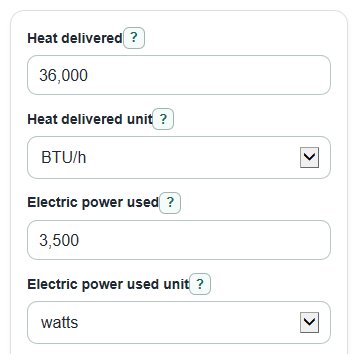
- Enter Heat delivered and choose the matching Heat delivered unit, such as BTU/h, kW, watts, or tons.
- Enter Electric power used for the same moment or rating point, then choose the matching Electric power used unit.
- Open Advanced options only if you want cost or theory checks, then fill Electricity price ($ per kWh), Natural gas price ($ per therm), Gas furnace efficiency (percent), or both temperature fields as needed.
- Click Calculate and read Heat pump COP first; Electric-resistance equivalent is the same result shown as a percent-style comparison.
- Sanity-check the answer: a very high Share of theoretical best, a Check note, or a COP that looks far above the equipment rating usually means the units, temperatures, or measurement boundaries do not match.
Definitions
Heat pump COP: Coefficient of performance. It is heat delivered divided by electric power used, after both are converted to the same power unit.
Electric-resistance equivalent: COP times 100. A COP of 3 is shown as 300%, meaning 3 times the heat of electric resistance for the same electric input.
BTU/h: British thermal units per hour. This is a common US HVAC heat-rate unit.
kW: Kilowatt, or 1,000 watts. In this calculator it can describe either heat output or electric power, depending on the label.
Ton: An HVAC capacity unit equal to 12,000 BTU/h.
MMBtu: One million BTU. The cost outputs use dollars per MMBtu so electric heat and gas heat can be compared on the same delivered-heat basis.
Therm: A natural gas billing unit equal to 100,000 BTU of fuel energy.
Theoretical best possible COP: The Carnot heating COP for the entered source and delivered temperatures. Real equipment should be below this number for the same boundary.
Common mistakes and quick fixes
Mistake: Entering heat output into Electric power used or electric draw into Heat delivered .
Fix: Put home heat output in Heat delivered and the heat pump's electric draw in Electric power used .
Mistake: Leaving Heat delivered unit on BTU/h when the value is really kW or tons.
Fix: Choose the exact Heat delivered unit printed on the spec sheet or shown by your data logger.
Mistake: Using yearly kWh from a bill as Electric power used .
Fix: Use a power rate for the same moment as the heat output, such as watts or kW, not total energy over many days.
Mistake: Filling only Electricity price ($ per kWh) and expecting COP needed to beat gas heat to appear.
Fix: Enter all three cost fields: Electricity price ($ per kWh) , Natural gas price ($ per therm) , and Gas furnace efficiency (percent) .
Mistake: Typing 0.90 in Gas furnace efficiency (percent) for a 90% furnace.
Fix: Enter percent form, so a 90% furnace is entered as 90.
Mistake: Entering Delivered heat temperature (deg F) lower than Outdoor or source temperature (deg F) .
Fix: For the Carnot check, the delivered heat temperature must be warmer than the source temperature.
Limitations & Key Assumptions / Boundary Conditions
- The core COP result assumes Heat delivered and Electric power used describe the same moment, rating point, or measurement period.
- Whole-system COP depends on what your electric reading includes. Outdoor unit only, outdoor plus indoor blower, crankcase heat, defrost, and backup electric heat can give different COP values.
- The natural gas comparison uses energy prices only. It does not include monthly customer charges, maintenance, demand charges, taxes that are not in your entered prices, or equipment wear.
- Gas furnace efficiency (percent) is treated as useful delivered heat divided by gas fuel input. Duct losses and cycling losses are not added separately.
- The Carnot check uses simple source and delivered temperatures in degrees F. It is a theory limit, not a predicted equipment rating.
- If Share of theoretical best is above 100%, the calculator still shows it because that usually points to mismatched units, temperatures, or measurement boundaries rather than a real heat pump above the physics limit.
Methodology
Core calculation
The calculator first converts Heat delivered and Electric power used to watts. COP has no unit because it divides one power value by another power value.
heat delivered in W = BTU/h / 3.412141633
heat delivered in W = kW * 1000
heat delivered in W = tons * 12000 / 3.412141633
electric power in W = kW * 1000
electric power in W = BTU/h / 3.412141633
COP = heat delivered in W / electric power in W
Electric-resistance equivalent percent = COP * 100
Cost comparison
When electricity price is entered, the calculator estimates the cost to deliver 1,000,000 BTU of heat at the measured COP. When all gas comparison fields are entered, it also computes the gas furnace cost and the COP needed for the heat pump to be cheaper.
Heat pump cost per MMBtu = (293.0710701722222 / COP) * electricity price
Gas cost per MMBtu delivered = (10 * natural gas price) / (gas furnace efficiency percent / 100)
COP needed to beat gas heat = (293.0710701722222 * electricity price) / gas cost per MMBtu delivered
Heat pump savings vs gas heat = gas cost per MMBtu delivered - heat pump cost per MMBtu
Positive Heat pump savings vs gas heat means the heat pump is cheaper for the prices entered. Negative means the gas furnace is cheaper.
Temperature check
If both temperature fields are entered, degrees F are converted to kelvin before the Carnot heating limit is calculated.
temperature in K = (temperature in deg F - 32) * 5 / 9 + 273.15
Theoretical best possible COP = hot-side temperature in K / (hot-side temperature in K - source temperature in K)
Share of theoretical best percent = COP / theoretical best possible COP * 100
Worked example
For Heat delivered = 36,000 BTU/h and Electric power used = 3,500 watts, heat delivered is 36,000 / 3.412141633 = 10,550.56 W, or 10.55 kW. COP is 10,550.56 / 3,500 = 3.014, so the electric-resistance equivalent is 301.4%.
With Electricity price ($ per kWh) = 0.18, Natural gas price ($ per therm) = 1.60, and Gas furnace efficiency (percent) = 90, the heat pump cost is about $17.50 per MMBtu. Gas heat costs about $17.78 per MMBtu delivered, so savings are about $0.28 per MMBtu and the break-even COP is about 2.97.