
Estimate the whole house fan airflow you need and see whether your attic vents can handle it.
Table of contents
How to use our Whole House Fan Calculator
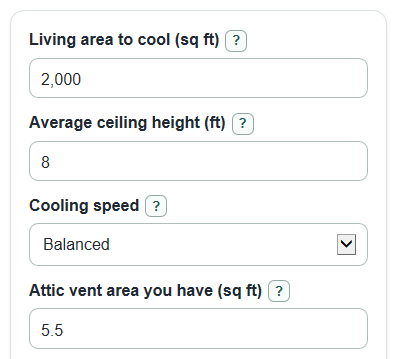
- Enter the finished Living area to cool (sq ft), leaving out the attic, garage, and rooms you will not cool with the fan.
- Enter the Average ceiling height (ft), then choose a Cooling speed: Gentle, Balanced, or Fast.
- Enter the Attic vent area you have (sq ft). In Advanced options, choose whether that number is Net free area or Gross opening size.
- If you are comparing a real model, enter its Fan rating to check (CFM) so the calculator can show its air changes and vent area gap.
- Sanity-check the answer: if Recommended fan airflow is higher than Largest fan your current vents support, use the negative Extra or missing attic vent area as the amount of net free vent area to add.
Definitions
CFM: Cubic feet per minute. It is the amount of air the fan moves each minute.
Air changes per hour: How many times the fan could move a volume of air equal to the home's air volume in one hour.
Net free vent area: The actual open vent area air can pass through after screens, louvers, and covers.
Gross opening size: The physical size of the vent opening before reducing it for screens or louvers.
Extra or missing attic vent area: Your usable attic net free vent area minus the vent area needed. Positive means extra area. Negative means missing area.
Largest fan your current vents support: The highest fan CFM estimated from attic vent area only. It does not mean your home needs that much airflow.
Common mistakes and quick fixes
Mistake: Using the whole building footprint for Living area to cool (sq ft), including the attic or garage.
Fix: Enter only the finished rooms that the fan will pull air through.
Mistake: Leaving Average ceiling height (ft) at 8 when the home has tall ceilings in most rooms.
Fix: Use a best average height, because taller rooms increase home air volume and Recommended fan airflow.
Mistake: Entering a louver or screen opening as Attic vent area you have (sq ft) while leaving What kind of vent area did you enter? set to Net free area.
Fix: Choose Gross opening size and enter Gross opening that is open (%) if you do not know the net free area.
Mistake: Treating a negative Extra or missing attic vent area as a small rounding issue.
Fix: A negative value means missing net free vent area, so add vent area or choose a smaller fan.
Mistake: Comparing a store-listed fan to Recommended fan airflow without checking Fan rating to check (CFM).
Fix: Enter the model's rated CFM so the calculator can show Air changes with the fan you entered and Vent area gap for the fan you entered.
Limitations & Key Assumptions / Boundary Conditions
- The airflow target is a sizing estimate, not an HVAC load calculation. Weather, shade, insulation, window area, and local climate can change comfort.
- Whole house fans need open windows and a clear exhaust path through the attic. Closed windows or blocked attic vents can reduce airflow and increase noise.
- The attic vent check uses 750 CFM per sq ft of net free vent area. Fan makers, local codes, and installers may require more vent area.
- If you enter Gross opening size, the Gross opening that is open (%) is only an estimate. Use manufacturer net free area when available.
- The calculator does not check duct losses, fan static pressure, roof vent placement, noise ratings, electrical limits, or fire separation details.
- Homes with combustion appliances, fireplaces, or attached garages need extra care because large exhaust fans can create pressure problems. Follow local code and qualified safety guidance.
Methodology
How the airflow target is found
Whole-house fans pull outdoor air through open windows and exhaust it through attic or roof vents [1]. The calculator starts by estimating the home air volume from Living area to cool (sq ft) and Average ceiling height (ft).
volume_cuft = floor_area_sqft * ceiling_height_ft
Next it applies the Cooling speed choice. Gentle uses 12 air changes per hour, Balanced uses 15, and Fast uses 20. These are planning presets, not universal manufacturer requirements. The DOE Building America guide discusses different fan types with different airflow needs; follow the selected fan manufacturer's sizing guidance.
target_cfm = volume_cuft * ach_goal / 60
The calculator also shows Airflow per square foot so you can compare the result with simple CFM-per-square-foot sizing rules.
cfm_per_sqft = target_cfm / floor_area_sqft
How the attic vent check is found
Adequate, unobstructed attic outlets are needed for proper cooling and efficient operation [2]. If What kind of vent area did you enter? is Net free area, the entered Attic vent area you have (sq ft) is used directly. If it is Gross opening size, the calculator reduces it by Gross opening that is open (%).
usable_nfva_sqft = attic_vent_area_sqft
usable_nfva_sqft = attic_vent_area_sqft * gross_open_percent / 100
The vent check uses 750 CFM per sq ft of net free attic vent area as a common planning guideline from the DOE Building America ventilation-cooling guide, Section 3.2, Table 7. Manufacturer requirements take precedence.
required_nfva_sqft = target_cfm / 750
vent_gap_sqft = usable_nfva_sqft - required_nfva_sqft
max_supported_cfm = usable_nfva_sqft * 750
If vent_gap_sqft is positive, the attic has extra usable vent area for the recommended airflow. If it is negative, that many square feet of net free vent area are missing.
Optional fan model check
When Fan rating to check (CFM) is entered, the calculator checks that exact fan rating against the same home volume and attic vent area.
planned_fan_ach = planned_fan_cfm * 60 / volume_cuft
planned_fan_vent_gap_sqft = usable_nfva_sqft - planned_fan_cfm / 750
Mini example
For a 2,000 sq ft home with 8 ft ceilings, the estimated volume is 16,000 cu ft. With Balanced cooling at 15 air changes per hour, Recommended fan airflow is 4,000 CFM. The needed attic net free vent area is 4,000 / 750 = 5.33 sq ft. If the home has 5.50 sq ft of usable attic vent area, the Extra or missing attic vent area is 0.17 sq ft, so the vent check passes by a small margin.