
Use this tire pressure calculator to turn your placard psi, gauge reading, and temperature into a safe pump target.
Table of contents
How to use our Tire Pressure Calculator
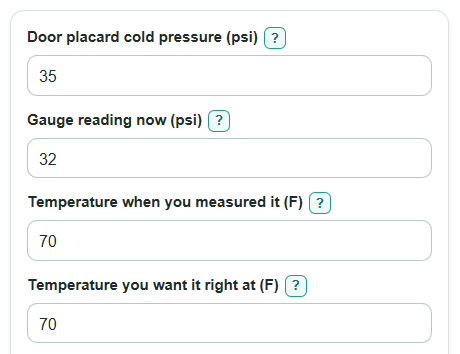
- Enter the Door placard cold pressure (psi) from the driver-door sticker or owner's manual, not the maximum number printed on the tire.
- Enter the Gauge reading now (psi) and the Temperature when you measured it (F).
- Enter the Temperature you want it right at (F), such as tomorrow morning's outdoor temperature or 70 F for a standard comparison.
- Use Advanced options only if you know a Gauge correction (psi), want a Tire sidewall maximum pressure (psi) warning, or want to change the Low-pressure light check (percent below placard).
- After you calculate, sanity-check the result: Set your gauge to this now should usually move in the same direction as the temperature change, and Air to add now tells you whether to add air or release air.
Definitions
Door placard cold pressure (psi): The tire pressure recommended by the vehicle maker for a cold tire, usually on the driver-door label or in the owner's manual [1].
Cold tire: A tire checked before driving, or after the car has been parked long enough that driving heat is not affecting the pressure.
Gauge reading now (psi): The pressure your tire gauge shows at the time you check the tire.
Gauge correction (psi): A known adjustment for your gauge. If the gauge reads 1 psi high, the correction is -1 psi.
Comparison temperature: The temperature used for the target condition, such as tomorrow morning's outdoor temperature.
Absolute temperature: Temperature measured from absolute zero. The calculator uses degrees Rankine by adding 459.67 to degrees F.
Gauge pressure: Tire pressure above surrounding air pressure. A car tire gauge reads gauge pressure, not absolute pressure.
Sidewall maximum pressure: The maximum cold pressure printed on the tire. It is not the normal pressure target for the vehicle.
Common mistakes and quick fixes
Mistake: Using the tire's sidewall maximum for Door placard cold pressure (psi) .
Fix: Use the driver-door sticker or owner's manual for Door placard cold pressure (psi) ; keep Tire sidewall maximum pressure (psi) only as a warning check.
Mistake: Entering a warm after-driving reading in Gauge reading now (psi) while using outside air for Temperature when you measured it (F) .
Fix: For the best result, measure when the tire is cold; if it was recently driven, treat the result as an estimate.
Mistake: Reversing Temperature when you measured it (F) and Temperature you want it right at (F) .
Fix: Put the current checking temperature in Temperature when you measured it (F) and the cold target temperature in Temperature you want it right at (F) .
Mistake: Reading a negative Air to add now as an error.
Fix: Negative Air to add now means your current gauge reading is above the temperature-adjusted target.
Mistake: Assuming Low-pressure light comparison level is the exact point where every vehicle light turns on.
Fix: Use Low-pressure light comparison level as a comparison point only; your vehicle's system can behave differently.
Limitations & Key Assumptions / Boundary Conditions
- This calculator estimates pressure for a constant tire volume. Real tires flex, warm up while driving, and can change slightly under load.
- The best input is a cold-tire reading. If the tire was driven recently, the tire air can be warmer than the outside air, so the estimate can be off.
- The calculation uses air temperature as a stand-in for tire air temperature. Sunlight, pavement heat, and braking can make the tire warmer than the air.
- The Tire sidewall maximum pressure (psi) field is only a warning check. It does not replace the vehicle maker's placard pressure.
- The Low-pressure light check (percent below placard) is a comparison level, not a guarantee of when your vehicle's tire pressure warning light will turn on.
- Do not use this tool for damaged tires, racing setup, heavy overloading, or non-passenger tire systems without checking the tire and vehicle manuals.
- Temperatures at or below -459.67 F are blocked because the gas-law temperature step cannot use zero or negative absolute temperature.
Methodology
What the calculator does
The calculator starts with the vehicle maker's cold placard pressure, the tire gauge reading, and two temperatures. NHTSA says the proper tire inflation pressure is on the Tire and Loading Information Label on the driver's side door edge or in the owner's manual, and tire pressure should be checked when tires are cold [1].
Pressure correction
If you enter a gauge correction, it is added to your gauge reading to estimate the true gauge pressure in the tire.
corrected_current_psi = current_pressure_psi + gauge_offset_psi
Temperatures are converted to absolute temperature in degrees Rankine because gas pressure calculations need an absolute temperature scale.
measured_temp_rankine = measured_temp_f + 459.67
compare_temp_rankine = compare_temp_f + 459.67
Temperature adjustment
The pressure estimate uses the ideal gas relationship for a fixed amount of gas in roughly the same tire volume: absolute pressure changes in proportion to absolute temperature [2]. Because a tire gauge reads pressure above outside air pressure, the calculator first adds standard atmospheric pressure, then subtracts it at the end.
expected_compare_psi = (corrected_current_psi + 14.6959) * (compare_temp_rankine / measured_temp_rankine) - 14.6959
This gives Pressure at comparison temperature if you do nothing. The target pressure needed now is found by running the same temperature ratio from the comparison temperature back to the measurement temperature.
required_true_now_psi = (target_cold_psi + 14.6959) * (measured_temp_rankine / compare_temp_rankine) - 14.6959
pump_target_now_psi = required_true_now_psi - gauge_offset_psi
air_to_add_psi = pump_target_now_psi - current_pressure_psi
gap_to_target_psi = target_cold_psi - expected_compare_psi
tpms_threshold_psi = target_cold_psi * (1 - tpms_trigger_percent / 100)
Mini-example
If the placard says 35 psi, the gauge reads 32 psi, the measured temperature is 70 F, the comparison temperature is 70 F, and gauge correction is 0 psi, the temperature ratio is 1. The pump target is 35.0 psi, Air to add now is 3.0 psi, Pressure at comparison temperature if you do nothing is 32.0 psi, and How far from the placard target is 3.0 psi low.
Rounding and warnings
Displayed pressure results are rounded to 0.1 psi. Signed differences are kept: positive Air to add now means add air, while a negative value means the current reading is above the adjusted target. The safety note can warn when the pump target is above the entered sidewall maximum, when the placard and sidewall entries conflict, or when the do-nothing estimate is at or below the selected low-pressure comparison level.