
Enter your car's original price or current market value to estimate its future value and the value it may lose while you keep it.
Table of contents
How to use our Car Depreciation Calculator
- Choose Start from. Select original purchase price to estimate value from when the car was new, or current market value if you have a recent valuation for the car.
- Enter the visible dollar amount. For original purchase price, also enter the car's current age.
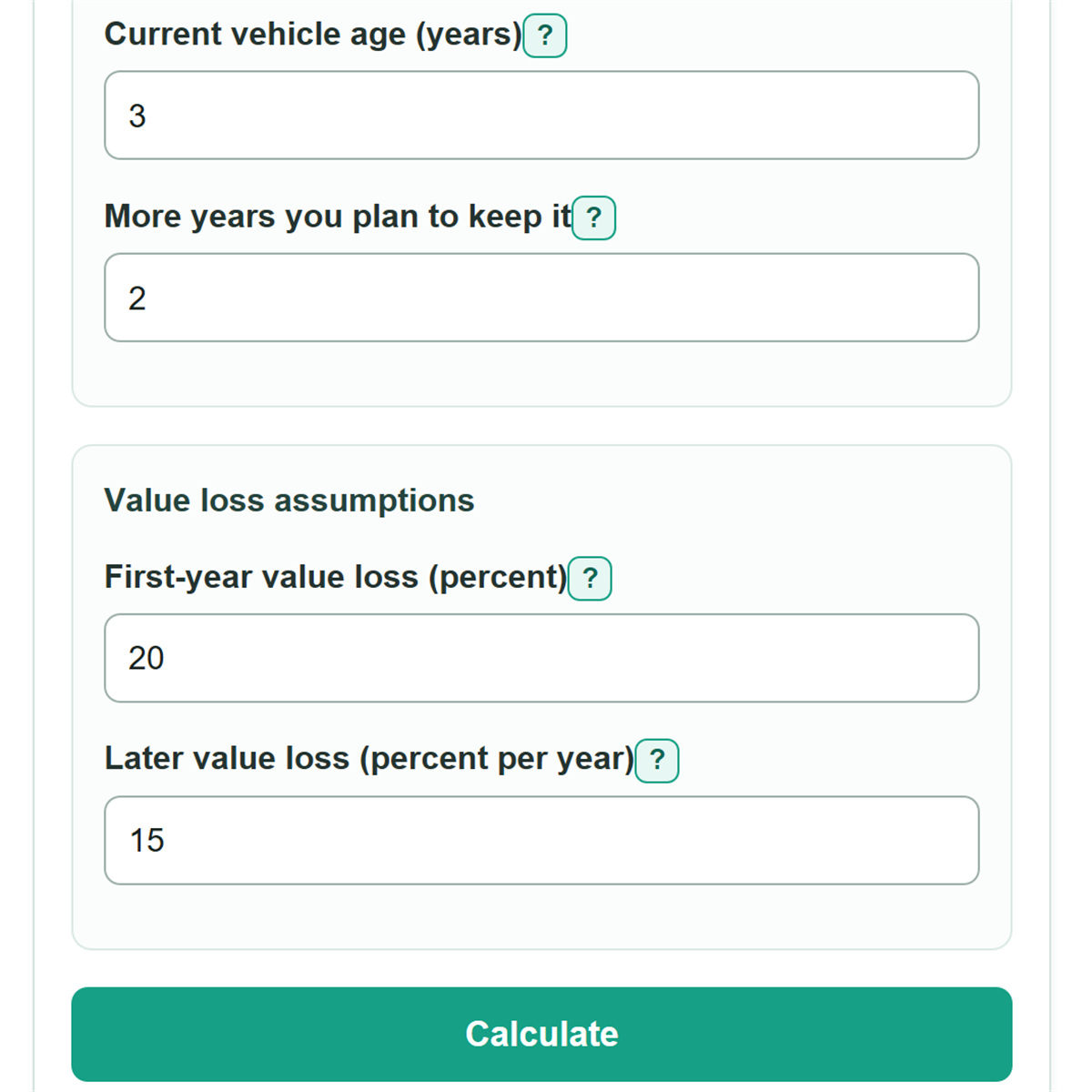
- Enter the additional years you plan to keep the car. Enter 0 to estimate its value today.
- Enter the first-year and later yearly value-loss percentages that fit your planning estimate, then select Calculate.
- Check the estimated value today against a recent valuation if possible. If they are far apart, use current market value as the starting point or reconsider the rates before relying on the future estimate.
Definitions
Original purchase price: The car's price when new. It is the starting value for the original-price calculation.
Current market value: A recent estimate of what the car is worth today. It is the starting value for the current-value calculation.
Depreciation: A decrease in the car's estimated value over time.
Value anchor: The original purchase price or current market value selected under Start from. Value-lost and percent-remaining results are measured from this amount.
Declining-balance depreciation: A percentage loss applied to the value still remaining. With the same rate, the dollar loss usually gets smaller as the car's estimated value falls.
First-year value loss: The percentage used only during the car's first year in original-price mode.
Later value loss: The yearly percentage used after the first year in original-price mode and for all future years in current-value mode.
Common mistakes and quick fixes
Mistake: Entering the remaining loan balance as the original purchase price.
Fix: Check Start from and then recalculate. Enter the car's price when new, without loan interest, insurance, repairs, or other later costs.
Mistake: Using an old or mismatched current market value.
Fix: Check Start from and then recalculate. Use a recent valuation or local comparison for the same trim, condition, and location.
Mistake: Expecting the first-year rate to apply every year.
Fix: Check Start from and then recalculate. The first-year value loss applies only during year one. Use later value loss for each year after that.
Mistake: Entering the car's total age as more years you plan to keep it.
Fix: Check Start from and then recalculate. Enter only the time from today until you expect to sell, trade, or replace the car.
Mistake: Treating additional value lost while you keep it as value already lost.
Fix: That amount estimates future loss during your planned keep period. Value lost from the selected starting value measures loss from the price or valuation you chose.
Mistake: Typing a money amount such as 30,00.
Fix: Check Start from and then recalculate. Enter 30000, 30,000, or $30,000. Commas must separate groups of three digits.
Limitations & Key Assumptions / Boundary Conditions
- This is a planning estimate, not a guaranteed sale price, trade-in offer, dealer offer, or vehicle appraisal.
- Your entered starting value and depreciation rates drive the result. Changing either one changes the estimate.
- Make, model, trim, mileage, condition, accident history, maintenance, options, local demand, and market changes can cause an actual resale value to differ from this estimate.
- Original-price mode estimates today's value from age and your two rates. Current-value mode uses your entered valuation as today's value and projects only future loss.
- The calculation includes vehicle value loss only. It excludes financing, insurance, fuel, maintenance, repairs, taxes, registration, and other ownership costs.
- This calculator is not for business tax depreciation or tax-deduction calculations.
- Rates from 0% through 100% are allowed. A 100% rate can reduce the modeled value to $0, although a real vehicle may still have some value.
Methodology
Calculation method
The calculator uses declining-balance depreciation. Each percentage is applied to the value left after earlier depreciation, rather than to the original dollar amount every year. In original-price mode, the first-year rate applies only during the first year of the car's age. The later rate applies after year one. In current-value mode, the entered current market value is today's starting point, so the first-year rate is not used.
V_today = P x (1 - f/100)^min(a, 1) x (1 - r/100)^max(a - 1, 0)
For original-price mode, P is the original purchase price, f is first-year value loss, r is later value loss, and a is current vehicle age.
V_future = P x (1 - f/100)^min(a + y, 1) x (1 - r/100)^max(a + y - 1, 0)
In this formula, y is the additional years you plan to keep the car.
V_future = C x (1 - r/100)^y
For current-value mode, C is the current market value. Additional value lost is today's estimated value minus future estimated value. If y is 0, future value equals today's value, and additional depreciation and average yearly future loss are both $0.
Additional future depreciation = V_today - V_future
Average future yearly loss = Additional future depreciation / y
Worked example
Suppose a car has a current market value of $18,000, a later value-loss rate of 12% per year, and 3 more years of planned ownership. The calculation is $18,000 x 0.88^3, which gives an estimated future value of $12,266.50. Estimated additional value lost is $5,733.50, or $1,911.17 per year on average. About 68.1% of the current value anchor remains.
Rounding
The calculator uses unrounded values during the calculation. Dollar amounts display to the nearest cent, and the percentage remaining displays to one decimal place.