
Estimate driveway light count, spacing, total lumens, maintained brightness, and rough monthly energy cost from a few measurements.
Table of contents
How to use our Driveway Lighting Calculator
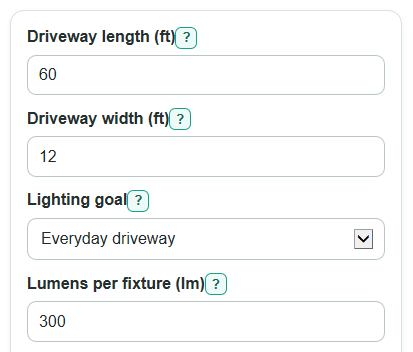
- Enter Driveway length (ft) and Driveway width (ft) for the paved area you want to light.
- Pick a Lighting goal, then enter Lumens per fixture (lm) from the fixture label or product page.
- Choose the Light layout that matches your plan: One side, Both sides, paired, or Both sides, staggered.
- Open Advanced options only if you want to adjust Light that reaches the driveway (percent), Dirt and aging factor, or energy cost inputs.
- After you calculate, sanity-check the output: if Suggested spacing is much larger than the distance you would feel safe walking between lights, use more fixtures, lower spacing, or a different layout.
Definitions
Lumens per fixture (lm): The amount of visible light one fixture is rated to produce before losses from aiming, dirt, or aging.
Foot-candle: A surface brightness unit equal to one lumen spread over one square foot.
Lux: The metric surface brightness unit; 1 foot-candle is about 10.7639 lux.
Light that reaches the driveway (percent): The share of fixture light you expect to land on the driveway instead of spilling into the yard, sky, or street.
Dirt and aging factor: A multiplier for light lost over time from dirt, cloudy lenses, and LED aging. A value of 0.80 means 80 percent remains.
Light layout: The fixture pattern along the driveway. Paired means lights face each other across the driveway, while staggered means they alternate sides.
Installed fixture lumens: Fixtures to install times Lumens per fixture (lm). This can be higher than the target because fixtures come in whole numbers.
Common mistakes and quick fixes
Mistake: Measuring Driveway length (ft) only to the first parking spot instead of the full lighted run.
Fix: Measure Driveway length (ft) from the garage or parking area to the street along the path the lights will cover.
Mistake: Using total yard width for Driveway width (ft).
Fix: Enter only the paved or travel width you want lit in Driveway width (ft).
Mistake: Putting an old incandescent equivalent wattage into Lumens per fixture (lm).
Fix: Use the fixture lumen rating for Lumens per fixture (lm); use Power per fixture (watts) only for energy cost.
Mistake: Leaving Light that reaches the driveway (percent) at 100 for unshielded or decorative fixtures.
Fix: Use a lower Light that reaches the driveway (percent) when light spills sideways, upward, or into landscaping.
Mistake: Choosing Both sides, paired in Light layout and expecting any odd fixture count.
Fix: Paired layouts round Fixtures to install to an even number so each light station has one fixture on each side.
Mistake: Treating Estimated energy cost as exact when Hours on each night changes with timers or motion sensors.
Fix: Set Hours on each night to the average nightly run time you expect.
Limitations & Key Assumptions / Boundary Conditions
- The Lighting goal presets are planning targets for a residential driveway, not a permit, code, or neighbor-spill check.
- Real brightness can differ because fixture height, beam angle, shielding, mounting side, driveway slope, trees, parked cars, and wall reflections are not modeled.
- Light that reaches the driveway (percent) and Dirt and aging factor are user estimates. Better fixture photometric data can change the count.
- Suggested spacing assumes a mostly straight lighted run. Curves, gates, steps, and dark corners may need extra fixtures.
- Estimated energy use and Estimated energy cost assume the same Hours on each night for a 30-day month.
- The calculator does not test glare, color temperature, dimming controls, property-line spill, or local dark-sky rules. Use shielded, aimed, and warm outdoor lights when those limits matter.
Methodology
How the calculator sizes the lights
The calculator uses the lumen method: estimated surface brightness in foot-candles equals useful lumens reaching the driveway divided by driveway area in square feet. Lighting work also depends on fixture selection and fixture placement, so the result is rounded into a usable layout count [1].
area_sq_ft = driveway_length_ft * driveway_width_ft
target_fc = 0.5 for soft, 1.0 for everyday, 2.0 for bright
recommended_initial_lumens = target_fc * area_sq_ft / ((utilization_percent / 100) * light_loss_factor)
The recommended initial lumens are the total fixture lumens to aim for before rounding to whole fixtures. The utilization percent and light loss factor lower the usable light because not every lumen lands on the driveway, and outdoor fixtures get dirtier and dimmer over time.
Fixture count and spacing
raw_fixture_count = recommended_initial_lumens / fixture_lumens
one_side_count = ceil(raw_fixture_count)
both_staggered_count = ceil(raw_fixture_count)
both_paired_count = 2 * ceil(raw_fixture_count / 2)
Both sides, paired rounds to an even fixture count so each station has one light on each side. One side and staggered layouts use the rounded fixture count directly.
one_side_or_staggered_spacing_ft = driveway_length_ft / (installed_fixture_count - 1), when count is greater than 1
paired_spacing_ft = driveway_length_ft / ((installed_fixture_count / 2) - 1), when pairs are greater than 1
If the count is 1, Suggested spacing is set equal to Driveway length (ft), and the note warns that one light can leave dark areas on a long driveway.
Brightness and energy
estimated_brightness_fc = installed_fixture_count * fixture_lumens * (utilization_percent / 100) * light_loss_factor / area_sq_ft
estimated_brightness_lux = estimated_brightness_fc * 10.7639
The lux conversion uses 1 foot-candle = 10.7639 lux [2]. Estimated brightness can be higher than the selected target because fixture counts are rounded up.
monthly_energy_kwh = installed_fixture_count * fixture_watts * hours_per_night * 30 / 1000
monthly_cost = monthly_energy_kwh * electricity_rate
If any optional energy input is blank, the energy outputs are hidden. If an optional energy input contains invalid text, the calculator asks you to fix that exact field.
Mini example
For a 60 ft by 12 ft driveway, the area is 720 square feet. With the Everyday driveway goal, the target is 1.0 foot-candle. With 50 percent utilization and a 0.80 dirt and aging factor, the total fixture lumens to aim for are 1,800 lm.
recommended_initial_lumens = 1.0 * 720 / (0.50 * 0.80) = 1800 lm
Using 300 lm fixtures gives 6 fixtures. In a One side layout, spacing is 60 / (6 - 1) = 12 ft. With 5 watts per fixture, 8 hours each night, and $0.16 per kWh, the estimate is 7.2 kWh per month and about $1.15 per month.