
Estimate outdoor security light coverage or the lumens needed for a target area using brightness, losses, height, and beam angle.
Table of contents
How to use our Security Light Coverage Calculator
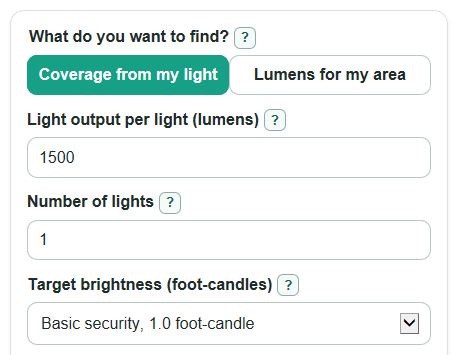
- Choose What do you want to find?: Coverage from my light if you know the package lumens, or Lumens for my area if you know the square feet you want to light.
- Enter Light output per light or Area to cover, then enter Number of lights and pick a Target brightness in foot-candles.
- Open Advanced options if you want to adjust Light that reaches the area, Dirt and age loss, Mounting height, Full beam angle, Expected overlap between lights, or Number display.
- Click Calculate and read the first result: Usable covered area in coverage mode, or Lumens needed per light in lumens mode.
- Sanity-check the output by comparing What limits the coverage with Beam footprint check; if the beam footprint is small, more lumens alone may not light the full ground area.
Definitions
Lumen: A measure of how much light a lamp or fixture gives off. Use the package lumen rating for Light output per light.
Foot-candle: Light landing on 1 square foot. In this calculator, Target brightness uses foot-candles.
Useful lumens after losses: The estimated lumens that reach the target after aiming loss plus Dirt and age loss are applied.
Beam footprint check: The estimated ground area reached by the light beam from the Mounting height and Full beam angle.
Expected overlap between lights: The percent of each added light's beam that repeats an area already lit by another light.
Glare: Light that shines toward eyes or nearby property and can make seeing harder, even when the fixture is bright.
Common mistakes and quick fixes
Mistake: Using wattage for Light output per light.
Fix: Enter the lumen number printed on the bulb, fixture, or product specs.
Mistake: Entering only driveway length for Area to cover.
Fix: Use length times width in square feet, such as 20 ft times 30 ft = 600 sq ft.
Mistake: Setting Number of lights to the number of bulbs in one fixture when they all point at the same small spot.
Fix: Count separate fixtures or heads that spread light over the target area.
Mistake: Choosing a high Target brightness without checking glare.
Fix: Use the lowest Target brightness that lets you see the area clearly, then aim lights downward.
Mistake: Leaving Full beam angle too wide when your fixture is a narrow spotlight.
Fix: Enter the product's beam angle so Beam footprint check does not overstate coverage.
Mistake: Ignoring Expected overlap between lights when two lights shine on the same patch.
Fix: Raise Expected overlap between lights so Usable covered area does not count the same ground twice.
Limitations & Key Assumptions / Boundary Conditions
- The beam estimate treats each light as a straight-down cone on flat ground. A tilted fixture, wall mount, slope, trees, cars, or fences can change the lit area.
- The calculator uses average brightness. Real outdoor lights have bright centers, softer edges, shadows, and dark spots.
- Light that reaches the area and Dirt and age loss are user estimates. Changing either percent can strongly change the coverage or lumen recommendation.
- Beam footprint check does not replace a photometric lighting plan, a light meter reading, or local outdoor lighting rules.
- In Lumens for my area mode, a lumen answer can be valid while the beam footprint is still too small. That means the light may be bright enough but not spread wide enough.
- More light is not always better. Poorly aimed security lights can cause glare, bother neighbors, and reduce useful visibility.
Methodology
How the calculator chooses the target
The calculator first turns Target brightness into a number of foot-candles. The preset choices are 0.5, 1.0, 2.0, and 5.0 foot-candles. If you choose Use my own target, it uses My target brightness instead.
target_fc = preset_fc
target_fc = custom_target_fc when Target brightness is Use my own target
Coverage from a known light
In Coverage from my light mode, the calculator reduces the package lumens for aiming and loss, then finds the area that those useful lumens can support at the chosen brightness.
effective_lumens = fixture_lumens * num_lights * (light_reaching_area_percent / 100) * (1 - light_loss_percent / 100)
brightness_area_sqft = effective_lumens / target_fc
It also estimates the physical beam footprint from Mounting height and Full beam angle. The final Usable covered area is the smaller of the brightness area and the beam footprint.
beam_radius_ft = mount_height_ft * tan((beam_angle_deg / 2) * π / 180)
beam_footprint_sqft = π * beam_radius_ft^2 * (1 + (num_lights - 1) * (1 - overlap_percent / 100))
covered_area_sqft = min(brightness_area_sqft, beam_footprint_sqft)
Lumens for a known area
In Lumens for my area mode, the calculator works backward from Area to cover and Target brightness. It divides by the number of lights and by the useful-light factors to estimate the fixture lumens needed per light.
needed_lumens_per_light = (area_sqft * target_fc) / (num_lights * (light_reaching_area_percent / 100) * (1 - light_loss_percent / 100))
total_fixture_lumens_needed = needed_lumens_per_light * num_lights
average_brightness_fc = effective_lumens / area_sqft
Mini-example
For one 1,500 lumen light, 70 percent light reaching the area, 15 percent dirt and age loss, and a 1.0 foot-candle target, useful lumens are 1,500 * 0.70 * 0.85 = 892.5 lumens. The brightness-only coverage is 892.5 sq ft. With a 10 ft mounting height and 120 degree beam, the beam footprint is about 942.5 sq ft, so the usable covered area is 892.5 sq ft and lumens are the limiting factor.
Assumptions used
The method is a quick planning estimate, not a measured lighting layout. It assumes flat ground, similar lights, a circular beam shape, and the same target brightness across the area. The Assumption note may also warn about spill light and glare, because outdoor LED glare can affect how comfortable and useful the light feels [1].